This is the second article in a series on time to revoke, following our piece on The Hacker News. The first explains how to measure the amount of time an exposed credential remains usable. This article focuses on the operational changes security teams can make to shrink that exposure window.
Why time to revoke matters for AI-era non-human identity risk
Every security team can find an exposed secret, but most can't tell you how long it kept working after they found it.
Over 28.6 million new hardcoded secrets hit public GitHub in 2025, up 34% year over year, with AI-service secrets up 81% (State of Secrets Sprawl 2026). AI-assisted development and agentic tooling cut both ways. Defenders find and triage more, but creation is outpacing governance. So while detection keeps up, revocation is where teams fall behind. And that disconnect is what this article is about.
If an exposed credential remains valid, an attacker doesn't need to breach the same system twice. They can use it directly against any service that trusts the identity behind it, like a cloud console or a production database. And these credentials stay valid far longer than teams expect: 64% of secrets confirmed valid in 2022 were still valid when we retested them four years later.
That is especially dangerous for non-human identities (NHIs). Service accounts and OAuth apps often run on long-lived tokens and deploy keys that no one rotates for months, sometimes years. Their access is broad, their ownership unclear. And because these identities keep critical systems running, teams hesitate to revoke them without knowing what will break. This is where NHI security and time to revoke intersect most directly.
The result is a recurring pattern: detection happens, but revocation stalls. Time to revoke turns that stall into a measurable risk window.
Why exposed secrets stay valid after detection
Secrets remediation often breaks down for operational reasons. The most common blockers are unclear ownership, fear of breaking something, provider-by-provider friction, and treating removal as the finish line.
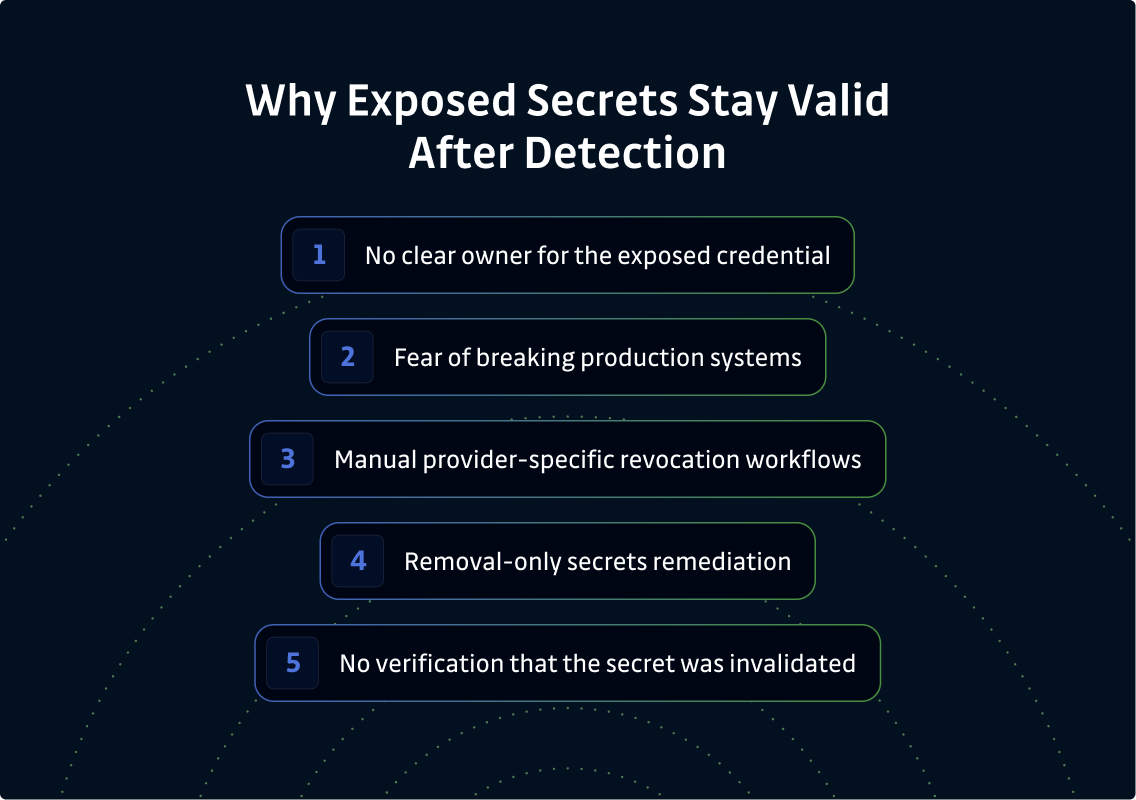
No clear owner for the exposed credential
Many exposed secrets belong to non-human identities. They may have been created years ago by a team that no longer owns the system, or wired into an automation workflow that no one will touch without proof. If no one knows who owns a credential, no one can confidently revoke it.
Fear of breaking production systems
A valid credential may be tied to a deployment pipeline, data sync, monitoring tool, internal service, or customer-facing application. Revoking it blindly could break something important. Security teams therefore need more than a detection alert. They need to know what the credential can reach, and what breaks if it stops working.
Manual provider-specific revocation workflows
Credential remediation is often provider-specific. The steps to rotate an AWS access key look nothing like the steps to revoke a Slack webhook. Some providers make it straightforward. Others require manual investigation or sign-off from another team. Every manual step adds delay.
Removal-only secrets remediation
Many workflows still treat removal as the end state. The secret was deleted from a repository, the pull request was merged, the Jira ticket was closed. But removal only reduces future exposure from that location. It does not invalidate the credential. If the secret was copied, scraped, logged, cached, indexed, or exposed elsewhere, it may still be usable.
This breaks down completely for public leaks. When a credential is exposed on public GitHub, often in a developer’s personal repository outside any perimeter you control, you usually cannot delete it, and it has likely already been cloned and indexed by others. There is no file to clean. Revocation is the only action that ends the exposure.
No verification that the secret was invalidated
Without validity checks, teams may not know whether a secret is still live or already dead. That uncertainty creates two problems: teams may waste time on dead secrets, and they may close incidents before live credentials are actually invalidated. Time to revoke depends on verification. Without it, the metric becomes another proxy instead of a measure of actual risk reduction.
How to reduce time to revoke
Reducing time to revoke means taking on those blockers directly. What follows tracks the path a leaked credential takes: prove it still works, get it to someone who can act, make the act of revoking safer, and cut the manual delays in between.
Validate exposed secrets quickly
Validity should drive priority. A valid production credential deserves a different response than an expired test key. Where safe and supported, automated validity checks help teams focus on secrets that still grant access. They also help confirm when a credential has been successfully revoked, which is essential for measuring time to revoke accurately.
Map exposed credentials to owners
Ownership is the bridge between detection and action. Security teams should connect exposed secrets to the systems and identities behind them wherever possible. The faster the right owner is identified, the faster the organization can revoke safely.
For NHIs, this is especially important. Machine identities often outlive the teams and pipelines that created them. Without machine identity ownership mapping, they become difficult to govern and even harder to revoke.
Discovering NHIs wherever they run and attributing each to an owner gets exposed credentials to the people who can act on them. Scoring them by risk decides who acts first.
Build provider-specific revocation runbooks
Revocation steps vary by provider. A mature program should not require responders to rediscover the process every time a secret leaks. Provider-specific runbooks should document how to identify the credential and what it touches, then rotate or revoke it and confirm the old one is dead. They should also name the approvers and which team(s) to notify.
Runbooks reduce hesitation, especially when a credential may affect production.
Separate emergency revocation from planned rotation
Not every exposed secret should follow the same path. Some credentials need immediate revocation. Others require coordinated credential rotation to avoid downtime.
Security teams should define risk-based pathways before an incident occurs:
- Immediate revocation for exposed credentials with known abuse, public leakage, or critical privilege
- Coordinated rotation for production-connected credentials with dependencies
- Standard cleanup for invalid, expired, or non-sensitive test credentials
- Governance review for recurring exposures from the same system or team
This keeps urgent incidents from getting stuck in general remediation queues.
Reduce reliance on long-lived credentials
The shorter a credential's lifetime, the smaller the window in which exposure can become abuse. Organizations should move away from static, long-lived secrets where possible. Short-lived credentials, just-in-time access, managed secret stores, and automatic rotation all cut the time a leaked credential stays useful.
This does not eliminate the need for detection. But it changes the blast radius. If a credential expires quickly, the exposure window shrinks even before a human responder acts.
Automate secret revocation where it is safe
Automation should be applied carefully, but it has a clear role in reducing time to revoke. For high-confidence findings on known providers, revocation can be automated or semi-automated through the provider's own controls, closing the attack window far faster than manual workflows. In other cases, automation can prepare the response by surfacing the owner and the remediation steps a responder will need.
Used this way, automation removes the delay from decisions that have already been made, and the judgment stays with the team.
Verify secrets remediation closure
Every secrets remediation workflow should end by confirming that the exposed credential no longer works. A cleaned file or a closed ticket is not proof on its own. Verification proves the old credential has actually been invalidated, and turns remediation from a reported activity into a measurable security outcome.
A maturity model for time to revoke
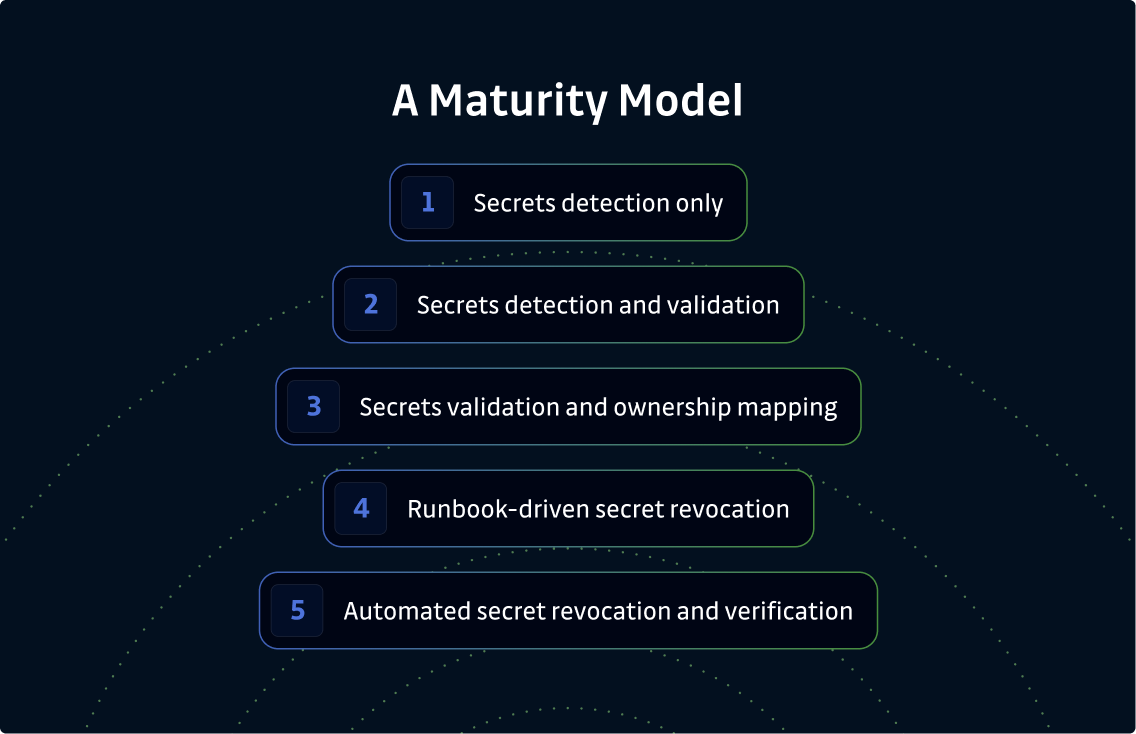
Organizations do not need to reach full automation immediately. Time to revoke can mature in stages.
The model applies across every surface where credentials leak: internal repositories, CI/CD, collaboration tools like Slack and Jira, cloud configurations, and public GitHub. Source code is only one of them. Maturity is as much about widening coverage as it is about speeding up revocation.
Level 1: Secrets detection only
The organization can find exposed secrets, usually in source code or public repositories, but coverage is uneven everywhere else. Remediation is manual and inconsistent. Ticket closure may be treated as success.
Level 2: Secrets detection and validation
The organization can distinguish valid secrets from invalid or expired ones. Prioritization improves because teams know which findings still represent active access.
Level 3: Secrets validation and ownership mapping
At this stage, ownership reaches past the repository to the identity behind the credential. The organization can tell which machine identity a secret belongs to and who owns that identity. It also knows what the identity can access. Remediation moves faster because alerts reach the people who can act, and because teams understand the blast radius before they revoke.
Level 4: Runbook-driven secret revocation
The organization has provider-specific workflows for rotating or revoking common credential types. Teams know when to revoke on the spot and when to rotate carefully, and how to verify closure.
Level 5: Automated secret revocation and verification
For supported providers and high-confidence incidents, the organization can move from detection into guided or automated remediation without leaving the incident workflow. That remediation validates the credential and identifies its owner, then initiates revocation through the provider's own controls. Closure is verified, and time to revoke becomes a reliable executive metric.
Exposed secrets incidents are not over until credentials stop working
Exposed secrets need the same measurement discipline security teams already apply to detection, investigation, containment, and remediation. But credential exposure needs a metric built for the way secrets create risk. What makes a secret dangerous is that it still works, and time to revoke is the one metric that tracks that directly, giving CISOs a way to measure the exposure window and pull it shorter.
No matter how clean the repo or how fast the ticket closed, the incident stays open until the credential is dead.
Reduce the time exposed credentials remain valid
The leak is just the start. GitGuardian is built for what comes after. It detects exposed credentials across code, CI/CD, collaboration tools, and public GitHub, checks which ones still work, and attributes each valid secret to the machine identity behind it and the owner who can kill it. Risk scoring puts the most dangerous exposures in front of the right person first, so revocation starts sooner. That path, from a leaked credential to a dead one, is what shrinks time to revoke.
See how GitGuardian helps security teams find exposed credentials, prioritize what matters, and revoke faster.