Most enterprises have no standardized framework for:
- How agents authenticate to MCP servers (and what credential type, lifetime, and scope is acceptable).
- How approved MCP server access is scoped and bounded (which agents can access which tools, and with what permissions).
- How MCP credentials are managed across their lifecycle (provisioning, rotation, revocation, and exposure detection).
- How MCP deployments are audited for compliance and security posture.
Here, we share a practical MCP governance framework for enterprises, covering authentication standards, scope control policies, secrets lifecycle management, and credential exposure detection.
Why MCP Governance Is Now an Enterprise Security Priority
Every MCP server connection creates a new credential, like an API key, OAuth token, database connection string, or service account secret. At enterprise scale, these credentials multiply fast.
Imagine a team running 10 agents, each with 5 MCP server connections, managing 50+ credentials. Moreover, each credential has its own provisioning story, rotation requirement, and expiration date. Plus, each lives somewhere, such as an MCP config file, an environment variable, a CI/CD pipeline, or a vault reference—and each location carries different exposure characteristics. It's a lot...
Traditional IAM frameworks weren't built for this. They don't answer who owns each MCP credential, what credential type is acceptable for each connection, how rotation gets enforced across dozens of pre-approved servers, or how to detect when a credential leaks into a repository or a Slack channel.
Without this knowledge, MCP deployments create ungoverned credential sprawl at the agent-to-tool layer. Fortunately, an MCP governance framework can close the gap.
MCP Authentication: Standardizing How Agents Prove Identity to Tools
The MCP specification has moved toward OAuth 2.1 as its authorization framework for remote MCP servers, though implementations vary and auth requirements are still maturing in the spec. In practice, MCP server implementations accept a wide range of credential types.
These credential types include OAuth tokens, API keys, service account credentials, database connection strings, and bearer tokens from existing identity providers. But the protocol doesn't mandate a specific mechanism, which means authentication standards fall on the implementing organization.
Security teams can use the following enterprise authentication standards for MCP:
- For remote MCP servers connecting to SaaS tools or cross-network services: The recommended default is OAuth 2.1 with short-lived, scoped access tokens. Use dedicated OAuth app registrations per MCP server, as shared credentials across multiple MCP servers or agents create a blast radius problem. One compromised credential exposes everything it touches. Also worth mentioning, store refresh tokens in a vault. Never store them in MCP config files.
- For remote MCP servers connecting to internal APIs and databases: Use vault-issued dynamic credentials or workload identity where the runtime supports it. Static database connection strings embedded in MCP server manifests are a governance failure waiting to happen.
- For internal MCP servers running in stdio mode on the same host: Process-level isolation and host-level trust apply, but credentials still need to be injected at runtime via environment variables or vault references. Hardcoding them in config files is just as dangerous here as anywhere else.
- For API key-only integrations: When the downstream tool only supports API keys, vault the key, set a maximum TTL, create a unique key per MCP server instance, and monitor for exposure continuously. Treat this pattern as transitional architecture, not a long-term solution.
Authentication Anti-Patterns to Prohibit
The agentic AI MCP tools governance policy you create for your enterprise should explicitly prohibit:
- Hardcoded credentials in MCP server configuration files committed to repositories
- Shared credentials across multiple MCP servers or agents
- Personal access tokens reused from developer accounts
- Long-lived OAuth refresh tokens stored in plain text config
- Static database connection strings embedded in MCP server manifests
Doing so will protect against default patterns that emerge when teams act without governance in place.
MCP Scope Control: Governing What Agents Can Access Through MCP
MCP servers are often configured with broad permissions to make development easier.
A code-generation agent receives write access to production repos. A database agent receives admin-level access when it only needs read access on specific tables. A CRM agent gets full API access when it only needs to query contacts. In enterprise deployments, overprivileged MCP connections like these are the primary driver of excessive blast radius and therefore need tighter security monitoring.
After all, if an agent is compromised, the attacker inherits permissions granted to every MCP server the agent connects to. So, access controls at the MCP layer deserve the same rigor as IAM role grants.
Scope Control Principles
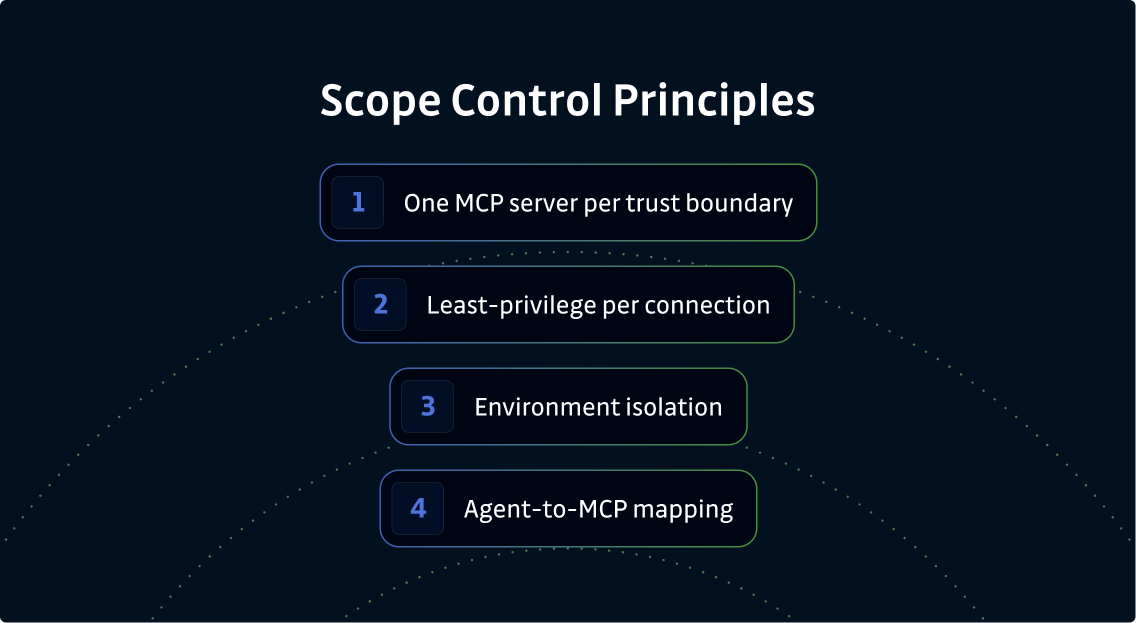
Both internal and customer data could be at risk due to your company's overbroad permissions. The four scope control principles below will ensure your MCP client is secure:
- One MCP server per trust boundary: Don't share MCP servers across agents with different trust levels. Read-only analysis agents and production deployment agents shouldn't share MCP server connections. Having them do so is a risky action that could lead to a data breach.
- Least-privilege per connection: Each MCP server should be configured with the minimum permissions required for its specific purpose. For example, give read-only access if the agent only reads. Then, scope permissions to specific tables, repos, or API endpoints where the tool supports it. Every tool call should carry the permissions it actually needs, nothing more.
- Environment isolation: Production MCP servers, staging MCP servers, and development environment MCP servers should use separate credentials with separate permissions. Never reuse production credentials in non-production environments.
- Agent-to-MCP mapping: Maintain a registry to track which agents connect to which MCP servers, what permissions each connection carries, and who owns each connection. Your MCP registry is key to your company's ability to assess audit logs in a meaningful way.
Putting Scope Governance into Practice
First, define an MCP connection request workflow. Teams should have a reason to request MCP access, then specify the agent, target tool, required permissions, and credential lifetime. Your approval process should then mirror the rigor applied to IAM role grants and service account provisioning.
Next, conduct access reviews of MCP connections. Is this agent still active? Does it still need this access level? Is the credential within its rotation window? These questions need answers.
Finally, use policy enforcement to block deployments with overprivileged MCP configurations or prohibited credential patterns before they reach production. Policy-as-code in CI/CD is the most scalable way to make this happen, and you should explore this option further.
MCP Secrets Lifecycle: Governing Credentials from Provisioning to Revocation
Most organizations struggle to govern the full lifecycle of MCP credentials.
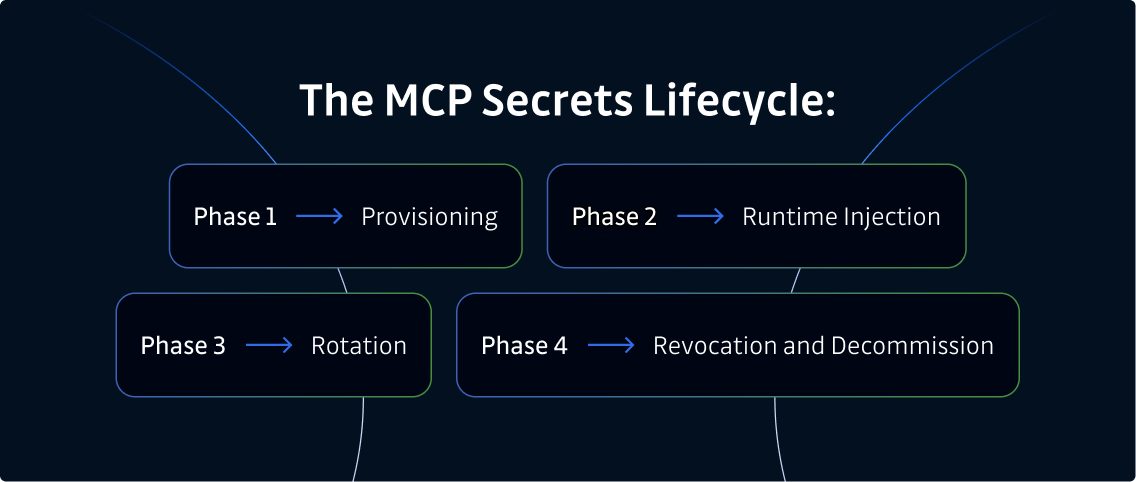
Credentials that are provisioned but never rotated, or revoked but never verified, create ongoing exposure that governance policies alone can't fix. This four-phase process will help.
Phase 1: Provisioning
The way you create and distribute MCP credentials determines their baseline security posture.
Provision your MCP credentials through a centralized secrets management system such as HashiCorp Vault, AWS Secrets Manager, or Azure Key Vault. Do not use manual creation or copy-paste distribution. Neither strategy scales. They don't create audit trails either.
At provisioning time, assign ownership for every MCP credential. Which team owns it, which agent uses it, and what it's for? Then, set expiration dates. No MCP credential should be provisioned without a defined TTL. Finally, record the provisioning event in an audit log with proper context.
Phase 2: Runtime Injection
Most credential exposure happens during runtime injection. So, inject MCP credentials via vault references or environment variables. Never bake them into MCP config files, Docker images, or deployment manifests.
Where the runtime supports it, use workload identity to bootstrap vault access, which substantially mitigates the 'secret zero' problem by shifting trust to the underlying platform's identity attestation.
Some MCP server implementations fall back to default or example credentials if the configured secret is unavailable. Treat this as a deployment-time validation requirement, not an acceptable fallback.
Phase 3: Rotation
Manual rotation doesn't scale across dozens of MCP servers.
Because of this, you should automate credential rotation through your secrets manager and define maximum credential lifetimes per credential type. As a starting point, OAuth tokens might rotate in hours, API keys within 90 days, and database credentials within 30 days. However, your specific TTLs should reflect the sensitivity of the access and your organization's risk posture.
Of course, you first need to test that rotation doesn't break MCP connections. Include rotation testing in your deployment pipeline validation. Also, alert on rotation failures. A credential that fails to rotate becomes a credential with an indefinite lifetime, and data retention becomes harder.
Phase 4: Revocation and Decommission
When an MCP server is retired or an agent decommissioned, revoke all associated credentials immediately. Then, verify the revocation. Don't assume revocation propagates instantly.
Next, remove the MCP server from your agent-to-MCP registry and update audit records accordingly. Finally, scan repositories and CI/CD configs for references to the revoked credential. Stale references get copied to new deployments more often than most teams expect.
Detecting MCP Credential Exposure: The Governance Layer You Can't Skip
MCP governance policy for enterprise teams define how credentials should be provisioned, stored, rotated, and revoked. Exposure detection verifies whether those policies are followed.
Where MCP Credentials Leak
MCP credentials can leak in multiple locations. Here are a few to watch out for.
MCP configuration files in repos
The most common exposure vector. MCP server configs containing API keys, connection strings, or OAuth tokens get committed to source control and persist in git history even after updates.
CI/CD pipelines
Credentials exposed in build output during agent deployment, pipeline variables stored without masking, or credentials embedded in deployment artifacts.
Collaboration tools
A source most teams underestimate. MCP connection secrets shared in Slack during setup, pasted in Jira tickets during troubleshooting, or documented in Confluence with live credentials.
Agent-generated artifacts
A subtler risk. MCP tool responses may return sensitive data or credentials from downstream systems. If an agent logs, persists, or passes this data to other tools, the credential escapes the MCP trust boundary.
Public repositories
The highest-severity exposure. MCP config files accidentally pushed to public repos expose every credential the MCP server uses, often before anyone notices.
- MCP configuration files in repos: These are the most common exposure vector. MCP server configs that contain API keys, connection strings, or OAuth tokens get committed to source control. The credentials persist in git history even after the config is updated.
- CI/CD pipelines: These create exposure via credentials in build output during agent deployment, pipeline variables stored without masking, or credentials embedded in deployment artifacts.
- Collaboration tools: These are a source that most teams underestimate. MCP connection secrets shared in Slack during setup, pasted in Jira tickets during troubleshooting, or documented in Confluence with live credentials represent real exposure with no automatic remediation.
- Agent-generated artifacts: These introduce a subtler risk. MCP tool responses may return sensitive data or credentials from downstream systems. If an agent logs, persists, or passes this data to other tools, the credential has escaped the MCP trust boundary.
- Public repositories: These create the highest-severity exposure. MCP config files accidentally pushed to public repos expose every credential the MCP server uses, often before anyone notices.
Integrating Exposure Detection into MCP Governance
Your MCP governance framework needs continuous scanning across all surfaces. That means:
- Scanning all repositories that contain MCP server configurations for hardcoded or committed credentials, including full git history.
- Running pre-commit and PR-level scanning to block MCP credentials from entering the codebase.
- Monitoring CI/CD pipelines that deploy MCP servers for credentials in build output and deployment artifacts.
- Scanning collaboration tools for MCP credentials shared during development and troubleshooting.
- Monitoring for exposed MCP configuration files in public GitHub.
- Tracking exposure metrics, like time-to-detection, time-to-remediation, exposure window, and recurrence rate.
This is where GitGuardian fits the framework. Our platform provides continuous scanning across repos, pipelines, and collaboration tools to detect exposed MCP credentials before they're exploited.
For enterprise MCP deployments, this offers visibility into whether agent-to-tool connection secrets have leaked outside controlled environments. Governance policies define the standard. Exposure detection tells you whether your company meets the standard in practice.
Policy Enforcement: An MCP Governance Framework for Enterprise Teams
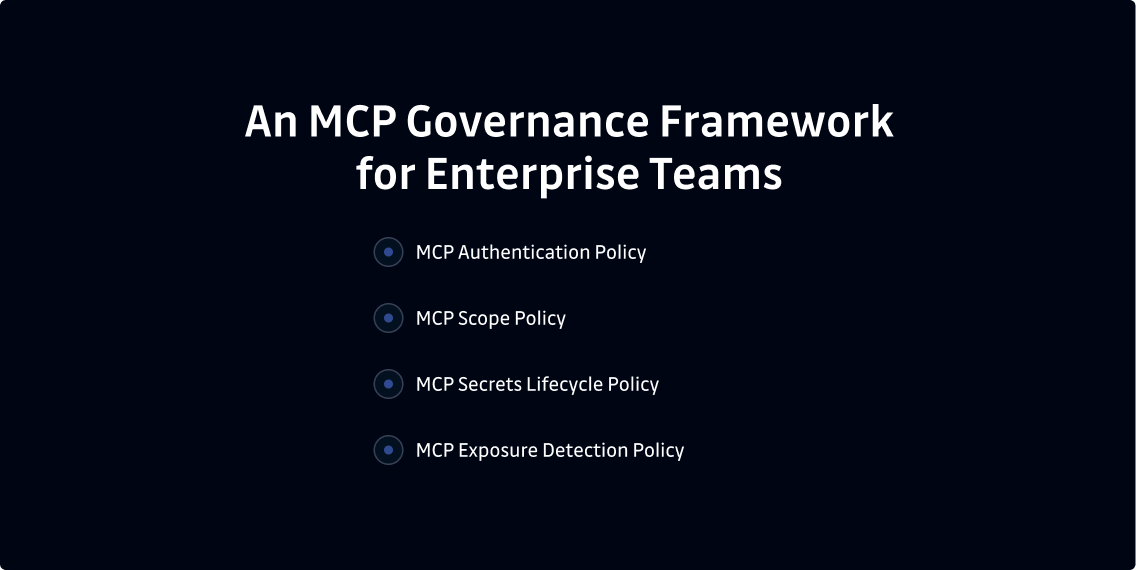
A complete enterprise AI agent security governance framework for MCP consists of four interconnected policies. Each one addresses a different layer of the problem.
1. MCP Authentication Policy
This policy defines approved authentication methods per deployment pattern. Examples include remote OAuth with scoped tokens, vault-issued dynamic credentials, workload identity, and scoped API keys—but only as a last resort. It also explicitly prohibits hardcoded credentials, shared credentials, PAT reuse, and static connection strings in MCP configs. Finally, it requires dedicated OAuth app registrations per MCP server and unique credentials per agent connection.
2. MCP Scope Policy
This policy requires least-privilege access for every MCP connection, mandates environment isolation with separate credentials for production, staging, and development, and requires a documented agent-to-MCP mapping with ownership and business justification for every connection. Periodic access reviews are a required component, not an optional one.
3. MCP Secrets Lifecycle Policy
This policy requires all MCP credentials to be provisioned through a secrets manager with ownership and TTL assigned at creation. It also mandates runtime injection and prohibits static credential storage in config files. Finally, it specifies maximum credential lifetimes per credential type, automated rotation, and immediate revocation on decommission with verification.
4. MCP Exposure Detection Policy
This policy requires continuous scanning of repos, CI/CD pipelines, and collaboration tools for exposed MCP credentials. Pre-commit and PR-level blocking of MCP secrets is also mandatory, and mean time to remediation (MTTR) targets for exposed credentials need to be defined and tracked. Finally, exposure metrics belong on security posture dashboards alongside other security events.
What’s Next for MCP Governance
MCP server governance is still maturing, but there are several trends to keep track of.
First, the MCP specification is evolving toward more prescriptive authentication and authorization standards, which will reduce the governance burden on implementing organizations.
Also of note, centralized MCP registries are emerging within enterprises as a single view into all agent-to-tool connections and their associated credentials. Plus, policy-as-code enforcement for MCP deployments is becoming standard practice for teams that take security monitoring seriously.
Then there's the agent-to-agent MCP delegation trend, which will introduce new trust boundary challenges as autonomous agents chain tool access through intermediary agents.
Last but not least, MCP governance is converging with broader non-human identity (NHI) governance frameworks. Organizations now recognize MCP credentials as a distinct category of NHI that requires security teams to apply the same lifecycle controls to service accounts and machine identities.
Protect Your Company With an MCP Governance Framework
MCP gateways are the connective tissue between AI agents and enterprise tools. At scale, it creates a new credential surface that requires explicit governance and continuous monitoring.
A complete MCP governance framework standardizes authentication, controls scope, manages the secrets lifecycle, and detects credential exposure. As such, it transforms agent-to-tool connections from ungoverned risk into auditable, secure infrastructure.
If you need to detect exposed MCP credentials across your repos, pipelines, and collaboration tools, try GitGuardian. Start for free today, or book a demo of GitGuardian to learn more.
FAQs About MCP Governance
What is MCP governance?
MCP governance is the set of policies, processes, and controls that govern how AI agents authenticate to MCP servers, what scope of access each connection carries, how MCP credentials are managed across their lifecycle, and how exposure is detected. It ensures that agent-to-tool connections are auditable, least-privileged, and secure at enterprise scale.
Are MCP servers secure?
MCP, as a protocol, defines the communication standard but leaves authentication, authorization, and secrets management to the implementing organization and human approval. As such, MCP servers are as secure as the credential and scope governance applied to them. Without explicit governance, like standardized authentication, scoped access, credential rotation, and exposure detection, MCP servers create ungoverned, unauditable credential sprawl that humans and AI models alike can exploit.
How should agents authenticate to MCP servers?
The recommended approach depends on the deployment pattern. OAuth 2.1 with short-lived, scoped tokens for remote SaaS integrations, vault-issued dynamic credentials or workload identity for internal services, and scoped, vaulted API keys only as a last resort when the downstream tool offers no better mechanism. You should inject all credentials at runtime. Don't hardcode them in MCP configuration files.
How do you prevent MCP credentials from leaking?
Layer preventive and detective controls by storing all MCP credentials in a secrets manager and injecting them at runtime (prevention), running pre-commit scanning to block credentials from entering repos (prevention), scanning CI/CD pipelines and collaboration tools for exposed MCP secrets (detection), and monitoring for MCP configuration files that your company accidentally pushes to public repos (detection). GitGuardian provides continuous scanning across these surfaces.
How do you audit MCP server access and permissions?
Maintain a centralized registry of all MCP server connections to clarify which agents connect to which MCP servers, what permissions each connection carries, who owns each connection, and when credentials were last rotated. Then, conduct periodic access reviews of MCP connections with the same rigor applied to IAM role grants. Finally, require business justification for each MCP connection and revoke unused connections.
What are the best practices for securing MCP servers?
Use OAuth 2.1 or vault-issued credentials instead of static API keys. Scope each MCP server to the minimum required permissions. Isolate MCP servers per trust boundary and per environment. Automate credential rotation with defined TTLs. Scan for exposed MCP credentials across repos and CI/CD. Assign ownership for every MCP server and its credentials. And include MCP connections in access review campaigns.
How does MCP governance relate to NHI governance?
MCP credentials are a category of non-human identity. The governance principles are the same: inventory, ownership, least privilege, lifecycle management, and exposure detection. Organizations that already have NHI governance frameworks should extend them to include MCP server credentials. Organizations without NHI governance should treat MCP as a catalyst for building it.
What should an MCP governance framework include?
Your MCP governance framework should include four interconnected policies: An authentication policy (approved methods, prohibited patterns), a scope policy (least privilege, environment isolation, agent-to-MCP mapping), a secrets lifecycle policy (provisioning, runtime injection, rotation, revocation), and an exposure detection policy (continuous scanning, pre-commit blocking, MTTR targets). Start with authentication and scope, then add lifecycle and detection when you're ready.