The biggest security risks are unmanaged lifecycle, overprivileged access, and exposed credentials across SDLC and cloud environments, not just secret storage.
The best NHI security tools in 2026 fall into four major categories:
- Secrets Detection and Exposure Prevention
- NHI Lifecycle and Governance Platforms
- Machine Identity and Certificate Management
- Vault and Authorization Extensions
Most enterprises require layered coverage across detection, governance, and lifecycle automation. Adopting this multi-layered strategy enables organizations not only to find leaks but also to close the structural gaps that allow them to occur.
Why Non-Human Identities Are the Fastest-Growing Attack Surface in 2026
In 2026, attackers rarely try to "hack passwords". Instead, they exploit the massive, often unmonitored web of non-human identities (NHIs) that power modern automation.
They specifically look for hardcoded API keys, overprivileged service accounts, stale OAuth tokens, misconfigured workload identities, unrotated certificates, and shadow SaaS integrations that slip through the cracks of traditional security programs.
This is a problem because machine identities far outnumber human users. However, most security programs rely on frameworks designed for human-centric access.
 Dwayne McDaniel
Thankfully, top non-human identity protection tools help secure this critical attack surface. By understanding the categories of enterprise NHI security solutions, you can build a strategy that provides complete visibility and robust security controls across your entire infrastructure.
What Do Non-Human Identities (NHIs) Include Today?
Non-human identities are the digital identities used by machines, services, and applications to authenticate and communicate with other systems without human intervention. They include:
- Service Accounts: Specialized accounts used by operating systems and/or applications to run background processes and access local or network resources.
- API Keys and Tokens: Credentials that allow software to communicate with external services and internal systems, acting as a kind of "passport" for data exchange.
- SSH Keys: Access credentials for the Secure Shell (SSH) protocol. They're commonly used to authenticate automated processes and privileged users to remote systems.
- Certificates: Digital documents that verify the identity of a machine, service, website, or individual user. They use public key infrastructure (PKI) to exchange sensitive data.
- OAuth Apps: An authorization framework that allows apps to obtain delegated access to resources on behalf of a user or service, without exposing the underlying credentials.
- Workload Identities: A set of credentials assigned to specific cloud resources, like a Kubernetes cluster or cloud IAM roles, to define access limits within an environment.
- Machine-to-Machine Access Credentials: Any credential used by one automated system to authenticate with another. Examples include service tokens, client secrets, and shared keys embedded within automated processes.
Why This Problem Is Urgent Now
Given the complexity of modern environments, a single security gap can lead to data breaches. As such, managing non-human identities is a primary concern for security teams.
- Multi-Cloud Sprawl: Organizations now distribute workloads across AWS, Azure, GCP, and more, creating fragmented identity silos that are difficult to monitor.
- Kubernetes and Ephemeral Workloads: The rise of containers means identities are often created and destroyed in seconds, making manual tracking impossible.
- SaaS-to-SaaS Integrations: Modern businesses rely on a web of interconnected tools, each requiring its own set of OAuth tokens and permissions.
- CI/CD Automation: Rapid deployment cycles require high-speed access to sensitive credentials. Oftentimes, these keys are hardcoded or poorly managed in the software development cycle, and devastating security breaches become a reality.
- AI Agents and Autonomous Services: Supposedly secure AI agents build their own identities to perform tasks, which further expands the non-human attack surface.
Credential-based attacks are one of the most common initial access vectors for cyber threats. Because of this, the non-human identity lifecycle is a top priority for risk reduction.
Key Capabilities of Modern NHI Security Platforms
Discovery and Inventory
Exposure Detection
Lifecycle Management
Authorization and Least Privilege
Governance and Compliance
Modern NHI security platforms provide a comprehensive layer of protection across the entire identity management landscape. The best ones include five key capabilities:
1. Discovery and Inventory
You can't secure what you can't see. Leading non-human identity security solutions provide complete visibility by cataloging every machine identity in use. This includes the detection of shadow service accounts that developers create outside of official channels. It also includes coverage across SaaS and cloud environments, and cross-environment mapping that connects identities to resources.
2. Exposure Detection
This capability finds sensitive credentials where they shouldn't be. Platforms scan git history and monitor public repositories to ensure secrets haven't leaked. They also provide continuous monitoring during the development process by integrating with developer workflows and CI/CD pipelines. Doing so enforces security policies before code reaches production.
3. Lifecycle Management
To properly manage the non-human identity lifecycle, streamline the "birth, life, and death" of credentials. This includes automating secret rotation and certificate renewals to ensure that no identity remains active longer than necessary. The platform should also provide workflows for revoking credentials and monitor for upcoming expirations to prevent service outages.
4. Authorization and Least Privilege
Many NHIs receive excessive privileges. Top security platforms use access relationship mapping and identity graphs to visualize what each identity can access. By detecting overprivileged accounts, they help teams enforce least-privilege policies and reduce the potential impact of a compromised account. As such, this capability is essential.
 Dwayne McDaniel
5. Governance and Compliance
To meet regulatory compliance standards such as SOC 2 and ISO 27001, organizations need detailed audit trails and reporting. Non-human identity management tools provide risk scoring for different identities, helping teams prioritize those that need attention. In addition, reporting dashboards offer a high-level view of the organization's security posture. This makes it easier to demonstrate control to auditors, ensure compliance, and avoid expensive fines.
Now that we've covered key capabilities, let's analyze top NHI security platforms in 2026—starting with the leader in secrets detection and NHI exposure prevention.
Top NHI Security Tools and Platforms for 2026
The market for machine identity security tools has matured. The solutions below represent the best options across detection, governance, lifecycle management, and authorization.
Here's what each does well, where they fall short, and who each platform is best suited for:
1) GitGuardian
Category: Enterprise Secrets, Security, and NHI Exposure Intelligence
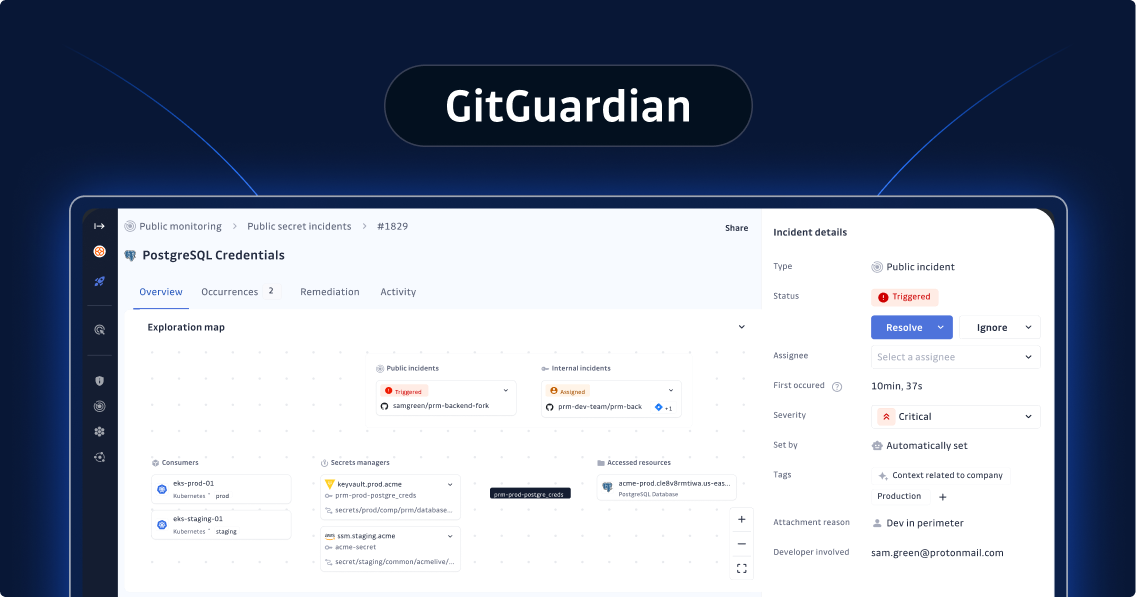
GitGuardian is an enterprise-grade secrets-detection and non-human identity protection tool. It was built to prevent credential-based security breaches at scale and delivers an unmatched breadth of exposure detection across public and internal repositories, collaboration tools, and CI/CD systems. As such, it provides deep secrets intelligence and governance for large DevSecOps organizations in a wide range of industries.
Key Features:
- Exposure Detection Excellence: Scans full git history for all internal and public repositories in real time, continuously monitors public GitHub for external exposure, and covers multiple source types, including multiple VCS, CI/CD pipelines, and collaboration tools.
- Secrets Intelligence: Delivers analytics on secret hygiene and distribution across the organization, including secret validity analysis, exposure window tracking, identification of unused and stale secrets, and risk-based prioritization with breach policy enforcement.
- Vault Integration Mastery: Integrates with major platforms like HashiCorp Vault and CyberArk, and acts as a "single source of truth" across vault and non-vault environments. That way, developers can migrate hardcoded secrets into secure storage systems. It also rates alignment between detection workflows and vault lifecycle controls.
- Proven Detection Accuracy: Uses ML-enhanced detection combined with entropy analysis and contextual validation to deliver a high signal-to-noise ratio with reduced false positives. In addition, continuous detector updates cover cloud providers, SaaS platforms, internal tokens, and custom patterns to stay current with new credential types.
- Agentic AI Security: Protects your organization across the entire AI value chain, from AI-powered CLI tools to autonomous agents running in production. As such, GitGuardian minimizes vibe coding risks, LLM exposure, AI agent sprawl, and risky developer endpoints.
Pros of GitGuardian:
- Unmatched breadth of detection across public and internal sources.
- Advanced secrets intelligence for effective risk prioritization.
- Strong integration with existing vault ecosystems.
- High detection accuracy with low false positives.
- Enterprise-ready governance and reporting.
Cons of GitGuardian:
- GitGuardian specializes in exposure detection and prevention, not full privileged access management. So, your desired use case will determine product fit.
Pricing: The "Starter" tier is free, while the "Teams" and "Custom" tiers offer individual pricing.
Enterprise Fit: Well-designed for mid-market and enterprise organizations in multi-cloud, Kubernetes-heavy, and CI/CD-driven environments that require scalable exposure detection, secrets intelligence analytics, and vault-aligned remediation workflows to reduce breach risk.
Website: https://www.gitguardian.com
2) Astrix Security
Category: SaaS and OAuth NHI Governance
Astrix focuses on discovering and securing non-human identities across SaaS environments. It is particularly strong at managing OAuth apps and third-party integrations that bypass traditional identity providers. These capabilities make it a strong option for NHI governance.
Key Features:
- SaaS Identity Discovery: Automatically maps connections between SaaS tools.
- OAuth App Inventory: Provides a detailed risk analysis of every third-party app connected to the corporate environment, improving security.
- Shadow SaaS Detection: Identifies integrations added without approval from the IT or security team, so they can be eliminated for security reasons.
- Token Exposure Visibility: Tracks where OAuth tokens might be exposed or misused.
Pros of Astrix:
- Focused NIH-first approach.
- Deep visibility into SaaS-to-SaaS communication.
- Strong governance controls, specifically for OAuth.
Cons of Astrix:
- While Astrix includes secret scanning capabilities, the platform's architecture prioritizes SaaS governance and third-party risk over developer-native SDLC prevention. Detection depth and developer workflow integration may not match specialized secrets platforms.
Pricing: Enterprise-tier pricing for commercial SaaS companies.
Enterprise Fit: Strong for organizations with complex SaaS ecosystems and OAuth sprawl.
Website: https://astrix.security/
3) Clutch Security
Category: NHI Governance Platform
Clutch is built on two philosophical principles: zero trust enforcement and ephemeral, short-lived credentials. It uses these philosophies to provide centralized visibility and governance over non-human identities across cloud and SaaS environments.
Key Features:
- Machine Identity Discovery: Builds a complete inventory of machine-related identities.
- Risk Prioritization: Ranks identities based on their potential risk to critical resources.
- Policy Enforcement: Allows security teams to set and enforce global policies for NHIs.
- Lifecycle Visibility: Tracks the status of identities throughout their entire existence.
Pros of Clutch:
- Strong focus on governance and an identity-first architecture.
- Good fit for large enterprises with complex compliance needs.
Cons of Clutch:
- Clutch Security offers less developer-workflow-native detection compared to secret scanning specialists. This is a turn-off to some enterprise organizations.
Pricing: Enterprise SaaS pricing.
Enterprise Fit: Suitable for enterprise teams that need NHI governance and policy enforcement.
Website: https://www.clutch.security/
4) Oasis Security
Category: Non-Human Identities Security Platform
Oasis Security delivers discovery, inventory, and risk management for non-human identities across various cloud and SaaS ecosystems. Its main goal is to help teams understand the "who, what, and where" of machine access so they can act accordingly.
Key Features:
- NHI Mapping: Visualizes relationships between identities and cloud resources.
- Credential Risk Analysis: Evaluates the strength and security of existing credentials.
- Exposure Tracking: Monitors systems for signs of compromised or leaked credentials.
- Governance Reporting: Generates reports to assist with regulatory compliance.
Pros of Oasis Security:
- Focused NHI security approach.
- Strong multi-environment discovery.
Cons of Oasis Security:
- Oasis Security's exposure detection features may not be as deep or specialized as dedicated secret-scanning vendors. So, potential customers might prefer other options.
Pricing: Enterprise-tier pricing for commercial SaaS.
Enterprise Fit: Solid for a dedicated NHI security platform with multi-cloud discovery needs.
Website: https://www.oasis.security/
5) Entro Security
Category: Machine Identity Management Solutions
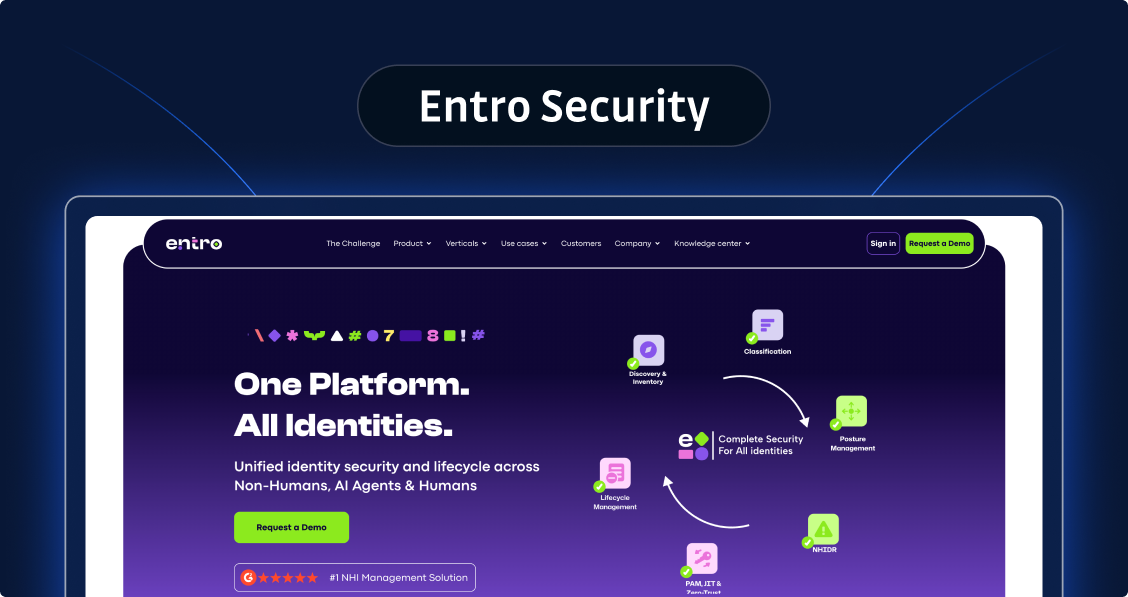
Entro provides machine identity discovery and lifecycle management to reduce secret sprawl and unmanaged credentials. The platform provides visibility into where secrets exist, what lifecycle stage they're in, and how to maintain a clean identity posture across environments.
Key Features:
- Secret Sprawl Discovery: Finds unmanaged secrets scattered across the environment.
- NHI Inventory: Keeps a running list of every machine identity.
- Lifecycle Governance: Manages credential rotation and expiration.
- Risk Posture Monitoring: Continuously assesses the security status of all NHIs.
Pros of Entro:
- Strong lifecycle visibility allows users to maintain excellent identity hygiene.
Cons of Entro:
- Entro wasn't specifically designed for SDLC-based exposure detection. It's also less focused on developer-native prevention, which could lead to unexpected breaches.
Pricing: Enterprise SaaS pricing.
Enterprise Fit: An ideal solution for lifecycle governance and machine identity management.
Website: https://entro.security/
6) Veza
Category: Authorization and Identity Governance
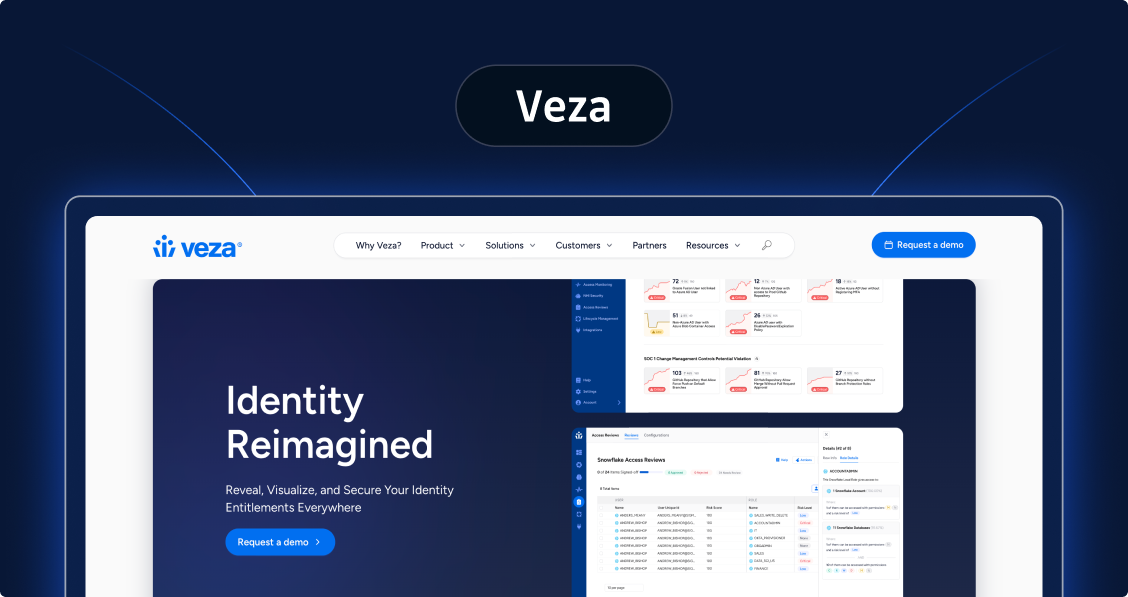
Veza delivers authorization graph intelligence to map and manage identity relationships across systems. For non-human identities, this means visibility into service account permissions, overprivileged workload identities, and access relationships that span multiple cloud and enterprise systems. In a nutshell, Veza answers the question, "Who has access to what data?"
Key Features:
- Access Relationship Mapping: Uses identity graphs to visualize complex permissions.
- Overprivilege Detection: Highlights accounts with more access than they actually use.
- Policy Governance: Helps teams create and enforce consistent access policies.
Pros of Veza:
- Deep authorization intelligence and powerful visualization.
- Strong enterprise governance capabilities.
Cons of Veza:
- While Veza solves the "access governance" problem, it doesn't find leaked keys. As such, Veza isn't a secret detection platform, so some users might prefer a different app.
Pricing: Enterprise commercial pricing.
Enterprise Fit: Best for enterprises that need to manage access management complexity and enforce least privilege across human and non-human identities.
Website: https://veza.com/
7) Apono
Category: Cloud Access Governance
Apono concentrates on just-in-time (JIT) access and privilege management. It helps minimize the risk of "standing privileges" across environments, including service accounts and workloads.
Key Features:
- JIT Access Provisioning: Grants limited-time access when it's needed, not before.
- Cloud IAM Governance: Manages roles and permissions within AWS, Azure, and GCP.
- Temporary Credential Automation: Automates the creation of short-lived access keys.
- Access Workflows: Provides a structured way to request and approve machine access.
Pros of Apono:
- Reduces the attack surface by enforcing least-privilege principles via JIT access.
Cons of Apono:
- Apono is not a tool for scanning code or detecting leaked secrets. For access to these features, you'll need another app, which will increase your tech budget.
Pricing: Enterprise SaaS pricing.
Enterprise Fit: A strong addition for enterprise teams that want to reduce standing access and implement time-bound credential models in a reliable way.
Website: https://www.apono.io/
8) Aembit
Category: Workload Identity Security Tools
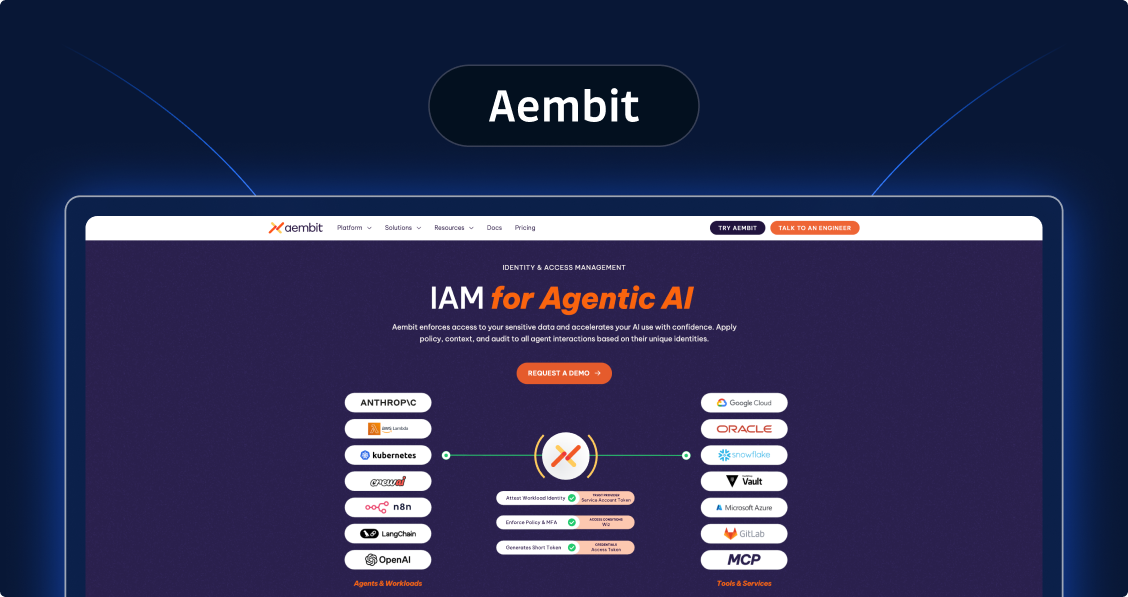
Aembit provides identity federation and access control for secure communication between machines and workloads. It helps eliminate long-lived static credentials by replacing them with short-lived, workload-attested tokens, thus reducing the risk of credential theft and misuse.
Key Features:
- Workload Identity Federation: Allows workloads to trust other identities securely.
- Access Policy Enforcement: Defines which services can talk to one another.
- Secure Service-to-Service Authentication: Ensures that machine-to-machine communication is verified and prevents unauthorized data leaks.
Pros of Aembit:
- A strong workload identity security model that aligns with cloud-native architectures.
Cons of Aembit:
- Aembit doesn't scan code repositories for existing leaked credentials. If you've already experienced a data breach, Aembit won't help you recover.
Pricing: Enterprise-tier pricing for commercial SaaS.
Enterprise Fit: Well-suited for cloud-native and Kubernetes-heavy organizations that plan to modernize their organization's workload identity security tools.
Website: https://aembit.io/
9) AppViewX
Category: Certificate Lifecycle and PKI Automation
AppViewX specializes in certificate lifecycle management and PKI automation for enterprises, especially those managing large and complex machine identity environments. With digital certificates underpinning most machine-to-machine communication, expiry monitoring and automated renewal workflows are critical to security and uptime.
Key Features:
- Certificate Discovery: Inventories certificates across networks to prevent outages.
- PKI Orchestration: Automates the deployment and management of certificates.
- Expiry Monitoring: Alerts teams before certificates expire to ensure security.
- Compliance Reporting: Tracks certificate usage for audit purposes.
Pros of AppViewX:
- Best-in-class certificate automation and enterprise PKI support.
Cons of AppViewX:
- AppViewX does a fantastic job on certificates, but it doesn't do much else. For a tool that can handle the full breadth of NHI types, like API keys or OAuth apps, look elsewhere.
Pricing: Enterprise commercial pricing.
Enterprise Fit: A solid option for complex certificate environments and PKI compliance needs.
Website: https://www.appviewx.com/
Implementation Strategy for Enterprise NHI Security
Exposure Risk Elimination
Comprehensive NHI Inventory and Governance
Lifecycle Automation and Preventive Controls
Deploying non-human identity security tools requires a phased approach to minimize critical risks and build long-term operational efficiency. Here's the three-step process we recommend:
Phase 1: Exposure Risk Elimination (Immediate Risk Reduction)
Many breaches begin with an exposed credential, according to Verizon's 2025 DBIR. With that in mind, your first goal is to reduce the likelihood of these breaches within the first 90 days. Focus on identifying and removing already-exposed sensitive credentials.
- Priority Actions: Implement continuous scanning of source code repositories (including full git history), real-time monitoring of CI/CD, public repository exposure detection, centralized triage and remediation workflows, and established MTTR targets for leaked secrets.
- Executive Outcome: A reduced external attack surface, faster remediation cycles, and immediate measurable breach-risk reduction to deliver peak ROI in the short-term.
Phase 2: Comprehensive NHI Inventory and Governance
Once you put the "fires" out, you can shift your approach and eliminate blind spots.
- Priority Actions: Catalog all NHIs, from service accounts and API keys to certificates and OAuth apps; map identity-to-resource access relationships; establish identity ownership models across AppSec, IAM, and Platform teams; and define enterprise-wide NHI policies, like least privilege, rotation frequency, and approval workflows.
- Executive Outcome: Reduced systemic identity risk, clear accountability for machine identities, and a stronger audit posture for SOC 2, ISO 27001, and PCI DSS standards. That way, NHI risk becomes a governed security domain, not an operational issue.
Phase 3: Lifecycle Automation and Preventive Controls
Finally, you can build a mature environment that prioritizes preventative identity security. Even better, you can automate these processes to ensure security at all times.
- Priority Actions: Implement automated secret rotation and expiration enforcement, just-in-time (JIT) access provisioning for machine identities, certificate lifecycle automation and renewal, vault-backed secret storage standardization, and continuous policy validation across multi-cloud and SaaS environments.
- Executive outcome: The elimination of standing credential risk, a reduced manual workload for security teams, sustainable compliance and audit readiness, and improved resilience against lateral movement attacks. Put simply, this phase embeds NHI security into your cloud operating model rather than treating it as a scanning function.
The Future of NHI Security in 2026 and Beyond
The NHI security space is evolving quickly, with several trends emerging.
First, AI agents autonomously create identities, which poses challenges for security teams. As AI-driven services proliferate, the ability to secure AI agents and their associated identities becomes a baseline requirement rather than an advanced capability.
We are also seeing a move toward continuous identity graph monitoring, in which every relationship is mapped in real time. Organizations need immediate visibility into identity relationships and access paths, not periodic access reviews, which are all too common.
Last but not least, the lines between tool categories are blurring, as secrets detection becomes integrated with governance and reactive scanning shifts to preventative lifecycle automation. After all, it's better to prevent credential exposure than respond to a breach.
To stay ahead of cyber threats, we suggest layering a best-of-breed NHI security tool with your existing pipeline stack. GitGuardian is a strong option for enterprises, offering top-level governance and remediation features on a single platform. Book a free demo of GitGuardian today.
FAQs About Non-Human Identity Management Tools
What's the difference between NHI exposure detection and NHI governance?
NHI exposure detection focuses on identifying leaked or hardcoded credentials across repositories, CI/CD pipelines, collaboration tools, and public sources. NHI governance goes further by managing the lifecycle of machine identities through access controls, rotation policies, and least-privilege enforcement. Mature security programs require both layers to reduce machine identity risk and prevent credential misuse.
How do we determine whether we need a secrets security platform or an NHI platform?
If your primary concern is preventing exposed API keys, tokens, or credentials in code and pipelines, a secrets-security platform is the right starting point. If your organization faces challenges with overprivileged service accounts, unmanaged OAuth integrations, or large-scale machine identity sprawl across cloud and SaaS systems, broader NHI governance capabilities are necessary to manage the full machine identity lifecycle.
How does NHI security integrate with existing IAM, PAM, and vault solutions?
Modern NHI security platforms integrate with IAM providers such as AWS IAM, Azure AD, and Google Cloud IAM, as well as PAM and vault solutions like HashiCorp Vault and CyberArk. Detection systems identify exposed or unmanaged credentials, while vault platforms securely store and rotate them. Together, these integrations ensure secrets are detected, migrated, and governed within secure lifecycle-controlled systems.
How do NHI security tools scale across multi-cloud and Kubernetes environments?
Enterprise-grade NHI platforms rely on API-based integrations to continuously discover and inventory machine identities across cloud environments and Kubernetes clusters. Centralized visibility, automated discovery, and policy enforcement allow organizations to manage hundreds of repositories and thousands of workloads without manual oversight.
What ROI can enterprises expect from investing in NHI security?
The primary return on investment comes from preventing credential-based breaches, one of the most common attack paths in modern environments. Additional benefits include reduced incident response costs, stronger compliance posture, improved prioritization of remediation activities, and lower operational overhead through automation.
Are open-source secret scanning tools sufficient for enterprise environments?
Open-source scanners can provide baseline detection within developer workflows. However, they often lack centralized governance, public monitoring, advanced prioritization, remediation orchestration, and compliance reporting. Many enterprises combine OSS tools for local scanning with enterprise platforms that provide organization-wide visibility and policy enforcement.
What does a mature NHI security program look like in 2026?
Mature programs combine continuous secret exposure detection, centralized NHI inventory, lifecycle automation with credential rotation and expiration, least-privilege access controls, certificate management, and compliance-ready reporting. Leading organizations layer detection, governance, and vault-backed storage to achieve end-to-end machine identity protection.