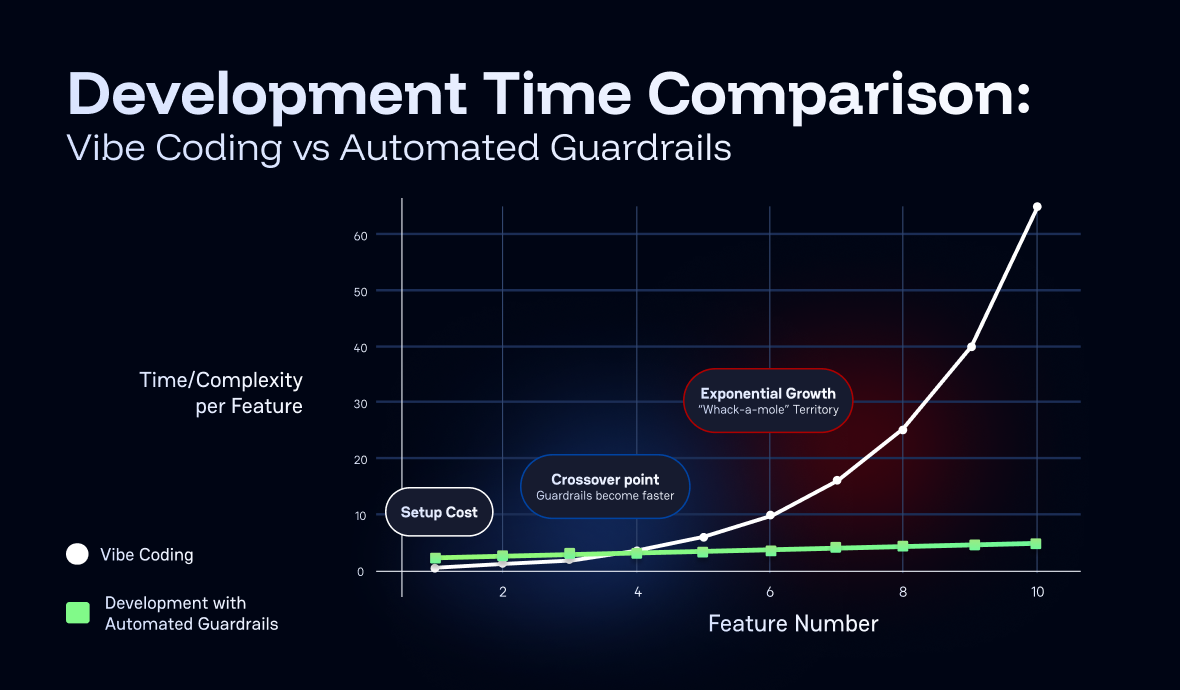
Vibe coding might sound like a trendy term, but it's really just developing software without automated checks and quality gates. Traditional engineering disciplines have always relied on safety measures and quality controls, so vibe coding should be no different in my honest opinion.
There are countless warnings and horror stories about "vibe coding"—that flow state where you're cranking out features and everything feels effortless. Sure, it looks productive and the code works, but the end result is often an unmaintainable, insecure, unreliable, and untested mess. But it works, for now. Vibe coding might sound like a trendy term, but it's really just developing software without automated checks and quality gates. Traditional engineering disciplines have always relied on safety measures and quality controls, so vibe coding should be no different in my honest opinion.
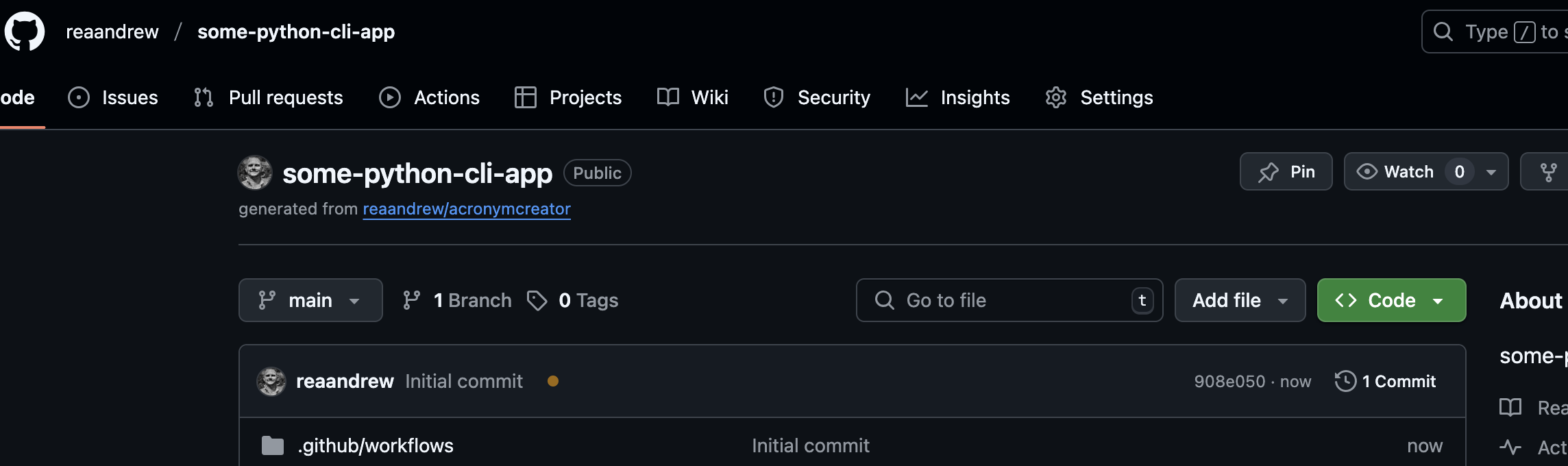
All source code and configurations for this project are available at https://github.com/reaandrew/acronymcreator.
Real Example: Acronym Creator
To demonstrate these concepts, I built a command-line tool that creates acronyms from phrases:
acronymcreator "Hello World"  # Returns: HW
acronymcreator "The Quick Brown Fox" --include-articles  # Returns: TQBF
This project includes comprehensive automated guardrails. Every time I made changes—even during rapid prototyping—the system automatically checked for secrets, formatted the code, ran tests, and verified security. This meant I could code freely without worrying about accidentally introducing problems.
The image below illustrates the automated guardrail cycle and process:

Pre-commit Hooks: The First Line of Defense

Pre-commit hooks are automated checks that run locally on your machine before code enters the repository. They're particularly crucial when working with AI coding assistants, which have transformed how we write code but can also introduce new challenges.
When AI assistants like Claude Code, GitHub Copilot, or Cursor are in "auto mode," they can rapidly generate and iterate on code. This speed is incredible for productivity, but it can also bypass human review of basic quality standards. The probabilistic nature of AI systems introduces unique security considerations that traditional deterministic approaches don't face.
Here's where it gets really powerful: when an AI coding assistant encounters a failed pre-commit check, it doesn't just ignore it—it uses that feedback to iterate and improve the code. The commit attempt blocks until all checks pass, creating a feedback loop where the AI learns to write better code that meets your standards. For example, if a commit fails because of missing test coverage, the AI can immediately add the necessary tests and try again. If code formatting is wrong, the AI learns the project's style requirements.
This creates a collaborative relationship where the AI handles the heavy lifting of code generation while the automated checks ensure quality standards are maintained. As distributed AI architectures like MCP become more prevalent, these automated guardrails become even more critical for managing the expanded attack surface. The developer gets the speed benefits of AI assistance without sacrificing code quality, security, or maintainability.
CI Pipeline: The Second Line of Defense

While pre-commit hooks catch issues locally, the CI pipeline provides comprehensive validation in a clean, controlled environment. The multi-stage approach ensures that even if something bypasses local checks, it won't reach production.
The pipeline runs progressive stages: basic linting and testing first, followed by comprehensive security scanning with GitGuardian's repository history analysis, then advanced quality analysis with SonarCloud and Semgrep security scanning. Each stage builds on the previous one, with failures stopping the pipeline immediately. This catches issues that might be missed locally due to environment differences, skipped pre-commit hooks, or complex integration problems that only surface during full builds.
For AI agents, the CI pipeline becomes even more powerful when they can query job status and receive clear failure messages. This enables the same feedback loop that works with pre-commit hooks—the agent can push code, check the CI results, and iterate based on specific failure details until all checks pass. Clear, descriptive error messages from CI jobs help the agent understand exactly what needs to be fixed.
Common Vibe Coding Security Vulnerabilities and Their Impact
While the current article focuses on implementation strategies, understanding the specific security vulnerabilities that emerge from vibe coding practices is crucial for cybersecurity professionals. Research from security teams reveals that vibe coding security vulnerabilities typically manifest in three critical areas: arbitrary code execution through unsafe serialization, memory corruption in binary parsing, and insufficient input validation.
The most dangerous pattern involves pickle serialization vulnerabilities, where AI-generated networking code directly deserializes objects without validation checks. This creates remote code execution vectors that attackers can exploit by crafting malicious payloads. Memory corruption represents another significant risk, particularly in C/C++ code where AI assistants generate parsers with unchecked buffer operations and unsafe pointer arithmetic. These vulnerabilities often remain hidden because the generated code appears functional during initial testing, embodying the core danger of vibe coding—working software that harbors critical security flaws.
Input validation failures compound these risks, as AI-generated code frequently assumes well-formed data without implementing proper bounds checking or sanitization. Understanding these vulnerability patterns enables security teams to design more targeted automated guardrails that specifically address the most common failure modes in AI-assisted development workflows.
Probabilistic vs. Deterministic Security in AI-Assisted Development
The intersection of vibe coding and AI assistance introduces a fundamental tension between probabilistic AI systems and deterministic security requirements. As GitGuardian's analysis of deterministic versus probabilistic systems reveals, security controls must provide binary assurances rather than confidence scores. This creates unique challenges when AI assistants generate code that "probably" follows security best practices.
Deterministic security systems like cryptographic hash functions and identity protocols provide definitive guarantees—either the hash matches or it doesn't. However, AI-generated code operates within probability distributions, making decisions based on training patterns rather than formal security proofs. This probabilistic nature means that even well-prompted AI assistants may introduce subtle vulnerabilities that deterministic security scanners can catch.
The solution lies in combining probabilistic AI capabilities with deterministic security validation. While AI assistants excel at pattern recognition and rapid code generation, automated guardrails provide the deterministic verification layer that security requires. Tools like GitGuardian's ggshield ensure that regardless of how code is generated—whether through human developers or AI assistance—it undergoes the same rigorous, deterministic security validation before entering production systems.
Automated Guardrails
Now let's examine the specific automated checks that form the backbone of a robust development workflow. The Acronym Creator project demonstrates each of these guardrails with real-world configurations that you can copy and adapt for your own projects. The repository can also be used as a repository template or as a reference to create other templates for different application types or languages.
Repository Configuration Files
The following table describes the key files required for implementing the guardrails, using pre-commit as the foundation technology for local hooks:
| File | Purpose | Technology Used |
|---|---|---|
.pre-commit-config.yaml |
Defines all pre-commit hooks including GitGuardian, Black, Flake8, and pytest | pre-commit framework |
.flake8 |
Flake8 linting configuration for code style and error checking | Flake8 |
pytest-precommit.ini |
Pytest configuration for pre-commit test execution | pytest |
.coveragerc |
Coverage.py configuration with 80% threshold and temp file handling | coverage.py |
pyproject.toml |
Main project configuration with dependencies and build settings | Python packaging |
.releaserc.json |
Semantic-release configuration for automated versioning | semantic-release |
.github/workflows/ci.yml |
Complete CI/CD pipeline with GitGuardian, SonarCloud, and Semgrep | GitHub Actions |
sonar-project.properties |
SonarCloud analysis configuration for code quality scanning | SonarCloud |
Secret Detection
Tools Used: GitGuardian ggshield https://www.gitguardian.com/ggshield
GitGuardian automatically scans your code for accidentally committed passwords, API keys, and other sensitive information. This protection works at two levels: locally during commits and comprehensively in the CI pipeline.
Pre-commit Hook - Scans staged changes before they enter the repository:
- repo: https://github.com/gitguardian/ggshield
  hooks:
    - id: ggshield
CI Pipeline Stage - Scans the complete repository history:
- name: GitGuardian scan repository history
  env:
    GITGUARDIAN_API_KEY: ${{ secrets.GITGUARDIAN_API_KEY }}
  run: ggshield secret scan repo .
Why both? The pre-commit hook catches secrets in new changes, but the CI stage scans the entire git history. This is critical because secrets can exist in previous commits even if they've been removed from current files. Git preserves the complete history of changes, so a password committed six months ago and deleted the next day is still accessible in the repository history. Tools like HasMySecretLeaked can help identify if such historical secrets have been exposed. The CI scan ensures comprehensive coverage and catches secrets that might have been introduced through merges, rebases, or commits made with --no-verify. For detailed setup instructions, see the GitGuardian GitHub Actions integration guide.
Code Quality Automation
Tools Used: Black (formatting) and Flake8 (linting)
Black automatically formats your code consistently, while Flake8 catches common programming errors and enforces PEP 8 compliance. This means you can focus on solving problems rather than worrying about spacing and style conventions, truly empowering developers in code security through automation.
- repo: https://github.com/psf/black
  hooks:
    - id: black
- repo: https://github.com/pycqa/flake8
  hooks:
    - id: flake8
For convenience, we simply run the pre-commit tool again in CI, which executes all these checks once more. This is essential for numerous reasons, including catching commits made with the --no-verify flag that bypass local pre-commit hooks.
Test Coverage Safety Net
Tools Used: pytest, coverage.py, and pytest-cov plugin
The system automatically runs your tests using pytest and calculates coverage with coverage.py through the pytest-cov plugin. Coverage is enforced at multiple levels with specific configuration files controlling the behavior.
Pre-commit Configuration - Uses a dedicated config for clean execution:
# pytest-precommit.ini
[pytest]
addopts = --cov=src --cov-report=term-missing --cov-fail-under=80
Coverage Configuration - Controls coverage calculation and thresholds:
# .coveragerc
[run]
branch = true
source = src
data_file = /tmp/.coverage_precommit

[report]
fail_under = 80
exclude_lines =
    pragma: no cover
    def __repr__
    if __name__ == "__main__":
The coverage enforcement works by requiring 80% of code lines to be tested, including branch coverage (testing both sides of if/else statements). The pre-commit hook uses a separate data file in /tmp to avoid modifying the working directory, and excludes common patterns like __repr__ methods that don't need testing. If coverage drops below the threshold, the commit is blocked until more tests are added. Like the code quality checks, the CI pipeline runs the pre-commit tool again to re-validate all tests and coverage requirements.
Code Quality and Security Analysis
Tools Used: SonarCloud and Semgrep
Security scanning tools like SonarCloud and Semgrep examine your code for common vulnerability patterns, code quality issues, and security hotspots, identifying potential problems before they reach production. These checks are only done in CI since they are not as quick, and I have focused on keeping the pre-commit tests and checks to those which are relatively fast, so you can fail fast.
# SonarCloud integration
- name: SonarCloud Scan
  uses: SonarSource/sonarqube-scan-action@master

# Semgrep security analysis
semgrep:
  container:
    image: semgrep/semgrep
  steps:
  - run: semgrep ci
Automated Release Management
The system includes automated release management using semantic-release and semantic versioning. When you write commit messages using conventional formats like "feat:" for new features or "fix:" for bug fixes, the system automatically determines the appropriate version number and creates releases with generated documentation. For more details on conventional commit formats, see conventionalcommits.org.
{
  "branches": ["main"],
  "plugins": [
    "@semantic-release/commit-analyzer",
    "@semantic-release/release-notes-generator",
    "@semantic-release/changelog"
  ]
}
This eliminates the manual work of managing versions and release notes, while ensuring consistent documentation of changes.
Enterprise Risk Management for Vibe Coding Workflows
Organizations adopting vibe coding practices face unique risk management challenges that extend beyond individual developer workflows. The rapid iteration cycles and AI-assisted development patterns create new attack surfaces that traditional security governance models may not adequately address. Enterprise security teams must establish comprehensive policies that account for both the productivity benefits and inherent risks of AI-assisted development.
The primary enterprise risk stems from the scale and speed at which vibe coding can introduce vulnerabilities. A single developer using AI assistance can generate thousands of lines of code in hours, potentially multiplying security debt exponentially if proper guardrails aren't enforced. This amplification effect means that security incidents resulting from vibe coding practices can have broader organizational impact than traditional development vulnerabilities.
Effective enterprise risk management requires implementing automated security controls at the organizational level, not just individual projects. This includes centralized secrets detection across all repositories, mandatory pre-commit hooks that cannot be bypassed, and comprehensive audit trails for AI-assisted code generation. Organizations must also establish clear accountability frameworks that define responsibility for security outcomes when AI assistants contribute to code development, ensuring that automated guardrails complement rather than replace human security oversight.
Implementation Strategy
The important principle is to fix issues immediately when the automated checks find them, rather than accumulating technical debt. This keeps the guardrails effective and prevents the quality standards from degrading over time.
However, there's flexibility in how you handle CI failures when working with AI tools. Some CI tasks can fail without blocking the AI assistant from continuing development work. In the short term, failed checks prevent builds and releases from occurring in this example, but development can continue. While it's preferable to tackle technical debt as soon as it's detected, you may choose to let some accrue while focusing on a feature delivery. Just be aware that the more technical debt that accumulates, the more difficult it becomes to pay back.
In trunk-based development workflows, failed CI checks mean you've broken the main build. It's advisable to return to a stable main branch as soon as possible to avoid blocking other team members and maintain development velocity.
For this example, I experimented with a test-first approach using the AI assistant. This was the first time I chose to let the AI assistant create empty test functions first, almost as a way of generating the specification. I then asked it to create the test code and the implementations it was testing. This helped me use the project as a tool to check the guardrails as I introduced them to the solution.
Benefits Beyond Safety
These automated systems don't just prevent problems—they actually enable faster development. With confidence that basic issues will be caught automatically, developers can experiment more freely and iterate more quickly, achieving the optimal balance between security and velocity. Code reviews become more focused on architecture and business logic rather than formatting and style. Teams can deploy more frequently because they trust that their quality gates will catch regressions, a key principle of DevSecOps that accelerates software development.
Getting Started
The Acronym Creator project serves as a template that other teams can copy and adapt for their own projects. It includes pre-configured automation for secret detection, code quality enforcement, test coverage, security scanning, and automated releases. New projects can inherit these protections immediately rather than starting from scratch.
The Bottom Line
Automated guardrails don't slow down vibe coding—they make it sustainable. They let you maintain that productive flow state while ensuring that the code you're producing meets quality and security standards. The initial setup takes some effort, but the long-term result is faster, safer development with fewer production surprises.
For teams using premium LLMs or pay-as-you-go AI services, these guardrails also provide significant cost savings. By tackling issues immediately rather than letting technical debt accumulate, you avoid the exponentially higher costs of having AI assistants work through increasingly complex problems. Simple fixes caught early require minimal AI interaction, while accumulated issues can require extensive back-and-forth conversations and multiple iterations to resolve.
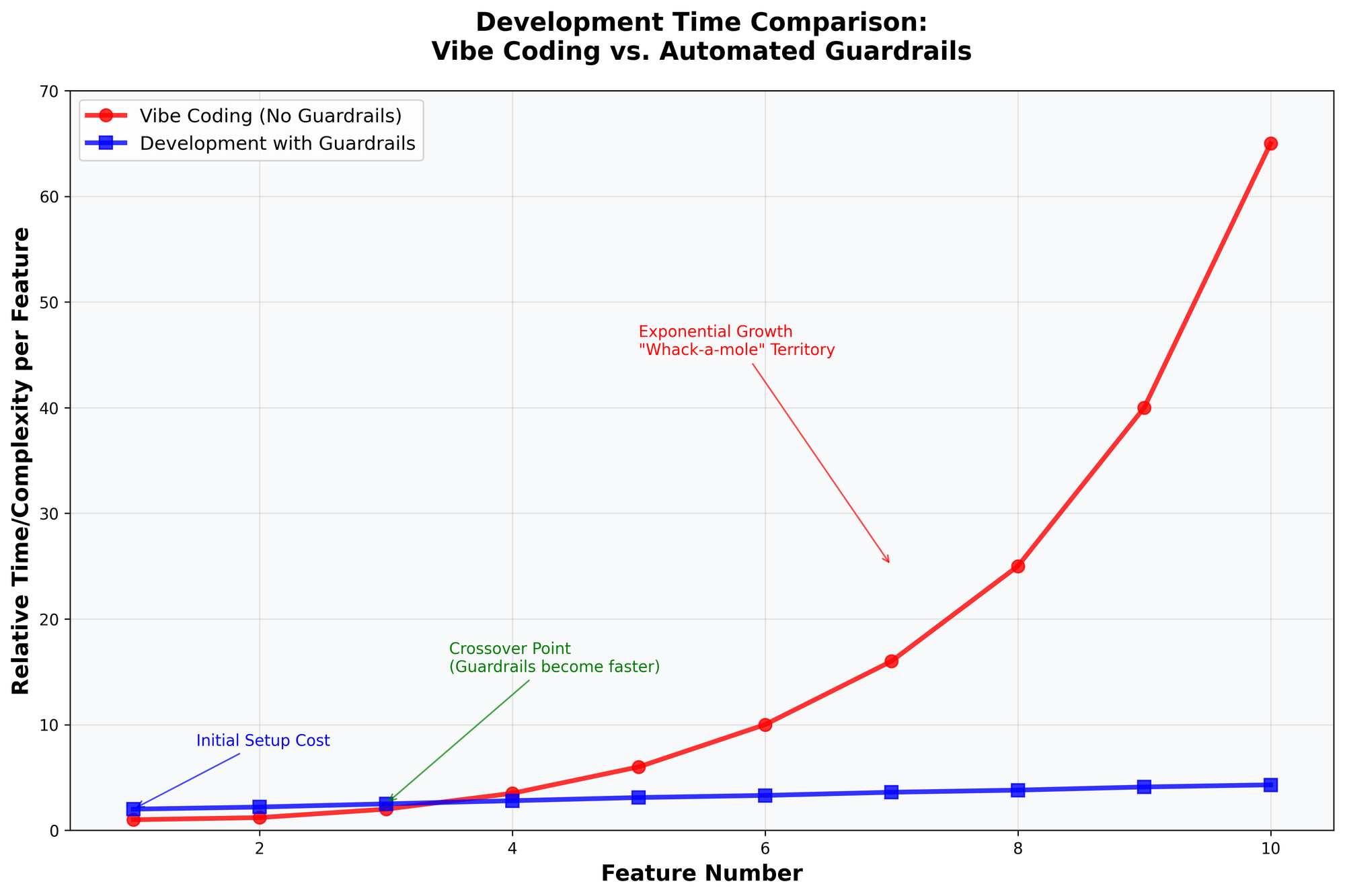
Without guardrails, development time compounds with each feature as the codebase becomes increasingly complex and fragile. What starts as quick feature additions gradually turns into a "whack-a-mole" scenario where fixing one issue creates two more. Each new feature takes longer to implement as developers must navigate around existing problems, leading to exponentially increasing development cycles.
The goal isn't to restrict creativity or slow down development. It's to catch the common mistakes that happen when you're focused on solving hard problems, letting you maintain both speed and quality without having to constantly worry about the details that computers can handle automatically.
By using this repository template for new projects, you skip the initial setup overhead and start right at the crossover point where guardrails are already paying dividends from day one.
The chart below is purely my opinion and describes what you hear in the news about the results of not using guardrails, but I like it and I think it's effective in explaining the results and benefits of using guardrails:
FAQ
What are the most common security vulnerabilities associated with vibe coding?
Vibe coding security vulnerabilities typically include unsafe serialization (e.g., pickle-based remote code execution), memory corruption in binary parsing (especially in C/C++), and insufficient input validation. These risks are amplified when AI-generated code bypasses standard review processes, leading to exploitable flaws that may remain undetected until production.
How do automated guardrails mitigate risks in AI-assisted development workflows?
Automated guardrails enforce deterministic security validation through pre-commit hooks, CI pipelines, and integrated security scanning tools. These controls ensure that all code—whether human- or AI-generated—undergoes rigorous checks for secrets, code quality, test coverage, and known vulnerability patterns before being merged or released.
Why is deterministic security validation critical in environments using AI coding assistants?
AI-generated code operates probabilistically, meaning it may "probably" follow best practices but lacks formal guarantees. Deterministic security validation—such as secrets scanning and static analysis—provides binary, auditable assurances that critical requirements are met, regardless of how code is produced or by whom.
How should enterprise security teams address the organizational risks of vibe coding?
Enterprise security teams should implement centralized, mandatory automated guardrails across all repositories, enforce pre-commit hooks, and maintain comprehensive audit trails. Clear accountability frameworks and continuous monitoring are essential to manage the scale and speed at which vibe coding security vulnerabilities can propagate in large organizations.
Can automated guardrails slow down development velocity or hinder creativity?
Properly implemented automated guardrails do not impede development velocity. Instead, they enable faster, safer iteration by catching common issues early, allowing developers and AI assistants to focus on business logic and architecture rather than manual quality checks. This approach sustains productivity while minimizing risk.
What role does secrets detection play in preventing vibe coding security vulnerabilities?
Secrets detection tools like GitGuardian ggshield are essential for identifying and blocking hardcoded credentials and sensitive information before they enter version control. This prevents accidental exposure of secrets, which is a frequent and high-impact risk in fast-paced, AI-assisted vibe coding workflows.