TL;DR: This demo shows how to wire up multiple AI agents using Google's Agent Development Kit (ADK) and the A2A protocol, with GitGuardian scanning content for secrets. The interesting part? There's no hardcoded workflow — the LLM decides which agents to call and when to stop.
What We're Building
Multi-agent systems are gaining traction, but most demos I've seen have one thing in common: hardcoded orchestration. Agent A calls Agent B, which calls Agent C. Predictable, but not particularly intelligent.
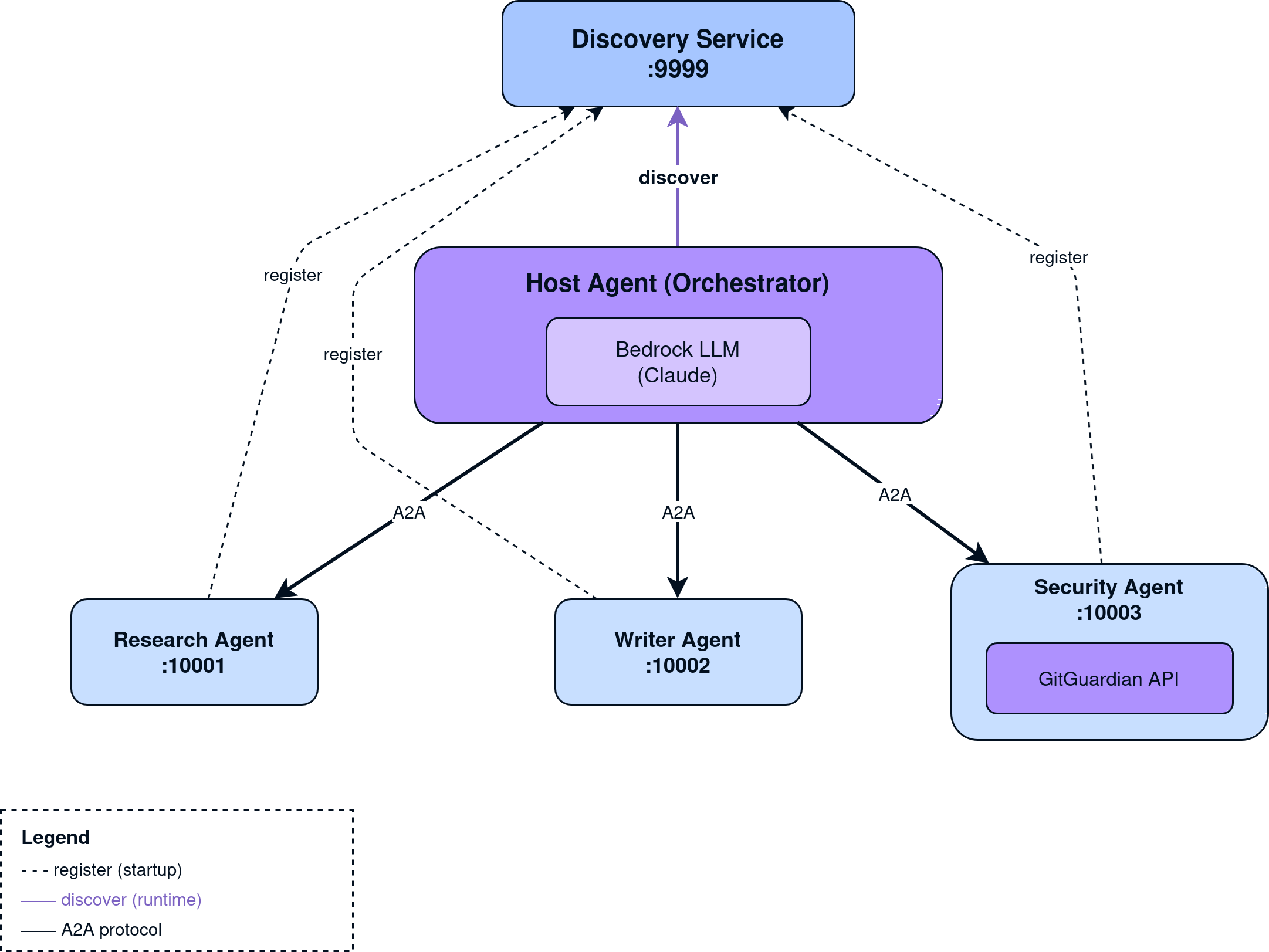
This demo takes a different approach. We have three specialist agents:
- Research Agent - gathers information on a topic
- Writer Agent - transforms research into polished content
- Security Agent - scans content for exposed secrets using GitGuardian
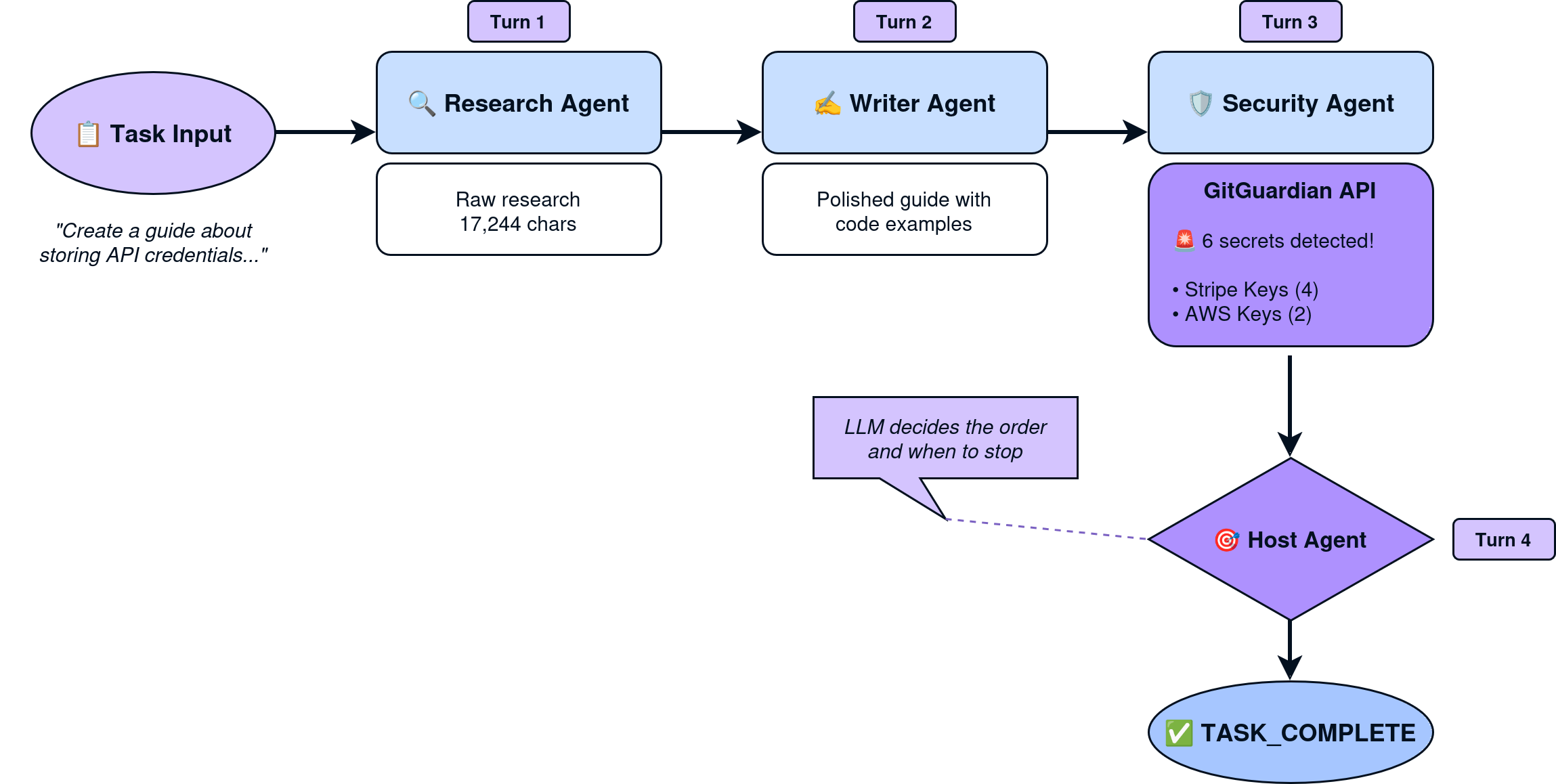
The twist? None of these agents know about each other. An orchestrator discovers them at runtime from a registry service, tells the LLM what's available, and lets the model decide the execution order. The LLM also decides when the task is complete.
A2A: The Protocol Connecting Agents
The Agent-to-Agent (A2A) protocol is Google's new open standard that enables AI agents, regardless of vendor, framework, or platform, to securely communicate, share information, and coordinate tasks across the enterprise. Built with contributions from more than 50 major technology partners, A2A creates a unified way for agents to collaborate across siloed systems, automate complex workflows, and deliver higher levels of efficiency and autonomy. Designed to complement Anthropic's Model Context Protocol (MCP), it provides a universal interoperability layer so businesses can mix and match agents from different providers and manage them consistently across applications and cloud environments, unlocking the full potential of agentic AI.
Each agent exposes an AgentCard, a JSON document describing its capabilities, at a well-known endpoint:
http://localhost:10001/.well-known/agent-card.json
This means agents can be discovered and invoked without prior knowledge of their implementation. Think of it like OpenAPI specs, but for AI agents.
The Agent Development Kit (ADK) provides the tooling to build agents and expose them via A2A with minimal boilerplate.
Why Bedrock Instead of Gemini?
Google ADK defaults to Gemini, but thanks to LiteLLM integration, we can swap in any supported model. I'm using Claude on AWS Bedrock:
from google.adk.models.lite_llm import LiteLlm

BEDROCK_MODEL = LiteLlm(model="bedrock/eu.anthropic.claude-haiku-4-5-20251001-v1:0")
This demonstrates that A2A and ADK are model-agnostic—your agents can run on whatever LLM fits your requirements.
Dynamic Agent Discovery
Here's where it gets interesting. The host agent doesn't have a hardcoded list of sub-agents. Instead, it queries a Discovery Service at runtime:
async def create_host_agent_with_discovery() -> Agent:
    # Query the Discovery Service for all registered agents
    discovered_agents = await discover_agents()

    # Create RemoteA2aAgent wrappers for each discovered agent
    sub_agents = []
    for agent_info in discovered_agents:
        remote_agent = RemoteA2aAgent(
            name=agent_info.name,
            description=agent_info.description,
            agent_card=f"{agent_info.url}/.well-known/agent-card.json",
        )
        sub_agents.append(remote_agent)

    # Build dynamic instruction listing discovered agents
    agent_descriptions = "\n".join([
        f"- {a.name}: {a.description}" for a in discovered_agents
    ])

    # The LLM sees these as available tools
    host = Agent(
        name="host_agent",
        model=BEDROCK_MODEL,
        instruction=f"""You have access to these agents:

{agent_descriptions}

Call exactly ONE agent per turn. Say "TASK_COMPLETE" when finished.""",
        sub_agents=sub_agents,
    )
    return host
The agents register themselves with the Discovery Service on startup. Add a new agent? It appears in the next orchestration run without code changes.
LLM-Driven Orchestration
Traditional orchestration looks like this:
# Hardcoded workflow - brittle and inflexible
result = research_agent.run(task)
result = writer_agent.run(result)
result = security_agent.run(result)
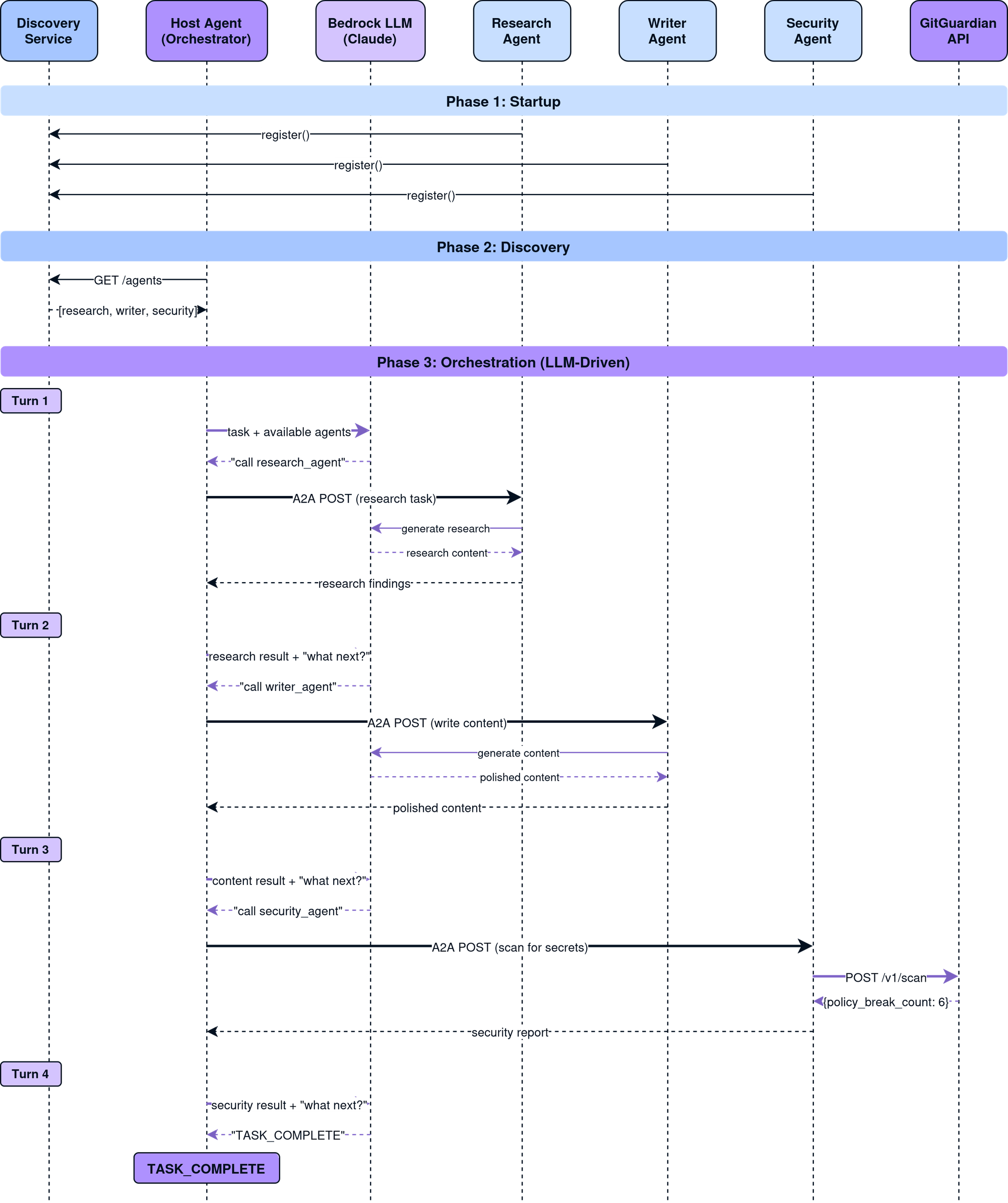
Our approach lets the LLM decide:
for turn in range(max_turns):
    # Ask LLM: "What should we do next?"
    async for event in runner.run_async(session_id=session.id, new_message=content):
        # LLM decides which agent to call (or signals completion)
        ...

    if "TASK_COMPLETE" in response:
        break

    # Prepare next turn with updated context
    current_message = f"The {agent_called} completed. What's next?"
The host agent's instruction tells it the rules: delegate to one agent per turn, and say "TASK_COMPLETE" when finished. The model figures out the rest.
A Note on Production Guard Rails
This demo lets the LLM decide whether to call the Security Agent—useful for showcasing A2A's flexibility, but not how you'd build a production system.
In reality, security scanning shouldn't be optional. GitGuardian would be a static guard rail that runs on every orchestration, regardless of what the LLM decides. The pattern would look more like:
# LLM-driven orchestration
result = await run_llm_orchestration(task)

# Static guard rails - always run, not LLM-dependent
security_report = await security_agent.scan(result)
if security_report.has_secrets:
    raise SecurityException("Content contains exposed secrets")
The power of having agents available to the LLM is real—it enables dynamic workflows that adapt to different tasks. But critical safeguards like secret scanning belong outside the LLM's decision loop. They're non-negotiable steps that execute every time.
For this demo, we've kept everything LLM-driven to illustrate the A2A protocol and show GitGuardian working within a multi-agent system. Just remember: in production, some agents are tools for the LLM to use; others are guard rails that the LLM cannot bypass.
The Turn Limit: A Necessary Guard Rail
Letting an LLM decide when to stop sounds risky. What if it never stops?
That's why we have a max_turns parameter:
async def run_host_agent(task: str, max_turns: int = 5):
    for turn in range(max_turns):
        # ... orchestration logic ...

        if "TASK_COMPLETE" in response:
            break

    if turn == max_turns - 1:
        print(f"Reached max turns ({max_turns})")
This prevents runaway execution while giving the LLM enough room to complete complex tasks. In practice, most tasks complete in 3-4 turns.
GitGuardian Integration
The Security Agent wraps GitGuardian's API to scan content for exposed secrets:
def scan_for_secrets(content: str) -> str:
    response = requests.post(
        "https://api.gitguardian.com/v1/scan",
        headers={"Authorization": f"Token {api_key}"},
        json={"document": content, "filename": "content.txt"},
    )

    result = response.json()
    if result.get("policy_break_count", 0) > 0:
        return f"SECRETS DETECTED: {result['policy_break_count']} found!"
    return "No secrets detected"
To make the demo more interesting, the Research and Writer agents are instructed to include realistic-looking fake credentials in their "anti-pattern" examples. This triggers GitGuardian's detection, demonstrating the security pipeline in action.
Why GitGuardian?
We chose to work with GitGuardian as we have found their detection engine to produce the cleanest output, with the lowest false positive rates, which is critical when dealing with agents. We started with the simplest use of their API, just scanning, but there are many ways we can evolve this integration based on the needs of the wider security and DevSecOps teams. For example, we could see the agents accessing severity scoring when evaluating secrets or automating certain remediation workflows directly from their platform.
Running the Demo
Here's what happens when we run the orchestration:
🌟 ADK + A2A DEMO - Multi-Agent Orchestration
============================================================
📋 Task: Create a guide about storing API credentials securely...

📡 Starting Discovery Service (:9999)...
📡 Starting A2A agents...
   - Research Agent (:10001)  ✅ Registered
   - Writer Agent (:10002)    ✅ Registered
   - Security Agent (:10003)  ✅ Registered

============================================================
🎯 RUNNING HOST AGENT
============================================================
📡 Querying Discovery Service...
✅ Discovered 3 agent(s)

🚀 Starting orchestration loop...
------------------------------------------------------------

[Turn 1/5]
   📤 Calling Bedrock LLM (Host Agent)...
   🔍 Research Agent activated
      → Bedrock LLM: researching topic...
   ✅ research_agent completed (17244 chars)

[Turn 2/5]
   📤 Calling Bedrock LLM (Host Agent)...
   ✍️  Writer Agent activated
      → Bedrock LLM: writing content...
   ✅ writer_agent completed (3078 chars)

[Turn 3/5]
   📤 Calling Bedrock LLM (Host Agent)...
   🛡️  Security Agent activated
      → GitGuardian API: POST /v1/scan
      → Scanning 16578 chars of content...
      ← Response: {
          "policy_break_count": 6,
          "policy_breaks": [
            {"type": "Stripe Keys", "match": "sk_live_..."},
            {"type": "AWS Access Key", "match": "AKIA..."},
            ...
          ]
        }
   ✅ security_agent completed (5197 chars)

[Turn 4/5]
   📤 Calling Bedrock LLM (Host Agent)...

============================================================
✅ TASK_COMPLETE - All agents finished
============================================================
The LLM chose to call Research → Writer → Security, then signaled completion. GitGuardian found 6 secrets in the generated content (the intentional fake credentials in the anti-pattern examples).
Key Takeaways
- Dynamic Discovery - Agents register themselves; the orchestrator finds them at runtime
- LLM-Driven Routing - No hardcoded workflow; the model decides execution order
- Model Agnostic - ADK works with Bedrock, not just Gemini
- Guard Rails Matter - Turn limits prevent infinite loops
- Real Security Scanning - GitGuardian catches secrets even in AI-generated content
Try It Yourself
The complete code is available at: https://github.com/reaandrew/a2a-demo
pip install "google-adk[a2a]" uvicorn httpx fastapi
export GITGUARDIAN_API_KEY="your-key"
python examples/adk_a2a/run_demo.py
Further Reading
- Google A2A Protocol Specification
- Google Agent Development Kit (ADK)
- GitGuardian API Documentation
- LiteLLM - Universal LLM Gateway
- Slack Engineering: Streamlining Security Investigations with Agents - A related approach to runtime security for credentials with AI agents