TL;DR:
- Credentials stay valid long after exposure: Exposed secrets are a standing risk because 64% of secrets confirmed valid in 2022 were still valid in January 2026, and they travel across repos, pipelines, laptops, and tickets.
- Context turns detection into decisions: Secret Analyzers show what a credential can access, and the Exploration Map shows its consumers and resources, so teams know who owns it and what breaks if it is revoked.
- One platform covers detect, remediate, prevent: Monitoring spans repos, CI/CD, public GitHub, and developer endpoints, with workflows, vault onboarding, and validity rechecks to confirm the old credential no longer works.
Modern enterprises run on credentials; those pieces of data that enable all of our services, infrastructure, AI, and fellow humans to connect together and get their work done.
This takes many shapes; for example, API keys connect applications to services. Access tokens allow automation to interact with infrastructure. Service accounts keep production systems running. AI agents use credentials hardcoded in MCP (Model Context Protocol) servers to access the tools and resources they need to complete their tasks.
Every one of those secrets represents real access. When a credential is exposed, an attacker may gain the same access as the person, application, or machine it belongs to. When an AI agent, like a coding assistant, finds it, the outcome can be unpredictable.
Finding exposed credentials is the first step in our mission to Detect, Remediate, and Prevent plaintext secret sprawl. While many teams have tried various methods to detect secrets in isolated systems, finding all the secrets across the enterprise remains a real challenge, especially as the surface continually grows. GitGuardian helps you see the whole credential layer. The other real challenge for security teams starts after they discover any secret. Answering the resulting questions of "Who owns this?" "What does this connect to?" and "What breaks if I revoke this credential?" become the immediate challenge security teams face. This is where a lot of programs get overwhelmed.
This is increasingly difficult for organizations as they rapidly expand their infrastructure and see new non-traditional engineers, or "citizen coders," adopt AI-assisted development. GitGuardian's State of Secrets Sprawl 2026 found 28.65 million new hardcoded secrets in public GitHub commits during 2025, a 34% increase from the previous year. The number of credentials requiring protection continues to grow as software development expands.
GitGuardian brings together detection, credential context, remediation workflows, and prevention across the credential layer. This allows security teams to investigate exposures more efficiently, work with the people responsible for fixing them, and understand whether their credential security programs are improving over time.
What the credential layer is and why attackers target it
The credential layer is a very broad concept. Basically, it is every surface where credentials can be created, stored, transmitted, or used. This is the real accounting of all systems, internal and external, where plaintext secrets can end up, regardless of their state or whether they are managed according to organizational policy.
A credential is any piece of authentication material that grants access to a service, system, or data. API keys, access tokens, passwords, and private keys all fit this definition.
As explained in our earlier article, What Is Credential Layer Security?, the credential layer spans the systems that connect an organization's software, infrastructure, and services.
Where credentials live now
It might be helpful to consider a typical application that retrieves customer information from a cloud database, rather than think about credentials in isolation. After all, no identity exists in a vacuum.
Let's say an application uses an API key. A developer generated it within an identity provider. They stored it in AWS Secrets Manager and referenced it through a Kubernetes configuration, where it is ultimately consumed by a workload in a container.
Another developer, later, troubleshoots the application and "temporarily" copies the needed credential into a local configuration file, forgetting to remove it before committing.
Each system has a different purpose and may be managed by a different team. Yet all these surfaces are connected by the same credential. This one secret subsequently appears in a repository, pipeline log, or support ticket.
Part of the challenge of dealing with this scenario is how we have administered security inside the enterprise. Security programs at most large organizations are divided along technology or departmental boundaries. Application security monitors code. IAM (identity and access management) manages identities and authorization. Platform engineering maintains the vault. Endpoint security monitors workstations.
The credential moves across all these environments, making the associated risk an enterprise-wide concern.
Why an exposed credential stays a standing risk
A credential represents access. Possession of a leaked credential may be enough to authenticate and perform authorized operations under the compromised identity. Those permissions tend to be overly broad when talking about AI or machine access, as non-humans tend to break when they hit permission boundaries rather than raising their hands and asking for more rights.
Static, plaintext credentials create a persistent opportunity for abuse while the credential remains valid. And they typically stay valid for a long time. The 2026 State of Secrets Sprawl research found that 64% of secrets confirmed valid in 2022 were still valid when retested in January 2026.
Long-lived credentials provide attackers with a continuing access opportunity, especially when the same secret is reused across multiple systems.
As AI agents become integrated into enterprise workflows, credential exposure takes on additional significance. Agents need access to APIs, infrastructure, and services to complete tasks. Credentials and permissions determine the blast radius when one of these identities is compromised.
Managing these risks requires organizations to understand the credential itself, the access it grants, and the systems that depend on it.
How GitGuardian approaches credential layer security
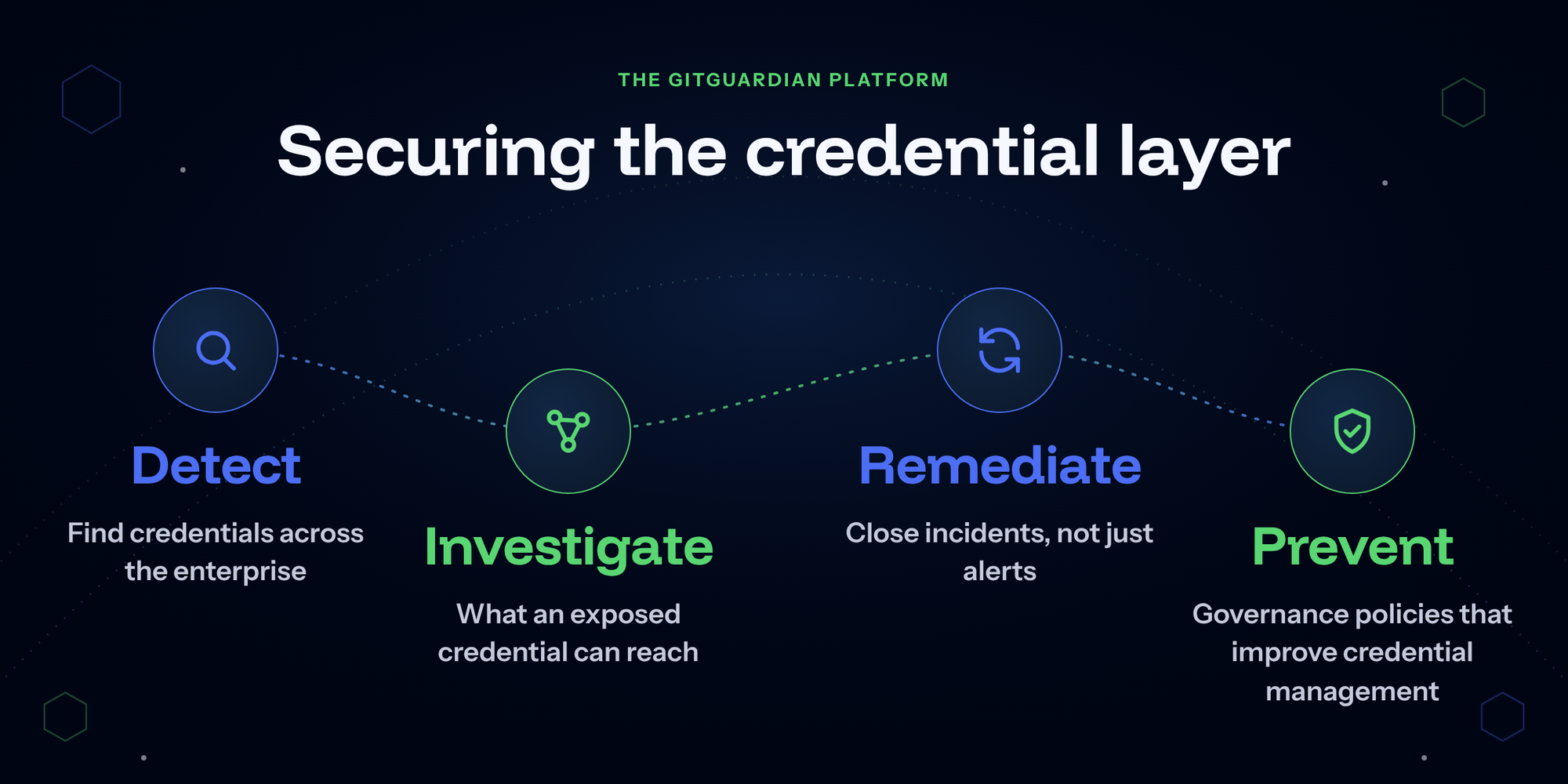
GitGuardian approaches credential layer security as a connected process that begins with discovering credentials and continues through investigation, remediation, and prevention.
The platform brings together evidence from connected development systems, cloud and SaaS environments, developer endpoints, and secrets managers.
The following table maps common security questions to the technical capabilities that help answer them.
Mapping credential risk to GitGuardian capabilities
These capabilities depend on the systems an organization has connected and the metadata available from each source. GitGuardian can progressively enrich credential context as coverage expands.
This is how a credential security platform supports credential lifecycle management: it gives teams a consistent body of evidence to understand risk and coordinate appropriate action across otherwise separate systems.
Detect: find credentials across the enterprise
The field of secrets security mostly grew from the world of software development, so it makes sense that traditional secrets scanning has concentrated on source code, the CI/CD (continuous integration and continuous delivery) pipeline, and artifacts created in the process. And that remains an essential starting point, but we need to acknowledge that those are just a few aspects of the credential layer.
Plaintext credentials routinely appear in places outside repositories and the traditional software supply chain or lifecycle. A comprehensive detection strategy must account for those additional surfaces, including all of the surfaces outside of traditional software delivery.
Code, CI/CD, containers, and collaboration tools
Git is in our name, so of course we have provided for code scanning in git repositories through Internal Secrets Monitoring. But the platform goes beyond code, detecting exposed credentials across connected internal development environments and supported additional sources. This includes monitoring development infrastructure and supported locations such as collaboration tools, cloud storage, and container-related sources.
This is vital to a complete inventory process, as the same credential may appear in multiple systems.
An API key discovered in a repository may also have been copied into a Jira ticket or exposed through a configuration file. Finding its other known occurrences helps security teams investigate the full exposure instead of addressing each discovery independently.
Public GitHub, including developers' personal repositories
Public Secrets Monitoring extends discovery to public GitHub.
This is particularly important for organizations whose developers work on personal projects, contribute to open source, or accidentally push company credentials to repositories outside the corporate GitHub organization.
GitGuardian can identify public exposures associated with monitored organizational assets and help teams determine which credentials require investigation.
Public exposure raises the urgency of understanding validity and privileges, since the credential may already be accessible outside the organization.
Developer laptops and the AI coding agents that run there
GitGuardian knows that any leak in a codebase, SaaS platform, or tool chain has to start somewhere. And that somewhere is most commonly the environment where the developer first created and copied any secrets. We refer to these environments as Developer Endpoints. This is where local configuration files, shell histories, IDE caches, and AI assistant directories accumulate plaintext secrets during the normal development process.
GitGuardian's Developer Endpoint Protection uncovers these exposed credentials and gives your team insight into the risks they carry.
Developer Endpoint Protection can be administered to all machines in your fleet via MDM (mobile device management) platforms like Jamf, Intune, or Iru. Detection happens locally, and the tooling only ever sends hashes and finding metadata to the GitGuardian platform. GitGuardian has no intention of storing your plaintext secrets either. Findings are evaluated by machine, severity, and validity.
This extends detection to credentials that may never enter a repository but remain accessible to local applications, malware, or AI workflows.
Secrets managers and the credentials behind them
Secrets managers are essential to securing credentials, but they only provide a view of the credentials enrolled in their systems.
GitGuardian can connect to any popular secrets manager or vault, like Delinea, CyberArk's Conjur, AWS Secrets Manager, and many more, with ggscout. This tool securely builds a credential inventory, collecting only partial hash fingerprints and metadata. It can also be connected to CI/CD and Kubernetes artifacts that show how these secrets are used and move through environments.
This includes information such as secret paths, associated environments, validity, provider permissions, ownership, and expiration where available.
This enables teams to identify when a credential stored in a vault also appears in plaintext in a monitored source, or when an exposed credential appears to lack an approved vault location.
GitGuardian can also help you move unvaulted credentials into a secrets manager with our Push-to-Vault functionality, providing a path developers can use to update their applications.
A detection engine tuned for precision
Detecting secrets across diverse sources requires handling different formats, providers, and authentication mechanisms.
GitGuardian's detection engine uses provider-specific and generic detectors to recognize credentials. The platform has built over 600 secret detectors that cover the widest enterprise use cases. You can read more about how the secret detectors work in detail in our documentation.
Precision matters in detection. Security teams only have so much time. They need to devote their attention to actual risks. On the other end, any missed credentials leave potential access paths undiscovered. Teams need to know the alerts they get are real, timely, and actionable.
After the alert is received, the security team's job is really just beginning. Next, they need to understand the context and risks associated with the detected plaintext credential.
Investigate: what an exposed credential can reach
Detection merely identifies a possible security problem. The larger challenge comes in the investigation phase, where teams need to determine what the organization should do about it.
For most, this is where the most time-consuming work begins.
Consider an exposed AWS credential. AWS supports an enormous range of services and permission configurations. A credential associated with narrowly scoped read access to one service presents a different risk from a root user key granting broad administrative controls.
Confirming that both credentials are valid is useful, but their privileges and operational roles are essential to determining the appropriate response.
Validity, permissions, and ownership
GitGuardian enriches incidents with information about the secret type, its occurrences, validity, source, and related metadata.
Secret Analyzers provide information about the access a credential grants for an ever-expanding variety of credentials. Connected sources can contribute ownership, environment, and dependency information.
This enriched data view of the world enables responders to address several questions directly:
- Is this credential still usable?
- What can someone do with it?
- Where has it been exposed?
- Who should participate in remediation?
- Which systems may depend on it?
GitGuardian's Exploration Map makes the relationships between a credential, its known consumers, accessed resources, secrets managers, and related incidents visible.
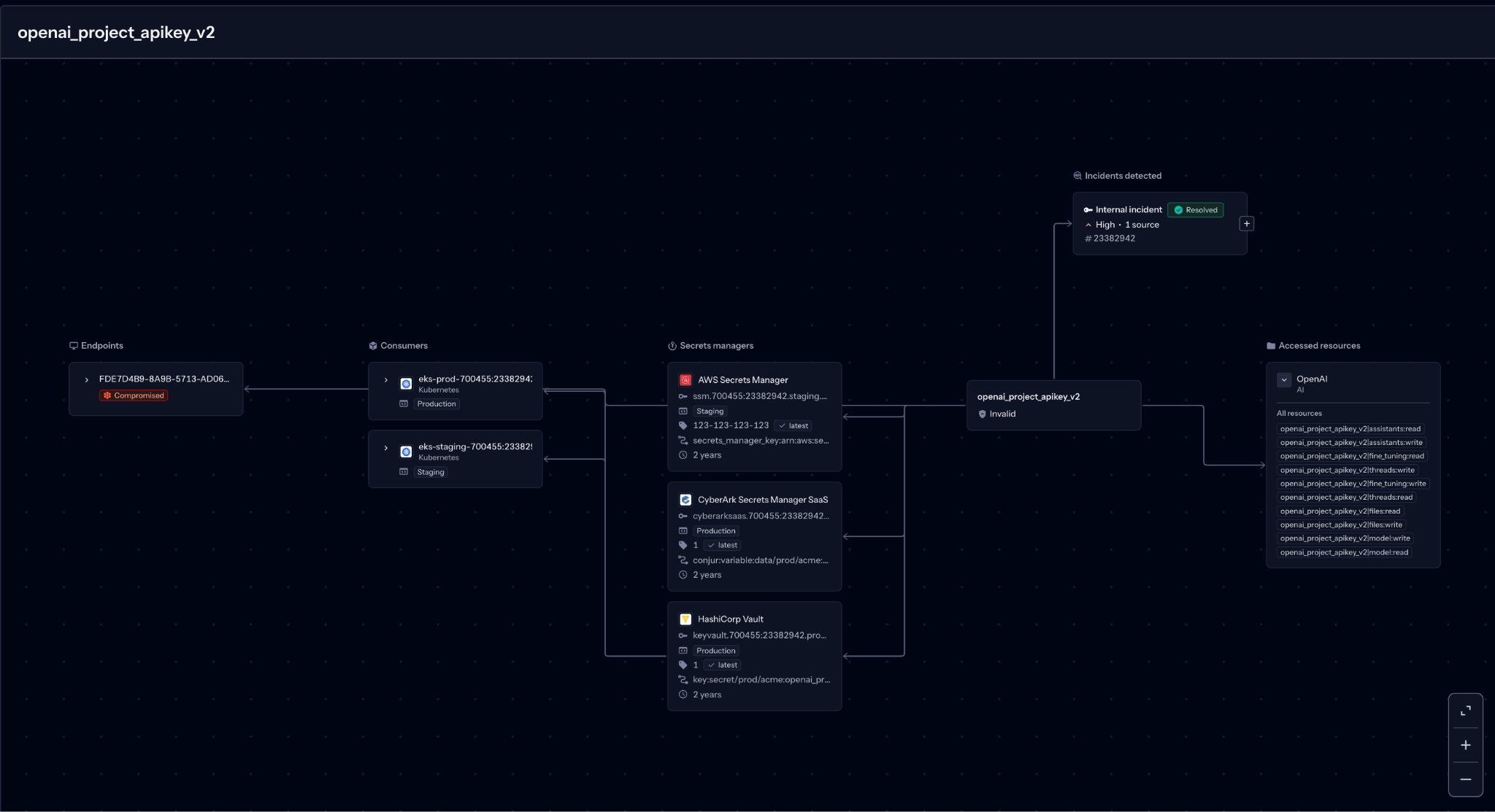
The exploration map assembles and presents all the information collected from across the platform. Responders can easily evaluate potential consequences and prepare informed conversations with the developers and operations teams responsible for the affected systems.
While it does not automatically eliminate the need for those conversations, it helps empower them to move more effectively.
GitGuardian can identify that several workloads depend on a credential. The organization must still determine which workloads are business-critical, what downtime is acceptable, and how to coordinate the change safely.
Prioritization that looks past validity
A valid credential deserves attention, but validity alone cannot describe the full risk.
GitGuardian provides incident risk scores that incorporate available context and explain the factors contributing to prioritization. Scores can change as additional information becomes available. These scoring criteria include scope of privileges and whether the secret connects to sensitive data or important operational systems. These high-risk exposures require a different response than narrowly scoped credentials used only in lower-risk environments.
The final remediation priority also depends on the organization's risk tolerance and business requirements.
By gathering the technical evidence, GitGuardian helps teams spend less time investigating basic facts and more time determining appropriate actions.
Remediate: close incidents, not just alerts
Secrets remediation often stalls because the team discovering the exposure lacks the authority or operational knowledge needed to resolve it.
A security engineer may know that a credential is dangerous while remaining uncertain about what revoking it would affect. Developers who understand those dependencies have limited time themselves and have competing priorities.
This creates a backlog in which validated exposures can remain unresolved long after their initial discovery.
GitGuardian helps bridge that gap by providing the technical context needed to move remediation forward. Incident details can identify the developer or other team member associated with a commit, ticket, blob, or message in a system.
From a security operations workflow perspective, the platform tracks assignments and support feedback from the people responsible for remediation. GitGuardian supports Jira and ServiceNow so that organizations can coordinate work through established processes.
The goal is to give the assigned developer or operations engineer enough information to act without having to repeat the investigation.
For example, a remediation request involving a production credential can include its validity, known exposure locations, provider information, and available dependency context.
The conversation can then focus on the operational implications of the proposed change.
Instead of spending days identifying which credential is involved, teams can discuss when to rotate the credential, which applications need updating, and how to minimize business disruption.
Rotate, revoke, and move secrets into your vault
Revocation and rotation are often the most appropriate responses to an exposed credential, particularly when there is a risk that an unauthorized party could use it. Both of these carry some level of risk, especially when the context is not fully understood. Performing any action that removes a credential from service without understanding its dependencies might interrupt production, break pipeline builds, or possibly cause cascading failures.
GitGuardian helps teams perform the needed contextual analysis, workflow coordination, and provider-specific revocation capabilities where available so they can remediate faster and at scale.
For credentials that remain outside approved vaults, GitGuardian can help move them into managed storage. Developers must then update their applications and deployment configurations to retrieve the credential through the approved mechanism.
Our guide to rotating a credential without breaking production provides additional operational guidance.
Moving a credential into a vault is one part of the remediation process. The organization must also address exposed copies, revoke or invalidate compromised values when appropriate, and verify that dependent workloads continue to function.
Human judgment remains essential when balancing immediate risk reduction against potential disruption to critical systems.
Verify remediation and retain the evidence
Incident closure should be supported by evidence that the relevant security risk has been addressed.
GitGuardian can recheck credential validity for supported secret types and determine whether known occurrences remain present in monitored surface, be it a repo, a SaaS platform, or the developer's laptop. The incident also captures feedback and remediation activity, including actions taken by developers and responders.
That history remains useful after the incident is closed.
GitGuardian provides a Closed but valid incident view, allowing teams to revisit incidents whose associated credentials are still reported as valid. This helps distinguish administrative completion from evidence that the credential can no longer authenticate.
For security leaders, these records contribute to an ongoing understanding of remediation effectiveness. They support investigations, audits, and the process of identifying recurring weaknesses that require broader corrective action.
Governance policies that improve credential management
Prevention also involves identifying recurring weaknesses in how credentials are created, stored, and used.
GitGuardian can reveal credentials stored outside approved vaults, excessive privileges in supported environments, and weaknesses in credential management practices.
These insights help organizations evaluate whether established policies are producing the intended results.
Over time, organizations can use this information to improve vault adoption, reduce credential reuse, address legacy authentication practices, and move suitable workloads toward stronger authentication mechanisms.
The organization determines the appropriate policies and architectural direction. GitGuardian provides visibility and evidence to support those decisions.
One credential, end to end: a working example
Let's tie this together with an example from a fictional organization, based on real-life stories we have seen. In this fictional company, production applications run on Kubernetes.
The application uses an API credential to access an external service. That credential was originally created through a SaaS provider and later placed in a secrets manager. During troubleshooting, a developer copied it into a local configuration file and eventually committed it to a repository.
GitGuardian detects the exposed credential and creates an incident.
Through supported validity checks and Secret Analyzer capabilities, the security team determines that the credential remains active and identifies its available permissions.
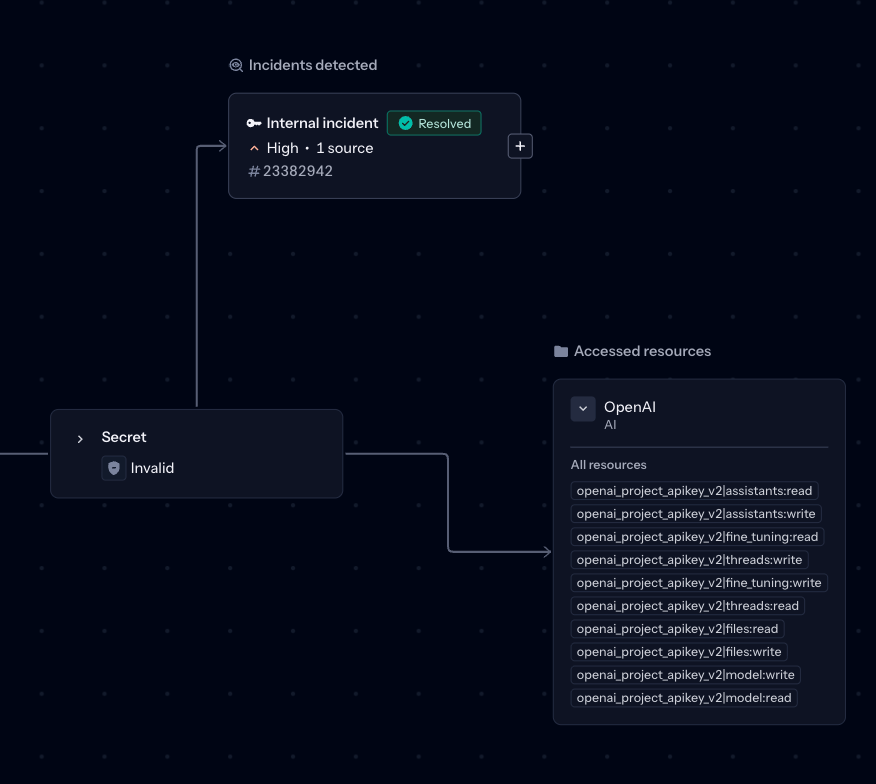
Responders use the Exploration Map to review known relationships involving the credential, its consumers, and accessed resources. The available context reveals that a production workload relies on the credential.
The platform also identifies each occurrence and, where connected sources allow, matches the credential to its vault inventory and provides associated context.
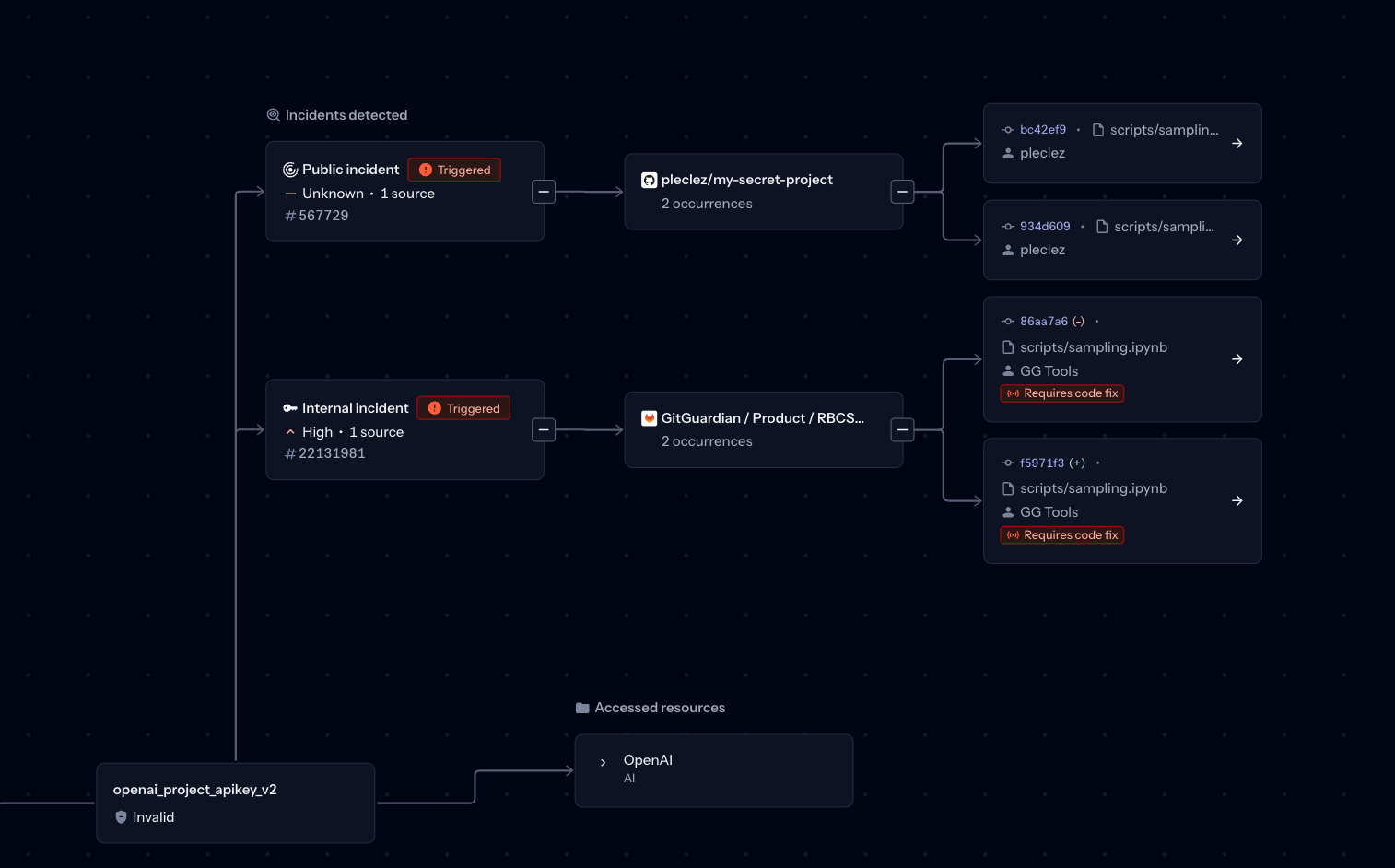
With information in hand, the security team can act with confidence or have a clear plan when they contact the responsible developer and operations teams.
Everyone involved needs to agree on a remediation plan that accounts for the production dependency. The team prepares a replacement credential, updates deployment configurations, and revokes the original credential according to the organization's approved process.
GitGuardian subsequently provides available validity and presence information to help the team verify its remediation work. The incident record preserves the actions and feedback associated with the resolution.
The same incident also reveals a broader issue: the organization has a valid credential in a vault that was copied into an unmanaged local file and committed to source control.
That discovery becomes useful beyond the immediate incident.
The security team can investigate similar patterns across other sources and use coverage and analytics information to determine whether additional preventative controls or improvements to developer workflows are needed.
One incident has generated the context needed for a safer remediation decision and evidence that can improve the larger credential security program.
Start with the credentials you already have
Security teams can only remediate credential risks effectively when they understand what those credentials do and how they are connected to the business.
GitGuardian brings credential discovery, contextual analysis, remediation support, and prevention together across the enterprise.
For responders, that means spending less time assembling basic facts and more time coordinating the actions that reduce risk.
For developers and operations teams, it means receiving better-informed remediation requests that account for the systems they maintain.
For security leadership, it means gaining a clearer understanding of exposure, credential management maturity, and whether security investments are producing measurable improvements.
The credential layer will continue expanding as organizations build more software, adopt new infrastructure, and introduce increasingly autonomous AI workflows.
The organizations best positioned to manage that growth will be those that can consistently turn credential discoveries into informed decisions and lasting risk reduction.
We invite you to take a tour of the GitGuardian platform.
If you are ready to move ahead and improve your credential layer security, you can go ahead and book your demo.
FAQ
Why does an exposed credential stay a standing risk?
Possession of a leaked credential may be enough to authenticate and act as the compromised identity, and static plaintext credentials typically stay valid for a long time. GitGuardian's State of Secrets Sprawl 2026 research found that 64% of secrets confirmed valid in 2022 were still valid when retested in January 2026.
Where does GitGuardian detect exposed credentials?
GitGuardian monitors private repositories, CI/CD pipelines, container images, cloud configs, collaboration tools such as Slack, Jira, Confluence, and Google Drive, public GitHub including developers' personal repositories, and developer endpoints.
Through ggscout, it also connects to secrets managers to build a credential inventory and spot credentials that never reached the vault or were copied out of it.
How does GitGuardian help security teams investigate an exposed credential?
GitGuardian enriches each incident with the secret type, occurrences, validity, source, and permissions. Secret Analyzers show the access a credential grants, and the Exploration Map shows its known consumers, accessed resources, secrets managers, and related incidents. Incident risk scores combine that context and explain what drives the prioritization.
How can teams remediate an exposed credential without breaking production?
Start by understanding what depends on the credential before revoking or rotating it, because removing it from service blindly can interrupt production or break pipeline builds.
GitGuardian provides ownership and dependency context, workflow integrations such as Jira and ServiceNow, and provider-specific revocation where available. For credentials outside approved vaults, Push-to-Vault helps move them into managed storage.
How do you verify that a credential incident is actually resolved?
GitGuardian can recheck validity for supported secret types and confirm whether known occurrences still exist in monitored sources. The Closed but valid incident view lets teams revisit incidents whose credentials are still reported as valid, which separates administrative completion from evidence that the credential can no longer authenticate.
Does Developer Endpoint Protection send my plaintext secrets to GitGuardian?
No. Detection happens locally on the machine, and the tooling only sends hashes and finding metadata to the GitGuardian platform. Findings are evaluated by machine, severity, and validity, and the tool can be deployed across a fleet through MDM platforms like Jamf, Intune, or Iru (formerly Kandji).
 Dwayne McDaniel