Align your AI pipelines with OWASP AI Testing principles using GitGuardian’s identity-based insights to monitor, enforce, and audit secrets and token usage.
Artificial intelligence (AI) is becoming a core component in modern development pipelines. Every industry faces the same critical questions regarding the testing and securing of AI systems, which must account for their complexity, dynamic nature, and newly introduced risks. The new OWASP AI Testing Guide is a direct response to this challenge.
This community-created guide provides a comprehensive and evolving framework for systematically assessing AI systems across various dimensions, including adversarial robustness, privacy, fairness, and governance. Building secure AI isn't just about the models; it involves everything surrounding them.
Most of today's AI workflows rely on non-human identities (NHIs): service accounts, automation bots, ephemeral containers, and CI/CD jobs. These NHIs manage the infrastructure, data movement, and orchestration tasks that AI systems depend on. If their access is not secured, governed, and monitored, AI testing becomes moot, because attackers won't go through the model; they'll just go around it.
Let's take a look at the underlying concepts found in the OWASP AI testing guide and see where their advice aligns with the goals of secrets security and NHI governance that many teams are already pursuing.
A Look At OWASP AI Testing Dimensions
The OWASP AI Testing Guide outlines several core dimensions of AI risk, ranging from security misconfigurations to data governance and adversarial resilience. While model-level testing often dominates the conversation, a substantial portion of these risks can be traced back to how non-human identities and secrets are managed across systems.
Security Testing: Secret Exposure and Misconfiguration
Security testing within AI environments must begin with how secrets are provisioned, stored, and exposed. Testing whether environment variables are protected, whether CI/CD pipelines are injecting secrets, or whether model-serving infrastructure leaks sensitive access tokens is as critical as testing model outputs.
One of the key aims of the OWASP AI Testing Guide is to ensure that principles of least privilege and zero-trust govern secrets. The goal is that no component of an AI system is granted excessive, unmonitored authority. Privacy and data governance require a similar approach. If training datasets are sourced through APIs or repositories secured only by embedded credentials, those access paths must be tested as part of the system’s privacy posture.
Credential leaks may allow unauthorized users to access training data, increasing the risk of privacy violations or model inversion attacks. Mapping the relationships between NHIs and data access points is essential for understanding whether AI systems truly comply with privacy requirements.
Adversarial Robustness: Supply Chain and Agent Integrity
Adversarial robustness isn't limited to inputs crafted to confuse a model. It also encompasses how external agents and third-party tools are integrated into AI workflows. These components often depend on tokens or secrets for authorization. If these credentials are stale, over-scoped, or reused across components, attackers may not need to exploit the model directly; they may instead compromise the plugin or container that surrounds it.
Especially in a world where we are watching 'vibe coded' systems hit production, ensuring that these dependencies are tested for secret hygiene is a foundational security task.
Monitoring and Governance
Finally, this new testing guide underscores the importance of monitoring and governance. Ongoing visibility into how secrets are being used, rotated, and revoked forms the backbone of an enforceable AI security policy. Testing shouldn’t stop at initial deployment; it must continue as environments evolve. Observability across non-human identity usage, alerting on unauthorized access attempts, and retaining historical timelines for credential use and exposure all support a test-driven approach to governance.
The OWASP AI Testing Guide calls for a layered approach to security, one that doesn’t just focus on models but addresses the full environment of access, automation, and identity that enables them. Secrets and NHI management are no longer supporting concerns; they are central to whether AI systems can be trusted and tested effectively.
Understanding the Four-Layer Testing Framework in Practice
The OWASP AI Testing Guide establishes a comprehensive four-layer testing methodology that extends far beyond traditional application security assessments. Each layer, AI Application, AI Model, AI Infrastructure, and AI Data - presents unique challenges for secrets management and NHI governance that organizations must address systematically.
At the AI Infrastructure Layer, testing focuses on container orchestration, cloud service configurations, and CI/CD pipeline security where secrets are most commonly exposed. The AI Data Layer requires rigorous testing of data access patterns, API authentication mechanisms, and storage encryption keys. Meanwhile, the AI Application Layer demands evaluation of how user-facing components handle authentication tokens and service-to-service communication credentials.
GitGuardian's unified secret inventory directly supports this layered approach by providing visibility across all four dimensions simultaneously. Security teams can trace how a single compromised API key might impact multiple layers—from data ingestion pipelines to model serving infrastructure—enabling comprehensive risk assessment that aligns with the OWASP AI Testing Guide's holistic methodology. This cross-layer visibility ensures that testing efforts address the interconnected nature of modern AI systems rather than treating each component in isolation.
GitGuardian’s Role in Building a Policy-Driven AI Security Culture
This newest testing guide from OWASP emphasizes that truly securing AI systems means building ongoing, infrastructure-aware processes, not just applying reactive patches. For organizations to succeed here, policies must be enforceable, and enforcement must be measurable and effective.
This is where GitGuardian's NHI-focused approach becomes critical.
Insights Into Your NHI Inventory
At the heart of GitGuardian’s platform is a unified secret inventory spanning code repositories, CI/CD pipelines, containers, and cloud environments. But visibility is only the beginning. GitGuardian also maps each secret to the non-human identity (NHI) that uses it, connecting infrastructure behavior with access governance. This allows security teams to analyze not only whether a secret exists, but also who or what is using it, and whether that usage aligns with defined policies. Truly for the first time, you can have a unified view of your NHIs no matter what form they take.
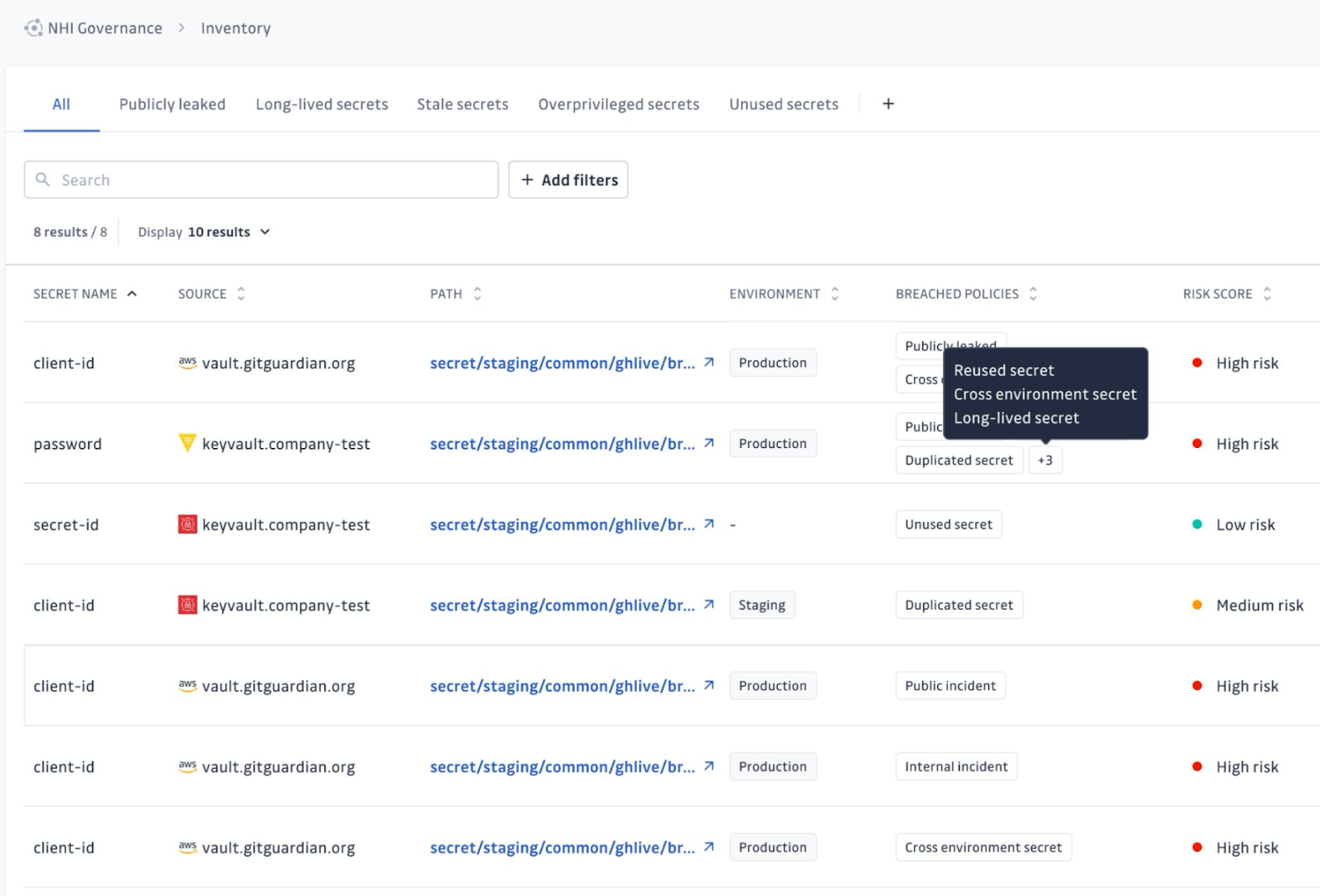
By tracking NHIs and their associated permissions, GitGuardian enables organizations to identify over-scoped tokens, detect secret reuse across different environments, and validate least-privilege enforcement. This level of insight supports proactive testing: security teams can simulate policy violations, get alerts for hardcoded secrets before they’re merged, and continuously assess compliance posture as infrastructure evolves.
Governance + Response Automation At Scale
Beyond prevention, GitGuardian strengthens incident response and long-term governance. The platform offers real-time alerting on leaked or rotated secrets, integrations with SIEM and SOAR tools for centralized response, and secret incident timelines that make root cause analysis and forensics possible. This combination of telemetry and traceability brings organizations in line with the guide’s governance and monitoring requirements.
GitGuardian doesn’t just protect secrets; it transforms how secrets are governed across AI workflows. It empowers teams to build policies around identities, enforce them consistently, and validate them continuously, ensuring that infrastructure stays as trustworthy as the AI systems it supports.
Implementing Continuous AI Security Testing with Automated Secret Rotation
The OWASP AI Testing Guide emphasizes that AI security testing cannot be a one-time activity due to the dynamic nature of AI systems and their evolving threat landscape. Continuous testing requires automated processes that can adapt to frequent model updates, infrastructure changes, and new attack vectors without compromising operational efficiency.
GitGuardian's automated secret rotation capabilities directly address this challenge by enabling continuous validation of credential hygiene across AI workflows. When training datasets are updated, model versions are deployed, or infrastructure scales dynamically, the platform automatically detects and rotates exposed secrets while maintaining detailed audit trails for compliance purposes.
This automation proves particularly critical for AI systems that operate with ephemeral containers and auto-scaling infrastructure, where manual secret management becomes impractical. By integrating secret rotation with CI/CD pipelines, organizations can ensure that each deployment cycle includes fresh credentials and removes stale access tokens that could provide persistent attack vectors. The result is a self-healing security posture that maintains the rapid iteration cycles essential for AI development while continuously reducing the attack surface through proactive credential management.
A Practical Example: Securing an LLM Pipeline with GitGuardian
To illustrate how this works in practice, consider a team responsible for fine-tuning a proprietary LLM using internal datasets. Their development workflow includes a training repository filled with scripts and configurations, Docker containers deployed through CI/CD, API integrations for querying proprietary data services, and a scheduled retraining agent with persistent infrastructure access.
This type of setup represents a rich and varied landscape of NHIs, each with its own operational scope, credential set, and unique risks. GitGuardian integrates seamlessly across these sources, detecting secrets embedded in code before they reach production, scanning container images for credentials inadvertently baked into infrastructure, and tracking API tokens as they move between environments. GitGuardian can map these secrets back to their respective NHIs.
This mapping enables the security team to ask the hard questions:
- Why does this retraining agent have access to production data and staging credentials?
- Why is a developer token being reused by an orchestration service?
- Has a critical token remained unrotated for six months across multiple pipelines?
With GitGuardian, these questions are no longer theoretical; they are answerable, auditable, and actionable.
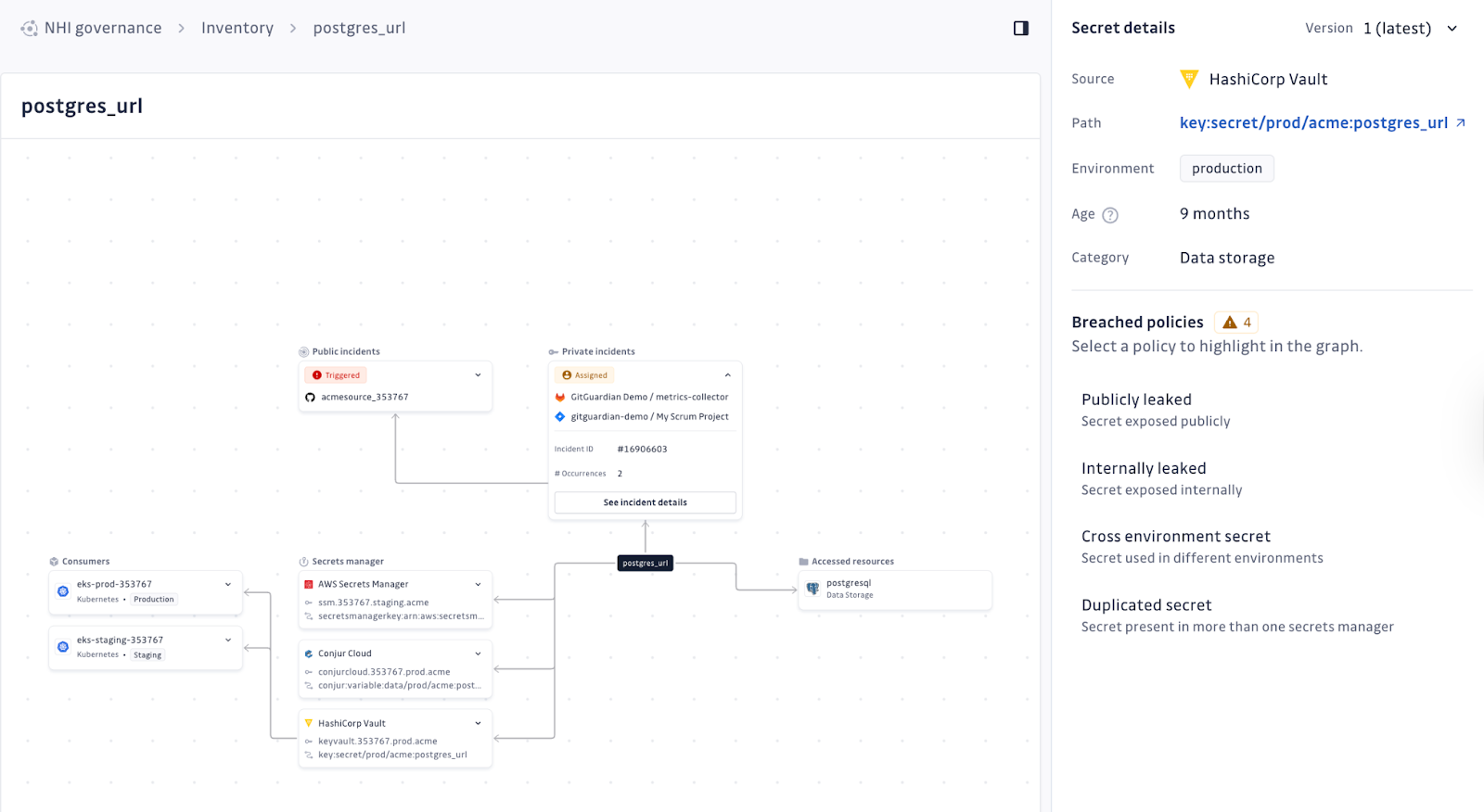
By continuously monitoring secret usage and correlating it with NHI behavior, GitGuardian transforms what would otherwise be a black box into a transparent system. It brings AI infrastructure in line with OWASP’s expectations for governance, testing, and assurance, giving teams a clear path from vulnerability identification to remediation and policy validation.
Bridging AI Governance Frameworks with Practical Secret Hygiene
While the OWASP AI Testing Guide provides comprehensive testing methodologies, organizations often struggle to translate these frameworks into actionable security policies that development teams can implement consistently. The gap between high-level governance principles and day-to-day development practices frequently leaves AI systems vulnerable despite well-intentioned security initiatives.
GitGuardian bridges this implementation gap by transforming abstract governance requirements into enforceable policies around secret usage, NHI permissions, and access patterns. For example, when the guide recommends implementing least-privilege access controls, GitGuardian's NHI governance features enable teams to automatically detect over-scoped tokens, identify unused credentials, and enforce time-limited access grants across AI infrastructure.
The platform's policy engine allows organizations to codify OWASP AI Testing Guide principles as automated rules that trigger alerts, block deployments, or initiate remediation workflows when violations occur. This approach ensures that governance frameworks translate into measurable security improvements rather than remaining as aspirational documentation. By providing real-time feedback on policy compliance, GitGuardian helps organizations maintain alignment with AI testing standards while preserving the agility essential for successful AI development initiatives.
From Testing Models to Securing the Ecosystem
AI security isn’t just about adversarial examples; it’s about building trustworthy systems, end-to-end. Your trust needs to encompass the NHIs and secrets that fuel training jobs, container deployments, and plugin integrations. That is clear from the OWASP AI Testing Guide, and we could not agree more.
GitGuardian brings this trust within reach. By building a unified inventory of secrets and mapping them to the NHIs that use them, GitGuardian enables organizations to implement security policy as a living, testable system. It equips teams to validate access controls, reduce identity sprawl, and enforce least privilege across every layer of their AI infrastructure.
For organizations looking to align with this guide or any of the Top 10 guides from OWASP, this level of control and visibility is foundational, not optional. GitGuardian turns hidden risk into actionable insight, helping security and ML teams move from patchwork defenses to proactive governance.
Ready to take the next step in securing your AI workflows? Set up a demo with GitGuardian today and see how NHI governance and secret hygiene can elevate your AI security posture from reactive to resilient.
FAQ
How does the OWASP AI Testing Guide address secrets management in AI pipelines?
The OWASP AI Testing Guide highlights secrets management as a foundational aspect of AI security. It recommends validating how secrets are provisioned, stored, rotated, and accessed across all layers of the AI stack. This includes enforcing least-privilege access, detecting secret exposure in pipelines, and ensuring non-human identities (NHIs) do not have excessive or unmonitored permissions.
What role does GitGuardian play in operationalizing the OWASP AI Testing Guide?
GitGuardian operationalizes the OWASP AI Testing Guide by providing unified visibility into secrets and NHI usage across codebases, CI/CD workflows, cloud infrastructure, and container environments. By mapping secrets to the NHIs that use them, GitGuardian enables enforcement of least privilege, detection of overly permissive tokens, and automated remediation—all core principles of OWASP’s layered testing framework.
How does GitGuardian support continuous AI security testing and automated secret rotation?
GitGuardian integrates with CI/CD pipelines to continuously scan for exposed secrets, validate their usage, and automate rotation workflows. This supports dynamic AI environments with rapid deployment cycles and ephemeral infrastructure, ensuring stale or leaked credentials are quickly replaced and compliance is maintained across evolving systems.
What is the significance of the four-layer testing framework in the OWASP AI Testing Guide?
The OWASP framework spans four layers—AI Application, Model, Infrastructure, and Data—to ensure full-spectrum security testing. Each layer introduces unique risks for secrets and NHI governance. GitGuardian’s cross-layer visibility enables teams to trace how a compromised secret impacts multiple layers simultaneously, strengthening risk assessment and response strategies.
How can organizations bridge the gap between AI governance frameworks and practical secret hygiene?
GitGuardian turns high-level governance frameworks like the OWASP AI Testing Guide into enforceable controls via automated policy checks. Its policy engine identifies over-scoped or unused credentials, enforces least-privilege rules, and provides real-time compliance insights—ensuring governance frameworks lead to measurable improvements in operational security.
Why is NHI governance critical for AI security in large-scale environments?
Non-human identities (NHIs)—including service accounts, automation bots, pipelines, and workloads—drive most operational activity in AI ecosystems. Without strong governance, NHIs can accumulate unmanaged or overly permissive secrets, becoming prime attack vectors. GitGuardian helps organizations inventory NHIs, monitor their behavior, and enforce policy-driven controls to minimize credential sprawl and privilege escalation risks.