AI Is the Newest Developer To Misunderstand Secrets In Your Git History
AI assistants are repeating a common Git mistake: committing fixes that remove secrets only from the latest code, not from repository history. GitGuardian AI Skills can help.
AI assistants are repeating a common Git mistake: committing fixes that remove secrets only from the latest code, not from repository history. GitGuardian AI Skills can help.
With these skills, any AI coding assistant, including Claude Code, Cursor, or Codex, can now scan code for secrets and provide guided remediation within developer workflows.

Using Cursor, GitHub Copilot, Claude Code, Codex, or another coding agent means giving software access to more than your code. It can also see the credentials available in your workspace, shell, config files, and development environment.
Understand where short-lived credentials reduce risk in agentic systems and where operational complexity requires stronger monitoring and governance controls.
The Mythos-ready briefing names secrets rotation, NHI governance, and honeytokens as critical controls. Zero-days don't replace credential attacks; they accelerate them. Credential security deserves to move up every CISO's priority list.
AI agents need to authenticate with numerous systems, making AI authentication a crucial security boundary that determines blast radius, revocability, and long-term governance risk.
The data from this year's State of Secrets Sprawl report shows that AI is not creating a new secrets problem; it is accelerating every condition that already made secrets dangerous.
Anthropic's Claude Code Security launch sent shockwaves through cybersecurity markets. As GitGuardian's CEO, here's why I believe the real battle has shifted from code vulnerabilities to identity and secrets management in the AI era.
In this article, we will explore the hot topic of securing AI-generated code and demonstrate a technical approach to shifting security left for cloud AI agents by using Model Context Protocol (MCP) tools.
I built a demo showing how to wire up multiple AI agents using Google's Agent Development Kit (ADK) and the A2A protocol, with GitGuardian scanning content for secrets.
We found a path traversal vulnerability in Smithery.ai that compromised over 3,000 MCP servers and exposed thousands of API keys. Here's how a single Docker build bug nearly triggered one of the largest AI supply chain attacks to date.
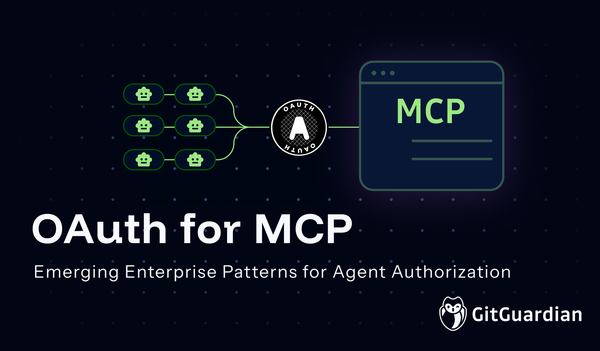
Why agents break the old model and require rethinking traditional OAuth patterns.

GitGuardian is the code security platform for
the DevOps generation.
With automated secrets detection and
remediation, our platform enables Dev, Sec, and Ops to advance together
towards the Secure Software Development Lifecycle.
Subscribe to our newsletter to receive the latest content and updates from GitGuardian.