If you run an application security program in 2026, secrets detection can look like a solved line item. Your static analysis suite ships rules for hardcoded credentials. Your code platform's built-in scanner flags API keys on push. So when someone asks if SAST and DAST are enough for secrets security, the reasonable response is: yes.
That answer holds only if a leaked credential behaves like any other finding. Spoiler alert: it doesn't.
Static application security testing (SAST) and dynamic application security testing (DAST) find vulnerabilities an attacker could exploit: an injection path, say, or a broken access control. A vulnerability finding identifies a condition an attacker may be able to exploit. A valid leaked secret requires no exploit. It is an authentication mechanism that already works, and it can spread far beyond the code those tools scan.
Nobody has to find a flaw or write an exploit; they copy the key and log in. Last year, credential abuse showed up in 39% of breaches, not just as the way in, but as the means to move laterally and reach the target once inside. Potential risk and active access are different problems, and tools built for the first were never meant to carry the second.
What static application security testing (SAST) and DAST do well
Static and dynamic analysis earned their place in the stack by answering a foundational question: where can this application be made to behave in ways it was never intended to?
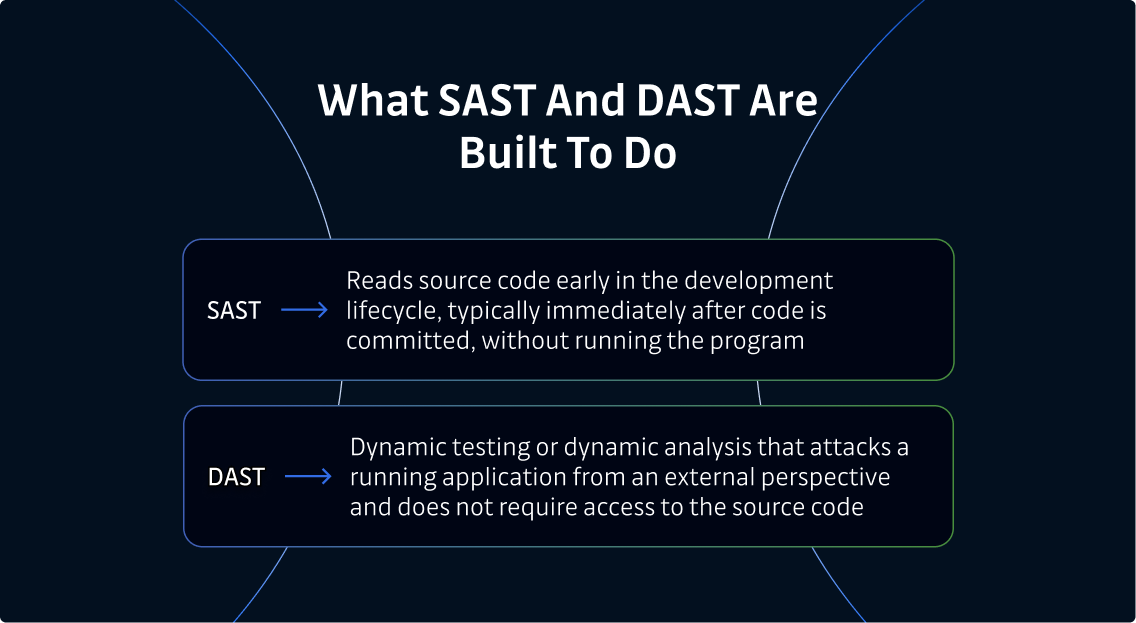
SAST analyzes application internals without executing the application, often through IDE, pull-request, and CI scanning, catching injection flaws and unsafe patterns while they are still cheap to fix. DAST tools probe the running application from the outside, surfacing runtime and configuration problems no static scan can see. Together, they take on much of the OWASP Top 10, and nothing in this article argues for removing either.
They also complement each other by design; most of the SAST vs. DAST question comes down to vantage and timing. SAST is white box testing. It reads the program's internals and can sit directly in the IDE, which keeps the feedback loop short. DAST is black box testing. It attacks from the outside the way a pentester would, agnostic to the stack underneath. One catches what the other can't.
A hardcoded secret does not behave like a conventional code vulnerability and can leave the application’s behavior completely unchanged. Even when a SAST tool detects the string, the code can compile, the tests can pass, and the build can go green while a live production key moves through places it was never meant to reach.
A vulnerability is a prediction. A valid secret is access
Vulnerability prioritization commonly combines technical severity, exploitability, exposure, and threat intelligence. A valid credential changes that calculation because authentication may already be possible without developing an exploit.
Take a SQL injection finding. Serious, worth fixing fast, and still conditional: an attacker has to find the endpoint and turn the flaw into a working attack. A live cloud key in a config file skips every step of that.
Not every leaked secret is still valid, though. Static detection alone cannot establish whether a credential remains valid. That requires provider-aware validation or other contextual evidence. More on that below.
Secrets are a credential problem that lives in code
Application security tools manage code risk. A leaked secret is an exposed credential, which makes it an access problem from the moment it leaves the developer's editor. The two disciplines sit side by side the way a web application firewall and an identity program sit side by side. Neither substitutes for the other.
So when a security team says their SAST suite already scans for secrets, the right response is agreement. It probably does. Pattern-matching a connection string is within reach of many static analyzers, and scanning git history has become table stakes for the secrets scanners built for the job.
Detection was never where this argument got decided, and without remediation, it’s just more noise.
The code-risk playbook assumes the finding and the fix both live in the codebase, and that the developer who introduced the issue owns the resolution. Both assumptions fail for credentials.
Secrets don't stay in repositories
Secrets sprawl across every surface developers touch, and most of those surfaces sit outside anything a SAST or DAST scan will ever read. The tooling's scope ends at the application. The sprawl doesn't.
The public numbers are only the visible edge. In 2025, we detected 28.6 million new secrets on public GitHub, up 34% year over year, and internal repositories are six times more likely than public ones to contain hardcoded secrets.
Inside a repository, platform scanning holds up. A pushed API key, connection string, or private token should be detected as early as possible. But the repository is only one stop in a secret's journey, and rarely the last.
A pipeline echoes credentials into its own logs. Someone attaches a config file to a Jira ticket. A database goes down at 2 a.m., and the key gets pasted into the incident channel. Every intact copy preserves the same access for as long as the original credential remains valid, and, based on our 2025 incident data, 28% of secrets incidents originated entirely outside code repositories, in collaboration and productivity tools.
And the sprawl extends beyond application source and collaboration tools:
- Container registries and image layers
- Infrastructure-as-code templates, including Terraform, Helm, and Kubernetes manifests
- AI tooling configuration, where Model Context Protocol (MCP) files alone exposed 24,008 unique secrets in 2025
- Public GitHub, through employees' personal repos, gists, and forks
The Shai-Hulud 2 supply chain attack gave researchers a rare look at what compromised developer machines actually hold: each live secret appeared in eight locations on average across the same machine, and 59% of the compromised systems were continuous integration and continuous delivery (CI/CD) runners rather than laptops. Traditional application testing does not provide comprehensive coverage across these surfaces, even when a broader suite adds selected integrations.
The same boundary problem shows up in adjacent security categories. Software composition analysis (SCA) adds dependency and component risk, while interactive application security testing (IAST) adds runtime instrumentation. Both remain centered on the application and its components rather than the complete credential lifecycle. Cloud posture tools can reveal risky permissions, configurations, and sometimes exposed keys within the cloud estate. They generally do not inventory every copy of a credential across code, collaboration systems, developer machines, and external repositories.
Git history still hides what code review cleans up
Pull-request review usually emphasizes the aggregate diff, so a secret introduced and removed in separate commits may disappear from the final change set unless individual commits or branch history are scanned. The branch history can retain every intermediate commit, including one where a secret was hardcoded and then removed before the pull request. The cleaned-up diff passes review while the credential stays in the history, clone after clone.
Secrets detection has to inspect not just what the code looks like now, but what it carried before and where that history has traveled. Once a secret enters git history, it can move with every clone, fork, mirror, and personal repository, including places the organization does not fully control.
The pattern is familiar. A developer opens a feature branch and hardcodes an API key to move fast, as in commit C in the tree below. The feature works, the branch gets tidied, the key becomes an environment variable, and the pull request shows nothing amiss. Commit C still holds the key. Squash-merging keeps the secret-bearing commit out of the target branch’s ancestry, but it does not guarantee that the object disappears. The original branch, pull-request refs, existing clones, forks, mirrors, caches, or reflogs may continue to retain it. Once a credential has been committed and pushed, rotation is still required even if repository history is later rewritten.
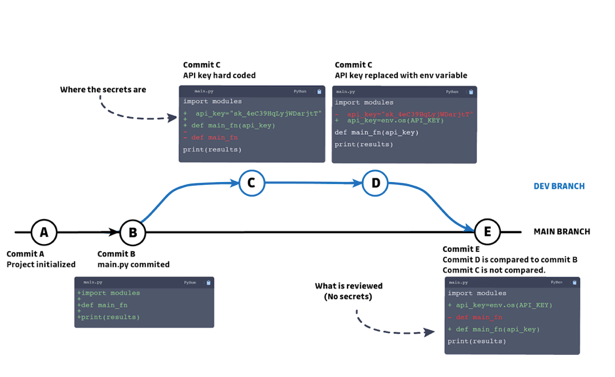
Purpose-built secrets scanners have treated history as a first-class surface for years. A conventional SAST run analyzes the revision it is given; it does not inherently enumerate every historical commit.
The gap in addressing security vulnerabilities shows up after detection
When a static analyzer flags an injection bug, the developer edits the code, and the finding closes. When a scanner flags a leaked credential, removing it from the code prevents further propagation, but it does not invalidate the credential or eliminate copies that already exist. Remediation means replacing the credential, updating its legitimate consumers, and confirming that the exposed credential has been revoked without unnecessarily breaking the systems that depend on it. That work crosses team boundaries a code fix does not touch.
At detection time, four questions decide everything, and static detection alone can answer none of them reliably:
- Is the credential still valid?
- What does it grant access to?
- Where else does it exist?
- Who owns it?
Without those answers, the alert stalls. The actual fix is operational. Replace the credential, update and verify every legitimate consumer, and then revoke the exposed credential. If active abuse is suspected, teams may need to revoke first and accept the resulting disruption. The replacement belongs in a vault rather than in another file. None of that resembles editing a line and merging a pull request, and none of it lands on a single developer.
The industry's track record on this follow-through is the most damning number in GitGuardian's research. Of the secrets confirmed valid in 2022, 64% were still valid in January 2026, four years after they first leaked. That persistence suggests many teams still lack a repeatable path from alert to confirmed revocation. The exposure may have been detectable, but the credential stayed usable. That is the difference between finding one instance of a secret and neutralizing the credential everywhere it has spread.
Context is the layer a code scanner can't produce
Prioritizing a leaked secret requires knowing whether it is valid, what it authenticates to, where else it appears, how long it has been exposed, and who owns it. A static analyzer models a secret as a string in a file, because that is what it sees. Answering those questions requires modeling it as a credential with state, checked against the provider that issued it.
Validity alone doesn't settle priority either. Roughly 46% of critical secrets have no vendor-provided validation mechanism, so exploitability has to be assessed from contextual signals: where the secret sits, what consumes it downstream, whether a copy already lives in a secrets manager, and whether the exposure is internal or public.
This is the layer the GitGuardian platform operates in. Where supported, validity is checked against the issuing provider, occurrences are mapped across connected repositories and the non-code surfaces above, ownership is attributed, and priority reflects real exposure.
Secrets are how non-human identities (NHIs) authenticate, and a program that treats them with that weight looks very different from a scanning feature bolted onto a code-quality tool.
Keep SAST and DAST, and close the gap they leave
Nothing here retires a scanner. Static and dynamic testing remain the right tools for the problem they were designed for, and the teams running them should keep investing in them.
The same is true for repository-native secret scanning and cloud posture management. They add important coverage, but each operates inside a boundary: the repository, the application, or the cloud environment. Credential exposure does not respect those boundaries.
A valid leaked secret is access that already works. It may be copied across code, history, logs, tickets, messages, images, runners, and developer machines long before anyone opens a remediation ticket.
The next time someone says the SAST suite already covers secrets, agree with them. Then ask whether it found every copy, identified the owner, and got the credential revoked before anyone else could use it.
Public GitHub is the one surface you can check in minutes, and the one an attacker checks first. See what's already exposed.
FAQs
What is the difference between SAST and DAST?
SAST (static application security testing) analyzes source code before the application runs, catching issues like SQL injection and access control mistakes early. DAST (dynamic application security testing) tests the running application from the outside, surfacing runtime and configuration flaws SAST cannot see. SAST is white box testing and DAST is black box testing. They are complementary, and most application security programs run both.
Do SAST and DAST detect hardcoded secrets?
Many SAST suites and code platforms now pattern-match hardcoded credentials, so they detect some secrets. But detection is only the first step. SAST and DAST cannot tell you whether a secret is still valid, what it grants access to, where else it has spread, or who owns it, and they do not scan the collaboration tools, pipelines, and registries where secrets also accumulate. Detection without that context and remediation leaves the access open.
Why aren't SAST and DAST enough for secrets security?
SAST and DAST manage code risk: weaknesses an attacker might exploit in the future. A leaked credential is active access risk that works right now, with no exploit required, and it spreads far beyond the repository and stays valid until someone revokes it. Those are different problems, and code scanners were never built to validate, locate, prioritize, and rotate live credentials across every surface where they leak.
Where do secrets leak outside of source code?
Secrets sprawl into every surface developers touch: CI/CD logs and pipeline variables, Jira tickets and Slack messages, container registries and image layers, infrastructure-as-code templates, AI tooling and MCP configuration files, and employees' personal GitHub repos. In 2025, 28% of secret incidents originated entirely outside code repositories, so scanning only the repo misses a large share of exposure.
How do you remediate a leaked secret?
Editing the code does not fix it, because the credential stays valid wherever it was copied. Real remediation is to revoke the leaked credential at the provider, reissue a replacement, update every consumer that depends on it, and store the new secret in a vault rather than in code. Because this crosses security, development, and operations, it needs validity, usage, and ownership context to move quickly.