
TL;DR
- Machine-speed attacks: AI agents have collapsed the time between credential discovery and abuse to near-zero, removing the human reaction window defenders used to count on.
- ChainDrop in numbers: This Shai-Hulud npm worm hijacked publishing access to hit 444 packages downloaded roughly 2 billion times per month, according to Microsoft.
- Attack path: Malicious hooks in Claude Code and VS Code trigger execution the moment a developer opens an infected branch or starts a coding session, no pause needed.
- GitGuardian's approach: The platform detects exposed credentials across the SDLC, prioritizes remediation by validity and severity, and uses Developer Endpoint Protection and AI hooks to prevent agents from accessing secrets.
There was a time, not too long ago, when defending against an attacker meant defending against a human taking turns down a kill chain over days or weeks. An attacker might exploit a system and steal credentials, but then they still had to stop, understand what they had found, and decide what to do next. Even when automation helped with individual steps, humans were still setting the pace.
Humans set the tempo, giving defenders something extremely valuable: human-scale reaction time.
Automation has collapsed the gap between discovery and abuse
Today, though, advancements in automation, driven largely by the rapid adoption of AI agents, have dramatically changed that model. Modern attacks now focus on discovering credentials, authenticating with them, enumerating accessible resources, and moving into the next phase without waiting for a person to decide what happens next.
As AI agents gain access to terminals, repositories, development tools, APIs, and other systems capable of taking actions on their own, that pace is only going to quicken. And the kill chain will continue to evolve along with it.
The attacker does not have to manually plot every additional move when the environment itself can execute the next step.
ChainDrop shows what machine-speed credential abuse looks like
One recent evolution in infosteals is the ChainDrop worm. This latest Shai-Hulud attack variant targets the npm ecosystem and automatically searches compromised developer environments and CI/CD systems for npm, GitHub, cloud environemnts, Kubernetes, Vault, and other credentials.
When it finds usable npm publishing access, it enumerates every package available to that identity, modifies package tarballs, increments their versions, and republishes them with the malicious payload. One compromised credential immediately becomes the starting point for additional malicious releases.The potential reach of ChainDrop is massive. Reports describe 444 packages from multiple publishers, collectively downloaded about 2 billion times per month, including dependencies such as keyv, flat-cache, and cache-manager, according to Microsoft.
As with almost all variants of Shai-Hulud attack, there is no meaningful pause between discovery and use. The attack propagates at machine speed.
And just like other infostealer attacks, the entire playbook depends on long-lived plaintext credentials that grant whatever uses them completely legitimate-looking authority. Once ChainDrop finds working publishing access, it uses that access to continue spreading through the software supply chain.
The whole attack is accomplished in seconds.
Exfiltration still occurs, and humans can still plan additional phases of an attack. The important change is how much damage can happen before a human needs to become involved again.
Opening an infected branch can trigger execution at the AI runtime
ChainDrop abuses the authority we grant AI agents living on developer machines in a new way, while keeping the same basic goal.
Researchers found malicious configuration placed into Claude Code and Visual Studio Code projects. In Claude Code, a SessionStart hook launched the dropper when an AI coding session began. In VS Code, a folderOpen task executes when a developer opens the infected repository.
Stolen GitHub credentials also allow the worm to push malicious configurations into branches of repositories the compromised identity can access.
Then, completely ordinary developer actions can become the trigger. If a developer opens a poisoned branch or starts an AI coding session, the attack begins executing within an environment they already trust. It happens in seconds, far faster than a human defender could reasonably react.
AI-empowered coding environments are now part of the attack surface
Agentic assistants bring a tremendous amount of value, but we need to be clear as an industry about the speed advantage attackers gain when they can abuse these automation platforms.
The AI runtime has become part of the execution environment, and it is one we must better secure. Developers increasingly grant coding agents access to repositories, local files, terminals, development tools, MCP servers, and the credentials those systems depend on.
ChainDrop is just the latest campaign showing how attackers can abuse that trusted environment. Once execution begins, defenders get no human-speed turns to react to.
AI agents have changed the credential abuse timeline
No matter what triggers code execution of any of these Shai-Hulud variants, once the malware starts, it searches local files, environment variables, shell history, cloud configurations, CLI credentials, and other locations where usable secrets can accumulate.
The credentials they find can then be used to authenticate to other services, enumerate what the compromised identity can reach, steal additional secrets, and spread the infection further.
This is the larger change AI and automation bring to credential abuse.
Traditional attack models often assume a sequence of discrete actions separated by investigation and decision-making. Agentic systems can compress those actions into a workflow. Discovery can lead directly to testing. Testing can lead directly to authentication. Authentication can lead directly to another tool call, another repository, another cloud account, or another system.
The speed comes from removing the pauses between those turns.
Valid credentials give automated attacks legitimate access
Giving your AI assistants autonomy definitely can speed up and power many useful workflows. But the same credentials make any AI-powered or triggered attacks especially dangerous because the next action can look completely legitimate.
A valid token, API key, cloud credential, or session artifact gives the system using it the authority associated with that identity. The service receiving the request sees authenticated access.
Automation can therefore move quickly through the same trusted pathways developers, workloads, and AI agents use every day.
This produces a much shorter credential abuse timeline than many security programs were built around. Detection, followed by investigation, followed by human remediation assumes there is enough time between those events to intervene. Automation increasingly consumes that window.
A discovered valid credential can become authenticated access almost immediately. The enumeration, modification, exfiltration, or propagation that follows no longer has to wait for a human in the loop.
Why credential security must start before runtime
Runtime detection remains an essential part of defending modern environments. EDR, supply chain monitoring, AI runtime controls, and behavioral detection can identify malicious activity while it is happening. They can catch unusual processes, malicious tool chains, unexpected network activity, prompt manipulation, and other behaviors defenders could not completely predict beforehand.
The amount of damage those controls have to contain depends heavily on the authority available to the compromised process or agent when execution begins.
Removing exposed credentials reduces the available blast radius
Security teams, working alongside DevOps and platform engineers, need to reduce the number of usable credentials waiting for an attacker before execution ever begins.
Every revoked token, rotated key, removed secret, and constrained identity eliminates one path an automated attacker might otherwise use at machine speeds.
As the time between credential discovery and credential abuse gets shorter, preparation becomes more important.
How GitGuardian helps stop machine-speed credential abuse
GitGuardian's mission has always been to help teams fight secrets sprawl by cleaning up plaintext passwords, API keys, tokens, and other credentials that leak into code, local files, configuration, messaging and ticketing systems, and everywhere else developers work.
Our Credential Layer Security Platform approach helps organizations get a real grasp on the underlying issue that allows infostealers to function: standing privilege represented by API keys and other secrets.
Teams need to detect exposed credentials across the places developers and machines actually work, remediate them while there is still time to remove the access they represent, and prevent new exposures from becoming the next link in an automated attack chain.
Detect exposed credentials across the software development lifecycle
The GitGuardian platform helps teams discover exposed credentials across source code, repositories, CI/CD environments, collaboration systems, and other tools touching the software development lifecycle.
Finding the secret is only the first part of the problem. Teams also need context around validity, severity, ownership, and the identity or resource associated with that credential so they can decide what deserves attention first.
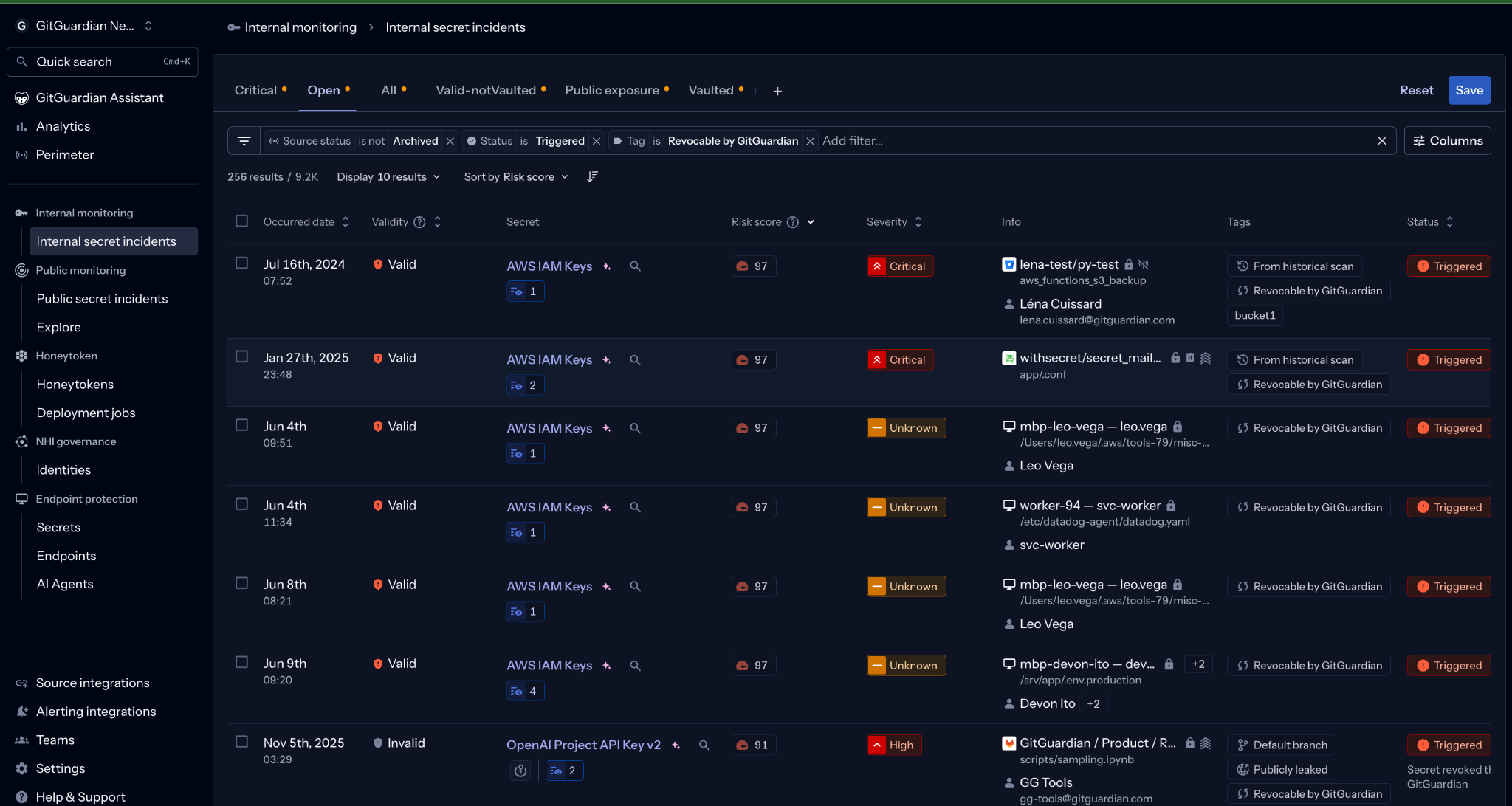
That context becomes increasingly important as the time available for remediation shrinks.
Remediate valid secrets before automated attackers can use them
Organizations need remediation plans built around shortening the time between discovery and action.
That starts with prioritization. A validated, still-active credential tied to a sensitive system deserves very different treatment from an invalid secret that no longer grants access. GitGuardian helps teams use validity, severity, ownership, and surrounding context to focus remediation on the credentials that represent real standing access.
Teams can also use Honeytokens as tripwires for faster response. When a planted credential is touched, that signal can trigger automated workflows to investigate the activity, revoke or rotate related credentials, or invalidate access, limiting the blast radius and preventing ongoing access with that key.
The earlier teams can turn context into action, the less authority remains available to the next malicious package, compromised developer tool, or automated attack chain.
Prevent AI agents and developer tools from accessing exposed secrets
Prevention becomes especially important as AI agents gain deeper access to development environments.
Credentials sitting inside files, configuration, command history, or local tooling can become reachable by an agent with permission to inspect those resources. Preventing that access gives teams another opportunity to stop the credential from ever entering the agent's context or being transmitted somewhere it should not go, such as public repos or frontend JavaScript files.
Developer Endpoint Protection secures credentials around AI agents
Developer Endpoint Protection brings credential security closer to the environments where developers and AI coding tools actually operate.
Developer machines increasingly contain .env files, cloud credential stores, shell histories, AI agent configurations, MCP configurations, and application logs that can hold usable secrets. Those locations matter even more when automated tools can inspect and act on what they find.
Developer Endpoint Protection inventories local AI agents and MCP servers and scans the locations where credentials accumulate on developer machines. This gives security teams visibility into exposed credentials that may never appear in a Git repository but can still be reachable by an AI coding environment or malicious local process.
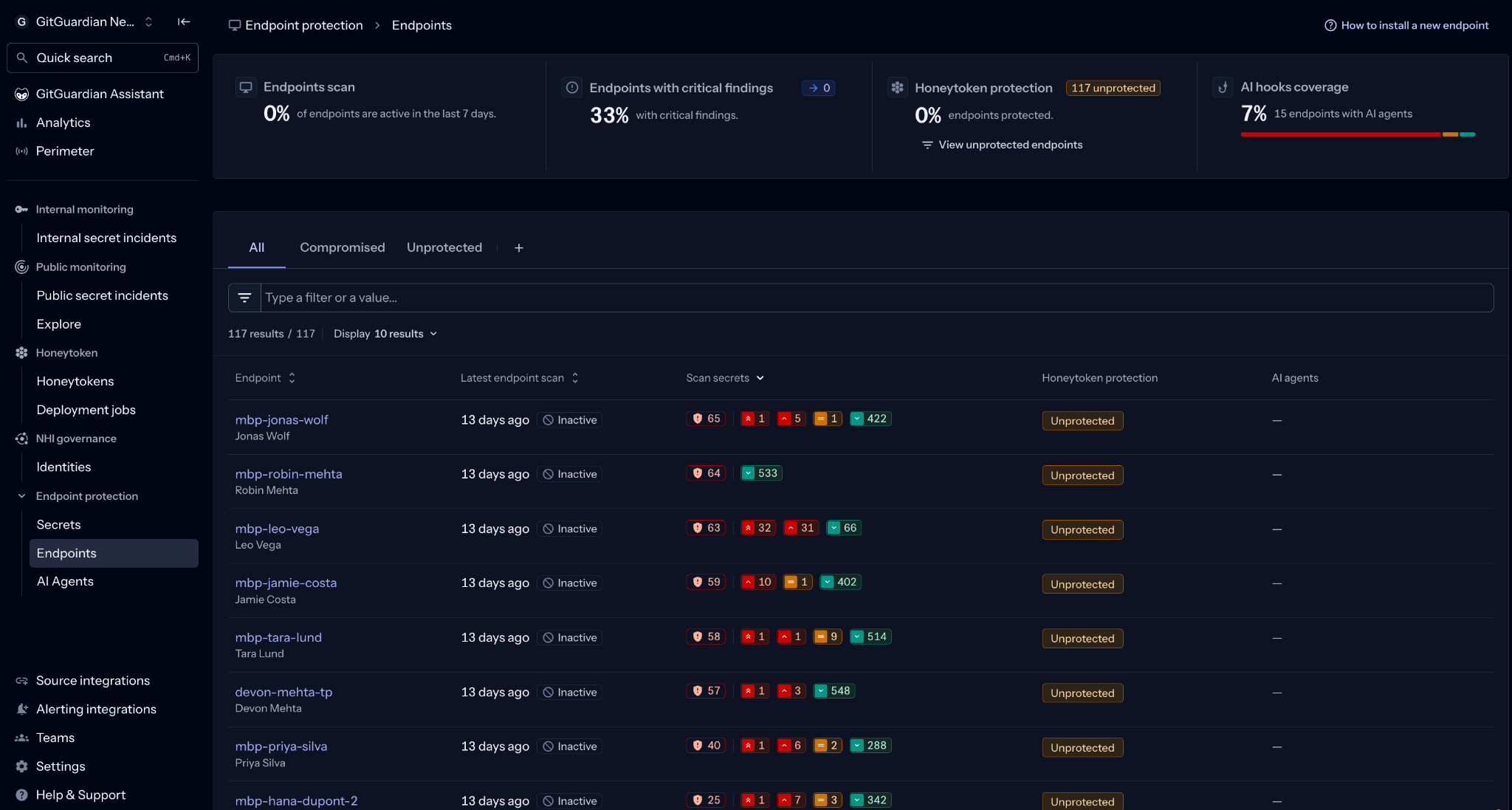
Endpoint Protection can be deployed via MDM, leveraging Jamf, Intune, Iru, and more. Scans are run on schedule, enabling organizations to extend credential detection to developer endpoints. This provides insight into the access the developer laptop holds, in what is otherwise a black box.
AI hooks prevent agents from reading and transmitting credentials
GitGuardian's AI hooks add a preventive control directly into AI-assisted development workflows.
They can stop local agents from reading, copying, or transmitting detected secrets. It does this at three steps of the agentic workflow:
It creates a guardrail at exactly the point where an agent might otherwise encounter a usable credential while inspecting files or executing a development task.
If AI runtimes are becoming part of the execution surface, as ChainDrop demonstrates, security controls also need to exist around what those runtimes are allowed to consume.
Credential security has to operate at machine speed
Machine-speed attacks reward credentials that have been forgotten, duplicated, left valid, or placed somewhere nobody thought to monitor. Agentic development expands both the number of environments where those credentials can be encountered and the number of automated systems capable of using them.
We are now in a world where the time between credential discovery and credential abuse is beginning to approach the millisecond range.
Security programs have to operate with that assumption.
Detect, remediate, prevent before the attacker gets a turn
The old security model often gave defenders a turn to react at human speed.
The new AI-driven model increasingly does not.
Credential security has to begin before execution, before propagation, and before a stolen credential becomes the next authenticated action in an automated chain.
Detect what is exposed. Remediate what remains valid. Prevent new credentials from becoming available to the systems and agents attackers are learning to abuse.
The best credential for an automated attacker to discover is one that has already been found, remediated, and removed before the attack gets its turn. And that is exactly what GitGuardian was purpose-built to help you with.
 Cybersecurity research team