TL;DR
- Vault stores, governs, rotates, and records: A secrets vault gives organizations a controlled system for storing credentials, governing access, rotating secrets, and recording how they are used. Mature secrets management best practices require both.
- Credentials copied into files, logs, and repos: The vault establishes where credentials should live. But every organization also has credentials outside that system of record. Some were created outside the approved process while others were legitimately retrieved and later copied into a local file, build log, or repository.
- One inventory, inside and outside the vault: Security teams need a living inventory of all credentials, both inside and outside the vault. They can then act on these incidents faster through automation, while providing stronger audit evidence and measurable proof that credential risk is going down.
What is secrets management?
Secrets is the all-encompassing word we use at GitGuardian for any credential, key, token or other string that can be shared in plaintext and used to access systems or unlock data. Secrets management is the practice of controlling credentials throughout their lifecycle, from creation and secure storage through access, rotation, revocation, and retirement.
A mature program needs visibility into that full lifecycle. Security teams need to know which credentials exist, where they are stored, what they can access, and whether they remain valid. That usually requires more than one category of secrets management tools.
The vault safely stores secrets and manages their use inside the approved system. Detection provides the feedback loop that shows how closely real-world credential use follows that policy.
What a secrets vault actually does
A secrets vault, like any other vault, exists to protect the contents. It does this in part by encrypting the secrets at rest and provides a centralized, protected environment that can be reached by authorized entities. People, applications and workloads can retrieve secrets when they need them through secure encrypted service calls. The vaults enforce access policies, records usage, and supports rotation.
This gives security and infrastructure teams control over the credentials enrolled in the system. A well-run vault can answer important questions about who should have access, when a credential should rotate, and where an approved credential belongs.
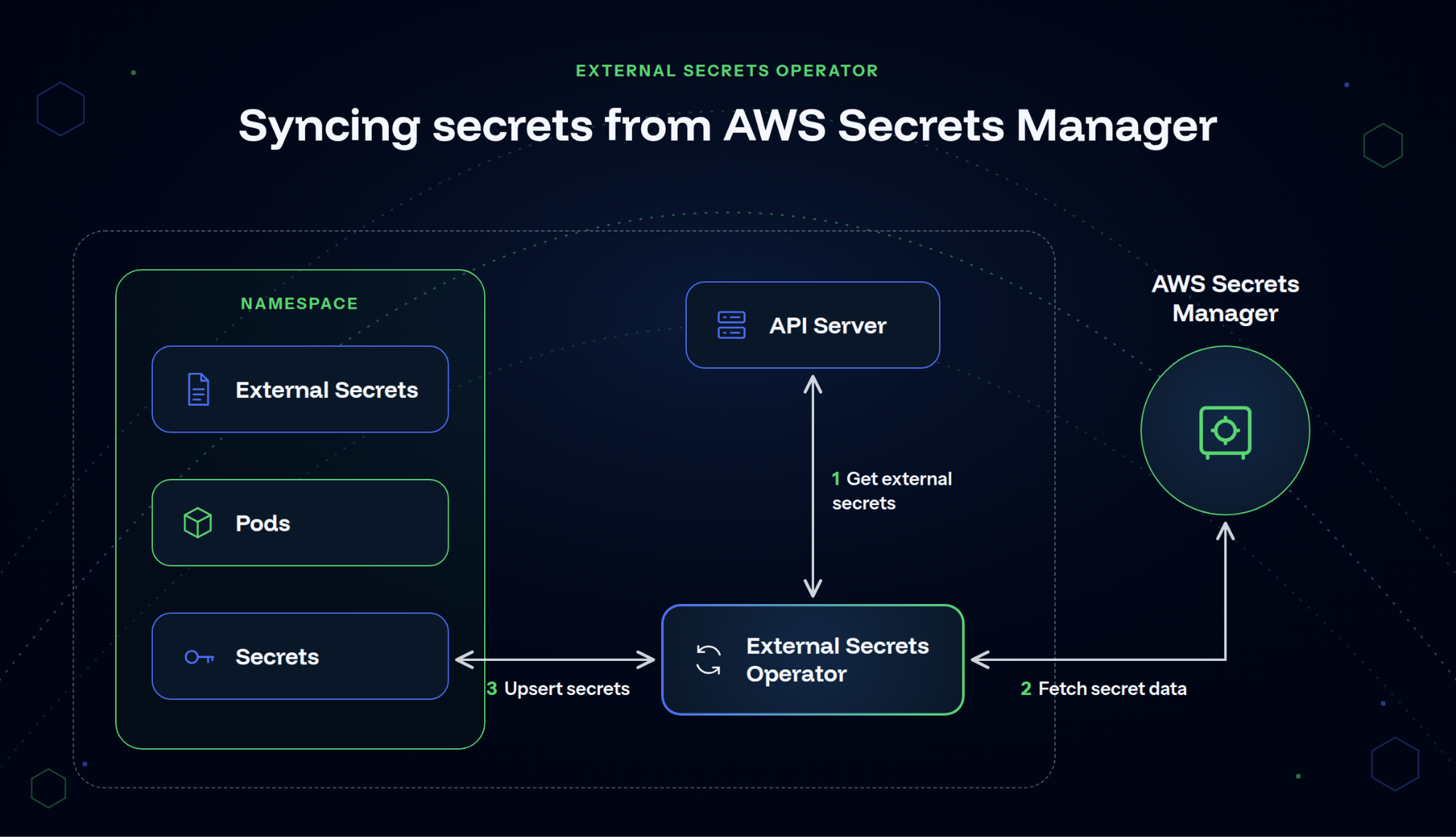
The reach of that control depends on adoption. A vault can provide insight over all the credentials registered within it, allowing teams to set policies and governance. But that is as far as it can see. Copies of those credentials generated outside the process, or created after retrieval from the vault and stored in plaintext somewhere else, create a second visibility problem.
What secrets detection actually does
Secrets detection is the process of scanning and searching for credentials throughout code, config, platforms, and everywhere else they can be stored. Secrets are continually being created during normal development and enterprise operations. Traditional detection approaches commonly start with source code and Git history, then extend into CI/CD systems and other development infrastructure.
More mature programs also scan collaboration systems, public exposure, and developer machines. These are all places where credentials can accumulate as people build and operate software.
The strongest secret scanning tools add context to each discovery. Validity checks can establish whether an exposed credential still works. Other context can help determine ownership, exposure, and whether the secret is already managed in a vault.
Total credential layer-wide scanning becomes the feedback mechanism around the vault. The vault shows the intended state. Detection measures what is happening across the wider credential layer.
6 reasons why you need both a secrets vault and a secrets detector
Vaulting and detection support different parts of the same risk management program.
The value becomes clearer when these capabilities are measured against governance, auditability, operational speed, and executive assurance.
#1 You cannot govern credential risk without knowing the full exposure
Risk management starts with inventory.
A vault gives the organization a reliable inventory of credentials enrolled in that vault. The larger credential inventory can extend far beyond it. Developers create tokens while testing integrations. Teams inherit service accounts through acquisitions. Applications and automated workloads generate credentials as infrastructure evolves.
That visibility gap can become quite large in production. In one consultancy environment, detection uncovered roughly 10,000 secrets across 42 GitHub organizations. About 99% were found in personal repositories rather than the centrally managed repositories security teams expected to monitor. This comes from the same report showing how GitGuardian found 28.6 million new secrets exposed on public GitHub in 2025, up 34% year over year.
Security teams can only govern the credential population they can see. Laptops, or developer endpoints, brings a real dilemma for teams who have spent years focused only on shared surfaces they can control.
Developer machines hold large numbers of secrets because local development requires access to cloud platforms, repositories, APIs, and other systems. Research behind GitGuardian's developer endpoint protection found around 40% of high and critical secrets discovered on endpoints in AI tool directories and log files.
Ultimately, you need to know what is both inside the vaults and outside the vaults to credibly answer the first question behind almost every risk program: what do we actually have? Then you can address the next concern of threat modeling: what are we planning to do about it?
#2 Regulators and auditors care about control effectiveness, not tool ownership
Purchasing and deploying a security control proves that the organization invested in a capability. Auditability requires evidence that the control is operating as intended.
Access logs from a secret management platform can show which identities retrieved credentials. They should also be able to easily bring up rotation records, demonstrating lifecycle controls. Teams, hopefully, can point to the policies as code they have in place to document which workloads should have access.
Detection provides evidence of the effectiveness of the broader policy around what happens to secrets before they ever reach a vault, or what happens when they leave it.
An organization may have a requirement stating that production credentials belong in an approved vault. A mature audit should show how often credentials appear outside that approved system, how quickly those exceptions are identified, and what happens after discovery.
From a risk-assessment perspective, reporting the percentage of known credentials under vault management is a better measure than the count of secrets in the vault. It can show trends in newly exposed credentials and average remediation times. It can also demonstrate whether previously exposed credentials remain valid.
These measurements give organizations stronger evidence for frameworks and certifications such as SOC 2 and ISO 27001. They also give internal audit teams a clearer way to evaluate whether secrets management policies are working across real development environments.When an auditor shows up after an incident, they are not likely to ask, "Do you own a vault?" That is table stakes for any organization managing enterprise infrastructure in the modern era. Their questions will examine whether credential access is controlled, whether exceptions are discovered, and whether those exceptions are resolved.
The vault documents the managed process. Detection measures where reality deviates from that process.
#3 Faster discovery shrinks the window between exposure and remediation
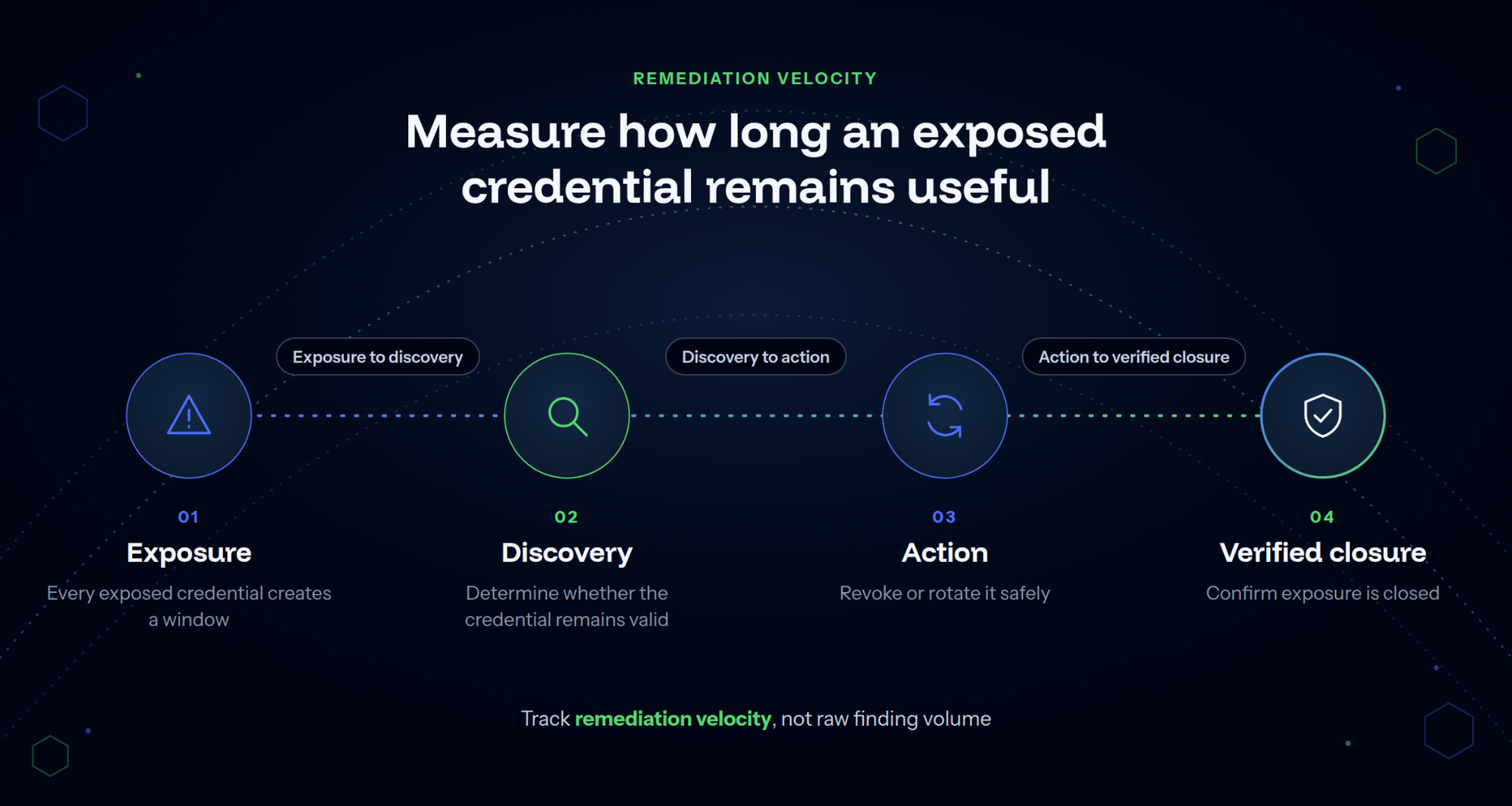
Every exposed credential creates a window during which someone else could use it.
Attackers are well aware that credentials appear somewhere they should not. Finding these credentials is a known part of playbooks and is central to the MITRE ATT&CK framework. There are many examples of attackers succeeding and getting as far as they did precisely because secrets commonly exist outside the vault. Organizations need to constantly discover the exposures, determine whether the credentials remain valid, understand what depends on it, and then revoke or rotate them safely.
Your maturity around scanning and discovery determines how long that process can remain invisible.
Long-lived credentials make delayed discovery particularly dangerous. The State of Secrets Sprawl 2026 found that more than 64% of credentials confirmed valid in 2022 were still valid in January 2026.
A credential exposed once can therefore remain useful for years.
Deleting the visible copy also provides limited assurance. The credential can remain in Git history or another location. Its underlying access remains available until the credential is revoked, expired, or otherwise made unusable.
Any scan needs to have validity checks to help responders identify which findings still represent active access. Vault context can then show how the credential is managed and support the rotation or revocation process.
This creates a much more useful operational metric than raw finding volume: remediation velocity.
Security leaders can measure time from exposure to discovery, discovery to action, and action to verified closure. Improvements in those measurements show that the organization is reducing the amount of time an exposed credential remains useful.
Outside of the security viewpoint, DevOps and product teams should be working to engineer systems that do not require heavy lifting for secrets incident mitigation. Faster detection ultimately supports faster engineering, but preventative engineering means there is less possible disruption. For example, if teams architect in vault use, green/blue deployment strategies, and enforce it through the build process, any secrets rotation should be invisible and painless.
Teams end up spending less time fixing systems months after the original exposure and more time deploying new features for customers.
#4 Credential visibility reduces the cost of incident response
A leaked credential immediately raises several questions. Is it still valid? Who owns it? What does it access?
Credential incidents become more expensive when responders have to discover basic facts during the response in real time. Unfortunately, mostly due to out-of-date documentation.
But those plans rarely answer the next set of questions: What production applications depend on the credential? Will rotation break anything critical? Is this already accounted for elsewhere?
Answering those further critical questions manually consumes time from security, engineering, and infrastructure teams. That is expensive expertise pulled away from normal operations during an already disruptive event. All the while, the clock keeps ticking and the potential blast radius keeps expanding.
You can lower the cost of remediation by approaching credential layer visibility as more then just a collection of plaintext findings in a spreadsheet report with a validity field. You need the context about how the secret is used, what it accesses, and what workflows are associated with it.
Security teams should spend their fastest response cycles on credentials that still work and provide meaningful access. An expired test credential can follow a different workflow.
This is where detection volume alone becomes a poor measure of security value. Ten thousand findings create work. A prioritized set of valid, reachable, high-impact credentials gives responders a path to action.
The goal is less time spent searching during an incident and faster containment, safer credential rotation, and less disruption to the teams responsible for keeping production running.
#5 Detection should help prove that remediation actually reduced risk
Security teams need to worry about both resolving the incident and resolving total credential exposure. Those are different measurements.
An effective secrets management program means closing the loop.
The original finding should lead to a concrete outcome. Any exposed credentials can be revoked or rotated, depending on circumstance. Any unmanaged credentials that remain necessary can be migrated into the vault before being accounted for in code; only then can you close the incident. Copies can be finally and safely removed from the locations where they were leaked.
Security teams need to have the tools to prove they have addressed the issue and no new ones hve emerged. This is what good and continual secrets discovery provides.
Validity checking can confirm whether an exposed credential remains usable after remediation. Continued scanning can identify additional copies. Vault context can show whether a replacement credential moved into the managed process.
This is where the persistence of old secrets becomes important. More than 64% of the credentials confirmed valid in 2022 were still valid four years later. A remediation program that measures ticket closure without checking credential validity can create a false sense of progress.
With the right analytics, security eams can deliver the metrics to prove a verified reduction of risk.
Time to revoke measures how quickly usable access disappears. The percentage of valid findings successfully invalidated shows whether remediation is producing the desired outcome. Vault coverage shows whether credentials discovered outside the process are being brought under management.
These measurements connect detection directly to risk reduction. Security teams can show that they found an exposure, took action, and verified that the original access path was closed.
#6 Detection gives leadership a defensible view of credential risk
Security leadership eventually has to translate technical activity into assurance.
Executives rarely need a count of every secret found in every repository. They need to know whether credential risk is understood, whether material exposures are being addressed, and whether the program is improving.
Vault data alone gives leadership a view of the managed credential population. Detection adds the surrounding exposure that security leaders need for a fuller risk picture.
Those two sources make better executive metrics possible.
Leadership wants reports on security posture, which can be shown, in part, by tracking the percentage of discovered credentials under approved management. Teams can show leadership reports of how many valid exposures remain and how quickly they are being revoked. They can also measure how much of the development environment falls within detection coverage.
Having these metrics at your fingertips gives any team a defensible position when they discuss how they are supporting the organization's security goals with CIOs, CTOs, audit committees, and boards.
Security leads can explain where credential exposure exists and how much of it represents active risk. The same leader can show whether remediation velocity is improving and whether more credentials are moving under centralized management.
Security needs confidence that their credential security program finds real risk, prioritizes it, and removes it, while proving that progress is being made toward agreed-upon organizational goals. A mature secrets management strategy needs both a the tooling for enterprise-wide vaulting and continual discovery across all surfaces.
Secrets management best practices
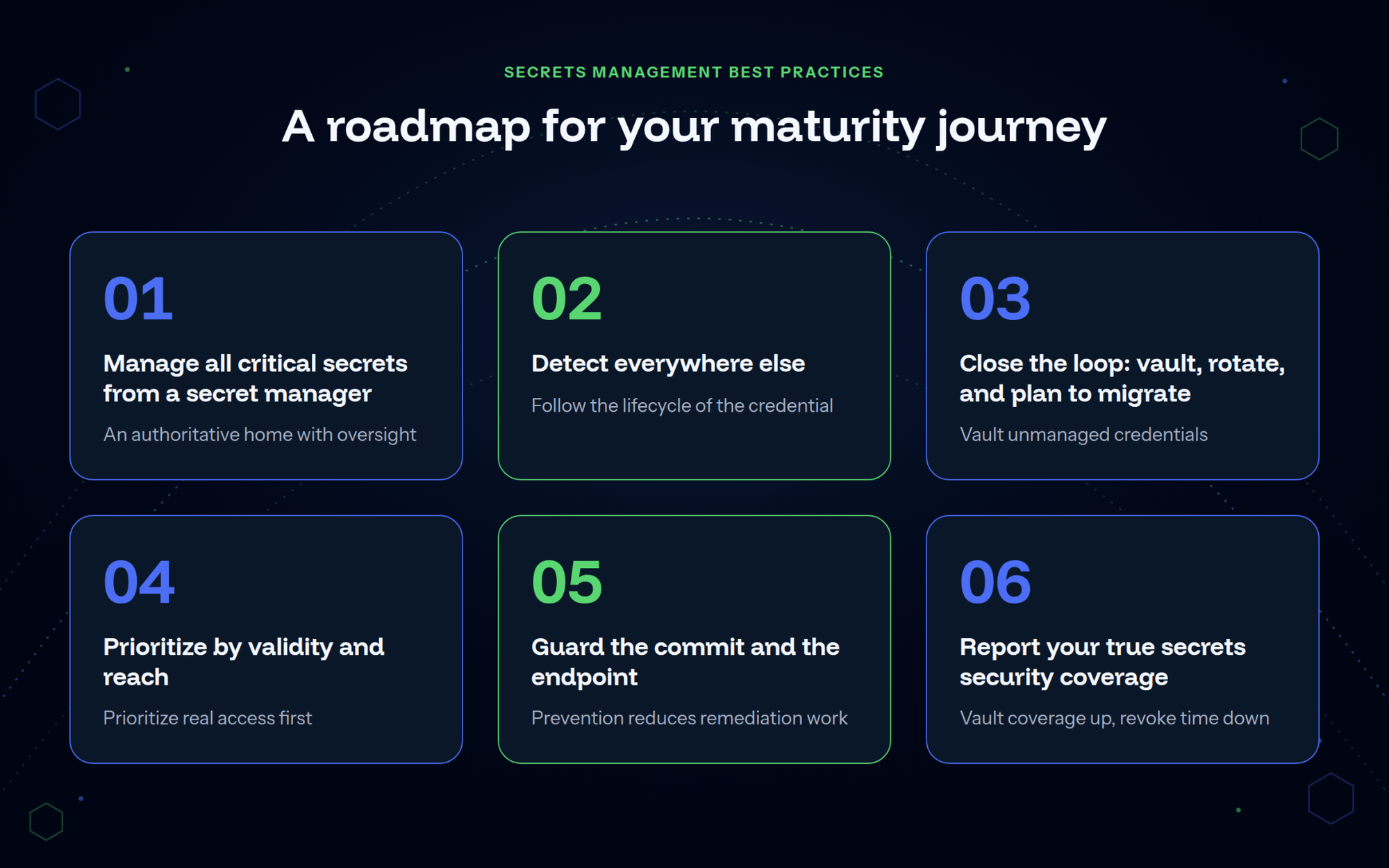
Every organization is on its own secrets management maturity journey. Use these six areas as a general roadmap:
- Manage all critical secrets from a secret manager: Any secret that can reach something critical needs an authoritative home with oversight. Scope it to least privilege, show who owns it, and keep the vault easy enough for developers to use, so they don't build workarounds.
- Detect everywhere else: Detection coverage should follow the lifecycle of the credential. While it is still vital to scan source code and Git history, teams also need to account for CI/CD systems, collaboration tools, developer endpoints, and public platforms like GitHub and DockerHub.
- Close the loop: vault, rotate, and plan to migrate: Every finding needs its own remediation plan. That likely will mean quickly rotating or revoking any exposed credentials that are already vaulted. Use tools that can automatically move any discovered unmanaged secrets into an approved vault and account for that in code. Over time, teams need to employ identity-based approaches like OIDC and SPIFFE/SPIRE that are the only real cure to reduce how many secrets need to exist at all.
- Prioritize by validity and reach: Teams need to quickly know which secrets bring the most risk. Credentials that still authenticate are a good start, but not the whole story. Just as important, especially for secrets that can not be verified, is what the key can access and how widely it was exposed to decide what comes first.
- Guard the commit and the endpoint: Good developer tooling puts controls in place that eliminate the need for later remediation work. Pre-commit hooks keep secrets out of Git history. AI hooks stop coding agents from writing or using secrets. Endpoint detection finds credentials already stored locally.
- Report your true secrets security coverage: Leadership needs to see that vault coverage is growing, and operational metrics, like time-to-revoke is falling. Auditors need to know when your SecOps workflows began and if remediation can be verified. Without an inventory to report from, these are impossible to deliver from a dashboard.
Together, these practices give you a program that can find credential risk, prioritize it, remove it, and prove the process is working.
How GitGuardian complements your secrets vault
GitGuardian provides the detection and discovery layer for the whole credential layer throughout your organization. Yes, it does safely map and inventory the secrets in your vaults. However, the platform finds credentials that were created outside the managed process and identifies copies that escaped after legitimate use.
GitGuardian provides holistic credential layer Coverage. Your team gets unparalleled visibility across source code repositories, CI/CD environments, public exposure, and developer endpoints. The platform uses specific secret detectors, finding known patterns, and generic detectors with contextual analysis, which eliminates false positives and finds secrets that don't match a fixed pattern.
Developer controls help stop new exposures closer to where they originate. ggshield is installed on hundreds of thousands of developer machines and CI/CD pipelines. We know the earlier any secrets are detected in the software development lifecycle, the easier it is to remediate. And now, GitGuardian's developer endpoint protection extends visibility into credentials already stored on local machines and inside emerging AI workflows, giving teams a way to inventory and deal with those risks before an incident occurs.
Public exposure adds another dimension. GitGuardian monitors for organizational secrets beyond repositories the company directly controls, while HasMySecretLeaked provides a way to determine whether a specific secret has appeared in GitGuardian's public exposure dataset.
Understand GitGuardian Public Monitoring more in depthIf any secret is found, the platform streamlines incident response, including context. Integrations with SaaS platforms and IdP providers, Kubernetes, and CI/CD systems to show how a is being used and what permissions it grants, helping responders retoate secrets faster. This context lets you know what systems are most resilient if a secret was to leak and where things need to be escalated during an incident.
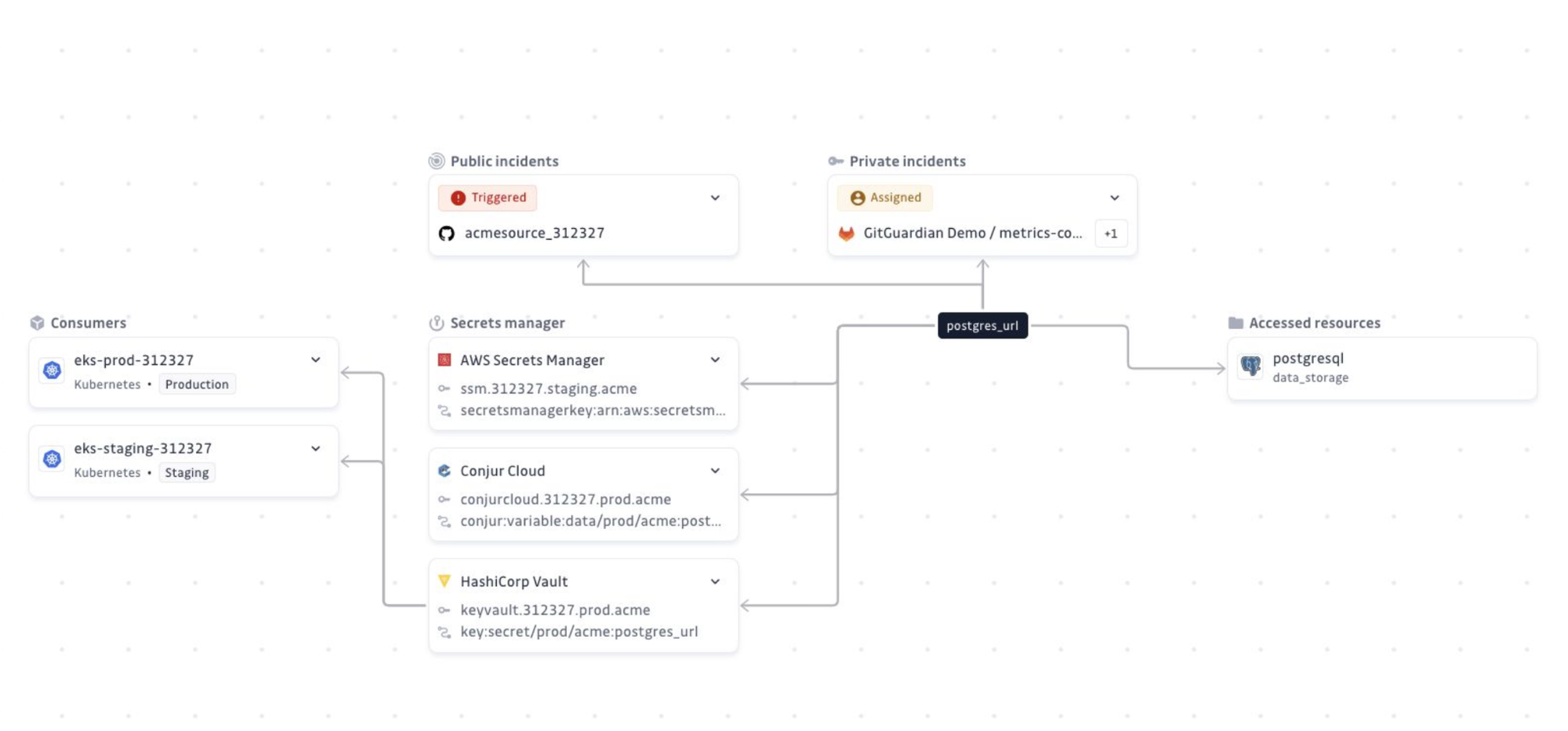
GitGuardian integrates with all leading secrets managers, including HashiCorp Vault, CyberArk, and AWS Secrets Manager. This integration works in both directions. Context helps teams understand whether a discovered credential is already managed, duplicated, or sitting entirely outside the approved process. With the platform's Push-to-Vault feature, teams can quickly move any secrets found outside proper management.
Your secrets security workflow needs to support the full credential lifecycle. Continual detection should catch every credential, wherever it appears. Teams need straightforward ways to prioritize any incidents, weeding out the low-risk ones automatically. Remediation should be automated as far as possible.
Vaulting in secrets managers remains the foundation for managing approved credentials. Detection gives security teams the visibility and evidence required to understand how well that foundation is working across the wider enterprise.
Book a demo to see how GitGuardian can complement your existing secrets vault and help measure credential risk across your environment.
FAQ
What does "secrets management" mean?
Secrets management is the process of controlling credentials throughout their lifecycle. It includes secure creation, storage, access, distribution, rotation, revocation, and retirement.
A complete program also needs visibility into credentials that exist outside approved storage. That allows teams to discover exposures and bring unmanaged credentials back under control.
Which secrets management tool is the best?
The right tool depends on the organization's architecture and the job the tool needs to perform.
Secrets vaults are designed to securely store and serve managed credentials. Detection platforms find credentials that appear outside that managed environment. Mature programs commonly use both capabilities because they address different parts of the credential lifecycle.
The GitGuardian guide to secrets management tools provides a deeper comparison of available approaches.
What is the difference between a secrets vault and secrets detection?
A secrets vault securely stores credentials and governs how applications and workloads access them. Secrets detection searches for credentials that appear elsewhere, including code, pipelines, public sources, and developer machines.
The vault provides the intended system of record. Detection measures the wider credential exposure and helps identify where policy and practice have diverged.
Do you need both a secrets vault and a secrets detection tool?
Organizations with a meaningful software development footprint benefit from both.
The vault manages credentials already enrolled in the approved system. Detection identifies secrets that were created elsewhere or copied outside that system during normal work.
Using both provides stronger inventory, faster remediation, and better evidence that secrets management policies are working.
Can secrets management be audited for security purposes?
Yes. Vault records can provide evidence around access, rotation, and credential lifecycle activity.
Detection adds evidence about credentials found outside approved management, how quickly exposures are resolved, and whether those credentials remain valid after remediation.
Together, these measurements help demonstrate control effectiveness rather than simply documenting that a secrets management control exists.
 Dwayne McDaniel
 Dwayne McDaniel
 Katie DeMatteis