TL;DR
- The problem: Service account credentials pile up with no clear owner, and teams avoid rotating them for fear of breaking production dependencies nobody has mapped.
- The checklist: Answer eight questions before rotating: validity, exposure, access scope, consumers, vault location, duplicate copies, ownership, and rollback plan.
- The fix: GitGuardian's Exploration Map links a credential to its incidents, permissions, consumers, and owner, turning rotation into a controlled change instead of a guess.
Every security team has credentials they know should already be gone.
They might want them gone because they were leaked. It might be because they are older than internal governance policies allow. They showed up in code and system config years ago. And with no clear owner, or owners who have already departed the company, nobody can remember why they still exist.
Nobody wants to touch these secrets out of fear that some mission-critical system, somewhere, might still depend on them. Touching in any way, and especially a credential rotation, might cause downtime, a very real risk teams want to avoid. After all, the "A" in security's CIA triad is "Availability."
For human access to accounts like email or CLI tools, you can usually ask the person what they use and figure out a secrets rotation plan that go through IAM or PAM tooling.
Machine identities, on the other hand, do not answer Slack requests about how they are used, nor do they raise their hands when they lose access. When a workload's secrets stop working, the whole app might stop working.
Making matters worse, their credentials may be buried across repositories, pipelines, scripts, vaults, applications, and infrastructure that has changed hands several times.
So how do we act in a way that balances the security risk with production risk?
Before you rotate a credential, you need enough context to know what will break, what could be exposed, and who needs to be involved when you make the change.
Why rotating a service account password breaks production
Machine identities now outnumber human identities by at least 109 to 1, according to Palo Alto Networks' 2026 Identity Security Landscape report. These identities include service accounts, workloads, bots, and increasingly AI agents.
Every one of those identities needs some way to authenticate.
That creates a huge credential layer underneath modern infrastructure. API keys, passwords, tokens, certificates, and other secrets get created for one workload, copied into another environment, stored in a vault, dropped into configuration, embedded in CI/CD, and occasionally forgotten altogether.
OWASP reflects the same problem in its Top 10 for Non-Human Identities. Improper Offboarding is the number one risk, followed by Secret Leakage, with overprivileged identities, long-lived secrets, and NHI reuse also appearing on the list.
GitGuardian's own research shows how long the problem can survive. Of the valid secrets GitGuardian identified in public repositories in 2022, 64% were still active when retested in January 2026.
For most orgs, answering the question of "Why would anyone knowingly leave an exposed credential active for four years?" is a real challenge. No one fully or confidently understands everywhere a service account is in use. The account might have a documented owner while the credentials appear in three repositories, two vaults, and an old script that somehow is keeping production running. Revoke the value and every live dependency finds out at once.
Credential rotation becomes a production system update, and that sounds risky to an already running system processing real customer requests.
What we need is a dependency graph view of every secret and to understand what effects any change will bring.
The service account credential rotation checklist: The eight questions to answer first
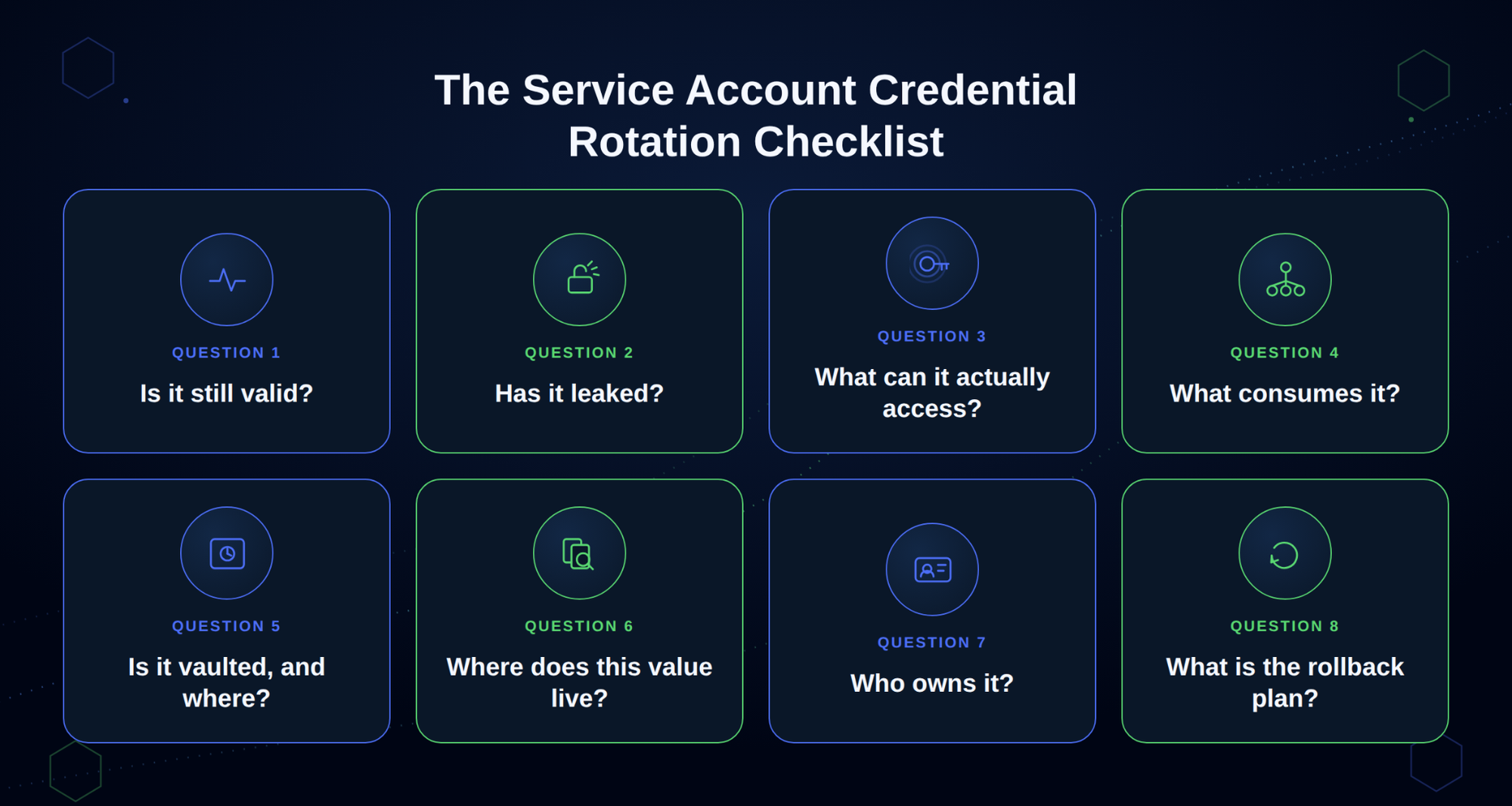
This set of questions is intended to help you standardize your processes when a service account is found to be out of policy, due to a leak, or a governance violation. If you cannot answer one of these questions, filling that knowledge gap becomes part of the remediation and secrets governance work ahead of you.
1. Is it still valid?
Usability tells you whether you are dealing with a historical artifact or a possible live security risk that might still be in use.
A credential that can no longer authenticate presents a very different operational problem from one potentially used by a production service account an hour ago.
GitGuardian uses validity as an important signal when investigating and prioritizing secret incidents, while also accounting for secrets whose validity cannot be automatically checked. GitGuardian will never mislead you if the platform can not confirm the key is active. The platform allows for API integration with any tools you might already use that can confirm if an internal key or secret is still live for a homegrown system, helping maturing teams improve their holistic posture.
But this is just one signal, and when a credential can not be validated, teams should answer the other questions quickly.
2. Has it leaked?
Exposure greatly increases the risk, and therefore the priority of remediating this secret.
A credential that exists only in an approved secrets manager can go through a planned secrets rotation process. A valid credential found in a public repository may already be available to automated attackers.
Public exposure can turn a scheduled maintenance task into incident response.
That does not remove the need to understand dependencies. It means you may have to build that understanding very quickly and accept some operational disruption to close the access path.
3. What can it actually access?
Look at the permissions the identity has today. What standing access do they allow, and what is the worst harm a malicious actor could do with those permissions?
A credential documented as read-only but attached to an identity with administrative privileges creates a much larger security blast radius. It may need faster remediation, while those same privileges increase the care needed during the change.
GitGuardian can add this permission context for supported identities and surface overprivileged NHIs as part of posture assessment.
4. What consumes it?
Map the services, scheduled jobs, pipelines, scripts, workloads, and other systems that authenticate using the credential.
This is the operational blast radius in its most literal form. Anything depending on that value can fail when the old credential stops working.
One service account can have multiple consumers, especially after years of copied configuration and shared automation. Find those dependencies before they find you during the secrets rotation.
5. Is it vaulted, and where?
Determine if the credential has a managed "source of truth." This is where security teams, IAM, and DevOps overlap quite a bit.
If it already lives in a secrets manager, identify the vault and path and determine which consumers retrieve it from there. GitGuardian can identify when an exposed secret also exists in a connected secrets manager and show its storage location during investigation.
If the credential is hardcoded everywhere, avoid turning secrets rotation into an exercise in replacing one unmanaged value with another. Push the secrets into the best vault and open the pull request to account for it in code, tracking if those changes are accepted before swapping out the secret.
The goal is not just to make the next credential rotation easier than the last one; the goal should be to work across teams to move towards short-lived credentials or federated workload identity where the architecture supports it.
6. Where does this actually live?
It is vital to find every copy across every surface, from communications platforms and ticketing systems to developer laptops. One copy in the right, unexpected place might be holding up surprising parts of your applications and pipelines.
Duplicate copies complicate secrets rotation and end up consuming operations and dev teams alike. An overlooked replacement path can also leave teams believing remediation is finished when the old credential is still sitting somewhere exposed.
GitGuardian specifically tracks issues such as duplicated, reused, cross-environment, internally leaked, and publicly leaked secrets.
7. Who owns it?
This is harder to answer for most teams than they would like to admit. Finding a named, current human who can confirm why the identity exists and why it needed that access seems like a reasonable thing on the surface. But over time, as things evolve, a lot can get lost.
The person who minted the credential might not be there anymore, and even if they are, do they own the application the credential belongs to? Answers like "The team and dev that used to own this application is <name>" gives you history. You need someone who can make a decision today, though.
Ownership matters because someone has to validate dependencies, coordinate the change, and determine whether the service account should survive at all. A credential attached to an orphaned identity deserves a very different remediation plan from one supporting a business-critical workload.
8. What is the rollback plan?
There should be a plan for what happens if the credential rotation fails. Even if the previous plans were around swapping plaintext credentials in the code, there should be a set of policies in place to reduce downtime. Your plans need to also update this plan.
Many providers support multiple simultaneously valid credentials, allowing staged rotation for a safer path. Create the replacement, update consumers, verify them, then invalidate the old credential.
Where overlapping credentials are unavailable, prepare and test the restore process. Have someone watching the consumers identified earlier as the change lands.
The rollback plan should come from the dependency map. You cannot watch the right systems if you never figured out what depends on the credential.
How to see a credential's blast radius before you act
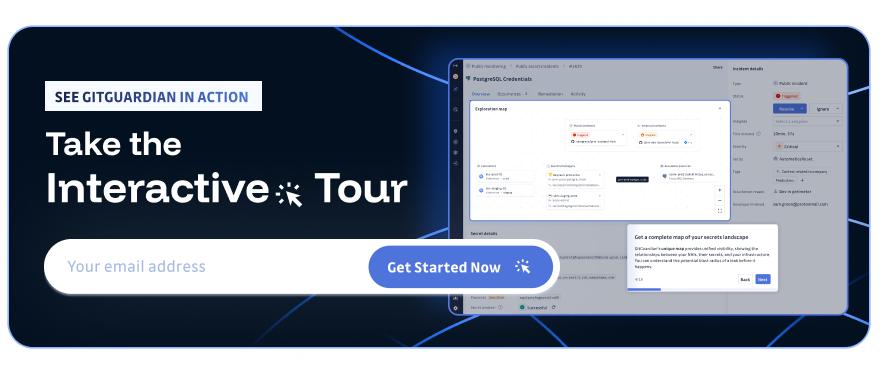
GitGuardian's Exploration Map was built to help teams answer those vital questions from the checklist.
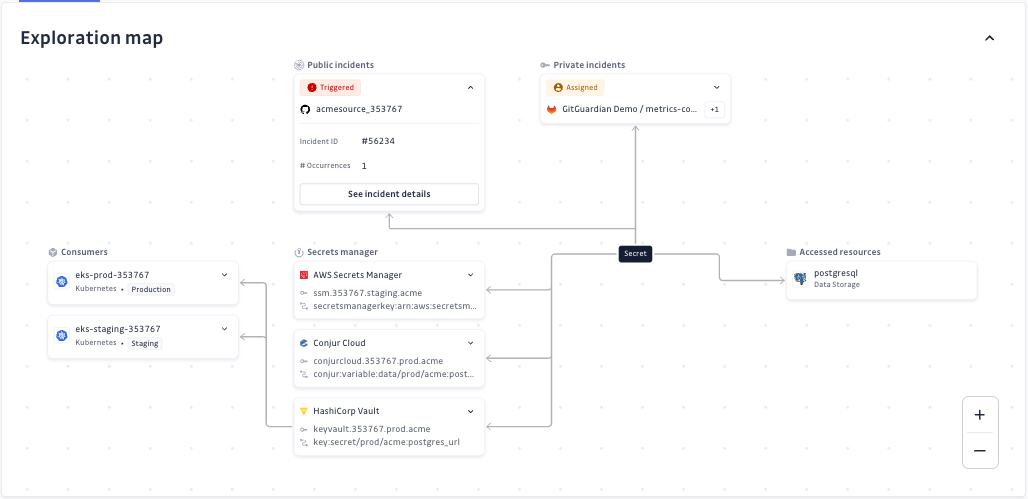
Instead of treating a secret as an isolated string found in a file, GitGuardian can connect the credential to the surrounding machine identity context.
The Exploration Map provides an end-to-end view that can include:
- Internal and public secret incidents associated with the same identity
- Accessed resources and the permissions used to reach them
- Secrets managers where associated credentials are stored
- Consumers such as services, scripts, and jobs using the secret
- Owners responsible for the non-human identity
This is how the GitGuardian platform gives teams a straightforward way to understand an NHI's connections, usage, and potential impact, including evaluating what will be affected when a secret is revoked.
That changes the starting point for rotation today and provides a reliable source of truth to build automation around for future remediation.
From one platform, you can identify affected consumers, coordinate the replacement, and verify that the old credential stops working. Along the way, you can find or assign the owner and start the conversation for moving towards better access patterns and architecture.
This is the difference between credential detection and secrets security at scale.
GitGuardian helps teams detect credentials across the places they accumulate, remediate them with the context needed to act safely, and prevent the same credentials from spreading again.
Before you rotate the next service account credential, find out exactly what is attached to it. Let's talk about how GitGuardian helps you map credential blast radius and remediate secrets with context.
FAQ
What is credential rotation?
Credential rotation is the process of replacing an existing password, API key, token, certificate, or other authentication secret with a new credential and invalidating the old one.
For machine identities, rotation also requires updating every legitimate consumer that depends on the old credential. Successful rotation ends with the old credential invalid, authorized consumers working with the replacement, and unmanaged copies removed or rendered useless.
When should secrets be rotated?
Rotate a credential when policy or its configured lifetime requires it, when ownership or access changes, when the credential is believed to be compromised, or when exposure creates a credible risk of unauthorized use.
Exposure and validity should influence urgency. A publicly leaked valid credential deserves incident-response speed. A healthy credential approaching a scheduled expiration can usually move through a planned change process.
Longer term, teams should reduce dependence on manually rotated, long-lived credentials by adopting managed secrets, dynamic credentials, workload identities, and short-lived authentication where possible.
How do you rotate a secret without causing downtime?
Start by mapping every consumer of the current credential.
Where supported, use a staged or blue/green rotation. Create a second valid credential, place it in the approved secrets manager, update applications to retrieve the new value, deploy the change, and verify that traffic succeeds before revoking the original.
Applications should retrieve the credential from a managed source rather than requiring the credential value to be changed throughout the codebase.
The sequence becomes:
Create replacement -> update managed value -> deploy consumers -> verify -> revoke old credential.
When the provider cannot support overlapping credentials, a dependency map, tested rollback, coordinated deployment, and active monitoring become even more important.
What is a credential's blast radius?
A credential's blast radius is the complete impact associated with that credential.
From a security perspective, it includes the resources, data, permissions, and systems an attacker could reach if the credential were compromised.
From an operational perspective, it includes every service, pipeline, job, script, workload, or other consumer that could stop working when the credential is rotated or revoked.
You need both views.
That is why the best question before rotating a service account credential is not simply, "Is this key old?"
Ask: Who owns it, where is it used, what can it reach, and what breaks when it disappears?
Once you can answer those questions, rotation stops being a gamble and starts looking like any other controlled production change.