TL;DR
- AI agent threat response has layers. Runtime detection watches agents in motion and catches prompt injection, goal hijacking, memory poisoning, and suspicious tool chains. Preventative, pre-runtime controls limit what credentials, systems, and authority an agent can reach before execution begins.
- Valid credentials within an agent's reach changes the response window. An agent using a legitimate API key can look completely normal until the surrounding sequence reveals something dangerous. At machine speed, that means detection may happen only after the credential has already been exercised, which is why exposed access has to be reduced before runtime.
- Mature programs address both layers, in the right order. Inventory agents and MCP servers, discover and remediate exposed credentials, enforce AI guardrails, and use honeytokens as tripwires. Then pair those controls with runtime detection for the manipulation and behavior you cannot predict in advance.
Why "AI agent threat response" means two different conversations
There are only two possible times anyone could implement a security plan. First is after something bad has already happened, when you're reacting in real time to a breach, data theft, or some other security event. The other is before that moment, when you put security controls around what systems exist, what they can access, and what any single action could do. This is always going to be true. What has changed with AI is the time scale.
AI speed in security is good in some respects, as AI-assisted SOC analysis and machine-speed response give defenders a better chance of keeping pace with attackers who themselves are constantly moving faster due to automation and AI. Runtime detection is a necessary part of modern security, and we absolutely need faster analysis to limit the blast radius and tell us when to reboot machines.
What is AI agent threat response
AI has had a serious impact on security by giving teams a new surface to worry about. In short, AI agent threat response is about reacting to and mitigating the risks AI poses to enterprise ecosystems. While this in part means monitoring for rogue behavior in the local sandbox or contained environment, the wider concern is about the impact AI agents can have on the rest of the environment.
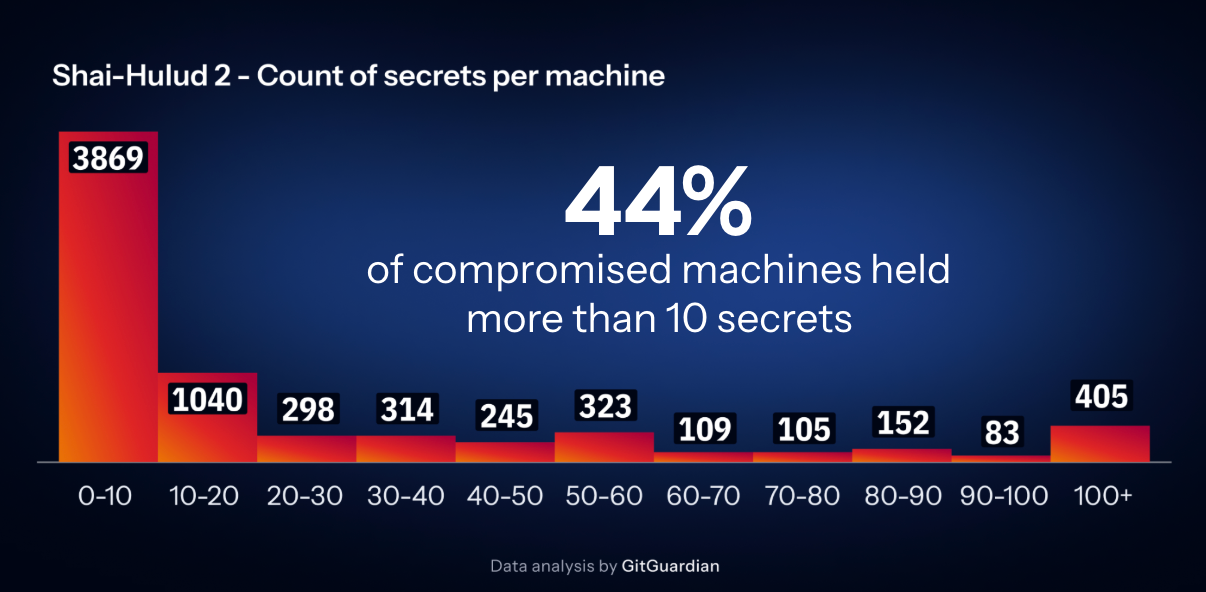
AI agents can access many other systems because they run on developer laptops, which have historically held access keys to all sorts of internal systems. GitGuardian's research into Shai Hulud and other infostealing campaigns has shown just how many secrets live on the average developer's laptop, with more than 10 valid plaintext credentials exfiltrated from over 44% of developer laptops.
AI agent threat response, in part, means securing what actions and systems the AI can reach with those credentials. If you wait until after something bad has happened, at machine speeds, that is far too late.
We need to shift our balance toward prevention rather than reaction.
Runtime detection can tell us when an agent is doing something dangerous or has already done something dangerous. Perhaps a more important question for security is: "What the agent was allowed to reach before that alert ever fired?" When an agent holds valid credentials and can autonomously use them to access or exfiltrate data, what does response even really mean?
What runtime detection does well when it comes to AI agents
Before we continue, let's clarify: Runtime detection is still an important part of securing autonomous agents, especially when those agents can reach production systems. These platforms, such as CrowdStrike's Falcon AIDR, Palo Alto Networks Cortex, and SentinelOne Singularity, monitor agent sessions, prompts, tool calls, memory interactions, and action sequences to identify behavior associated with prompt injection, goal hijacking, memory poisoning, tool misuse, and other forms of manipulation. Many of these approaches increasingly map detections to the OWASP Agentic AI Threats and Mitigations taxonomy, which provides a common way to describe threats across agentic systems.
One value of this approach is catching when several individually legitimate actions combine into something dangerous. A coding agent might normally be allowed to read files, execute commands, and make HTTP requests. A sequence such as read .env → extract credential → send HTTP request gives the runtime layer enough behavioral context to recognize potential tool misuse or goal hijacking.
The same approach can identify an agent whose behavior changes after reading malicious content, poisoned memory influencing a later decision, or one compromised agent passing manipulated instructions downstream. These scenarios align closely with the threats OWASP identifies across its Agentic AI guidance and its 2026 Top 10 for Agentic Applications. Runtime detection gives teams visibility into how those threats actually appear while the agent is operating.
Basically, these tools answer "What is this agent doing right now, and does that behavior make sense?" However, AI agents are non-deterministic by nature, so it is hard to predict and account for every conceivable path or action they could take. From a pure GenAI standpoint, that is where the real value lies. From the security standpoint, it means we need to do more than monitor and react.
The gap: a valid credential in an agent’s hands looks legitimate
Runtime detection is a real challenge when an agent is using legitimate access exactly as designed. If an agent reads a plaintext API key from an .env file or from an MCP call, and then uses that key to call an authorized API, every individual step can look normal. The credential works and the request is well-formed. Tool use may fall squarely within the agent's expected behavior so no alarms are sounded.
By the time the system has enough evidence to decide the behavior is dangerous, the agent may already have exercised the credential and reached the system behind it.
Machine speed changes the response math
AI agents shrink the time between credential discovery and credential use. A human attacker may pause to inspect what they found, choose a target, and decide what to do next. An agent can move directly through a "read-decide-act" loop and repeat that process across multiple tasks, as we saw it do in the OpenAI attack on Hugging Face.
The access mechanisms are already in agent environments. GitGuardian's State of Secrets Sprawl 2026 found 24,008 unique secrets in public MCP configuration files, including 2,117 valid credentials, while AI-service credential leaks increased 81% year over year. Supply chain incidents show the same compression from credential harvesting toward potential abuse, including the Nx "s1ngularity" attack, which harvested over 2,300 credentials from more than a thousand compromised developer systems, and Shai-Hulud-style campaigns, which demonstrated how automated compromise can spread through trusted developer infrastructure. Every valid credential that could be used to propagate the attack was used to further infect the supply chain.
Runtime detection still plays an essential role, including detecting suspicious harvesting through behavioral signals or deception such as honeytokens. Agent speed changes the response window, though, because detection may happen only after a credential has already been used.
Security teams need to put controls in place before that credential can be used, rather than relying on intervention after suspicious behavior has already executed.
Pre-runtime controls: shrink what an agent can do before it runs
Proactive security controls, implemented pre-runtime, reduce the agent's attack and abuse surface before a prompt, tool call, or credential becomes a runtime event. It starts with inventorying the agents and MCP servers running across developer environments, including what they connect to and who owns them. From there, teams need to discover the credentials within their reach, including secrets in .env files, MCP and IDE configurations, shell history, CLI caches, and AI tool data. GitGuardian's research into endpoints found that around 40% of high and critical secrets surfaced in AI tool directories and log files. A large amount of credential exposure can sit outside traditional source-code scanning.
Discovery only tells you what is exposed. The next step is remediation. This can mean revoking, rotating, or right-sizing any risky credentials before an agent has a chance to use them. Not all secrets carry the same risk, and some should not require any action. Context for each credential becomes much more important when thinking about remediation at scale.
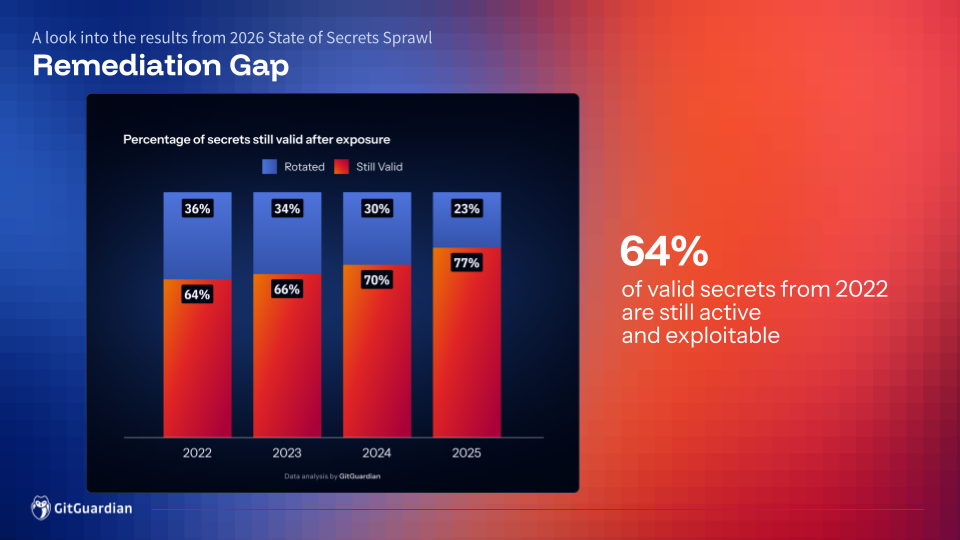
Long-lived credentials mean the risk piles up over time, so older exposures that carry the same risk might get missed if you are not looking at historical scan data. GitGuardian found that more than 64% of credentials confirmed valid in 2022 were still valid when retested in January 2026. Reducing that standing access limits what an agent can reach even when every individual action looks legitimate.
Security and development teams need to embrace guardrails and tripwires wherever agent behavior meets credentials. Policy controls via IDE tools can stop secrets from being included in prompts, read during tool execution, or transmitted through agent workflows before the action completes. Honeytokens add a complementary signal by showing when something actually reaches for a credential. Together, these controls move part of the security decision ahead of runtime response by reducing available authority and creating high-confidence signals before valid credentials become successful access.
Pre-runtime vs runtime: two layers, one timeline
Pre-runtime controls and runtime detection answer different security questions, and both belong in a complete AI agent security strategy. To understand the differences and where they overlap is to compare where each layer acts, what each one can see, and what happens when either layer is missing.
Threat modeling the agent credential plane
The current OWASP Agentic AI Threats and Mitigations is, in part, dependent on an agent having usable authority behind its actions. The newer Top 10 for Agentic Applications 2026 explicitly calls out agents misusing legitimate tools and leaked credentials, allowing agents to operate beyond their intended scope. Preventive credential controls reduce those risks by removing or constraining the access an agent can exercise.
- ASI02, Tool Misuse: Legitimate tool use becomes much more dangerous when the agent can also use valid credentials to access privileged systems. cURL in and of itself is not the danger, but using it to exfiltrate data or communicate with a C2 server most certainly is. Discovering exposed secrets and restricting agent access reduce the damage an agent can cause if it misuses them.
- ASI03, Identity & Privilege Abuse: OWASP specifically connects leaked credentials with agents operating beyond their intended scope. An old API endpoint put up for testing a few years ago and never decommissioned might still allow full access to copies of production databases. Too often, the forgotten API key sits in a knowledge base somewhere that the agent has legitimate access to. Revoking long-lived credentials, reducing standing privilege, and right-sizing access removes much of that available authority before an agent can assume or abuse it.
- ASI04, Agentic Supply Chain Vulnerabilities: Compromised MCP servers, tools, and other agent dependencies become far more consequential when they inherit credentials from the environment around them. If an agent can access a .env file or read local environment variables, it can act on behalf of the human who stored them for legitimate work purposes. Agent inventory and credential discovery expose those trust paths so teams can remove unnecessary access before a compromised component exercises it.
What good looks like: response that starts before runtime
A mature AI agent security program answers both questions on the timeline. Each practice states the control and what good looks like.
- Inventory agents and MCP servers. Build a current list of all agents and MCP servers across developer machines, with unknown ones surfaced automatically, along with ownership information and as much context as possible.
- Discover exposed credentials an agent can reach. Schedule regular scans of the locations where credentials accumulate, scored by machine, severity, and validity. Do it often, as developers often create new API keys daily.
- Revoke, rotate, and right-size. Prioritize findings by risk and blast radius. Start by tightening controls and access paths for your organization's crown-jewel assets, and work down the list based on risk scores. Adjust agent identities to be scoped to least privilege as you work.
- Enforce guardrails in agent environments. Agents need to have enforced guardrails put in place to prevent them from reading, copying, or transmitting secrets from the workstation.
- Plant honeytokens as tripwires. The goal is to receive high-fidelity alerts the moment anything reaches for a decoy credential, be they human, AI, or a malicious API call. For critical systems, this should trigger automated defensive actions like immediate session termination or credential revocation.
- Leverage runtime detection to improve policy. Behavioral monitoring of agent sessions, with alerts landing in the same response workflow as credential findings. One can drive the other, improving policy for each based on how your systems evolve.
How GitGuardian fits
The GitGuardian credential layer security platform addresses the reality of scattered secrets that determine how much authority an AI agent can exercise before runtime behavior is ever judged.
GitGuardian's Developer Endpoint Protection extends the platform's powerful credential discovery beyond code and internal systems to developer machines, where .env files, shell history, CLI caches, IDE configurations, MCP configs, and AI coding-agent caches accumulate secrets. It runs by making ggshield available to your developers and agents and can be deployed across a fleet through existing MDM systems. Developer Endpoint Protection also inventories the AI agents and MCP servers present on each machine, giving security teams visibility into the systems sharing that credential surface.
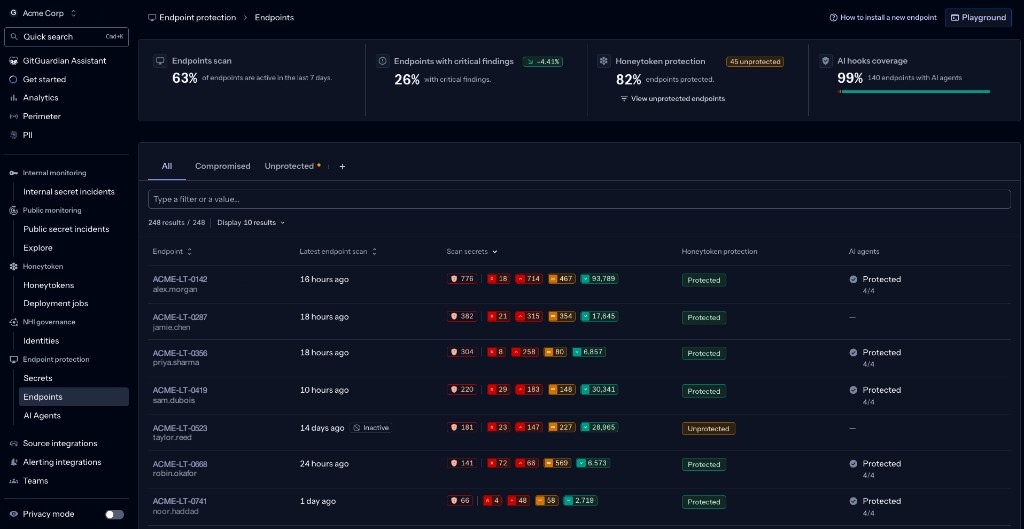
That visibility feeds the first part of the GitGuardian cycle:
Detect. Developer Endpoint Protection surfaces credentials by machine and severity, while validity checks help determine which findings still provide usable access. NHI context adds another layer by connecting those credentials to the identities, resources, and ownership relationships behind them. The result is a clearer picture of which credentials are exposed around agents, which still work, and which deserve attention before an agent ever tries to use them.
Remediate means reducing the authority those credentials represent. Teams can prioritize revocation, rotation, vaulting, and right-sizing based on validity and identity context rather than treating every exposed secret the same.
Prevent extends that control closer to the agent workflow itself. AI agent hooks can prevent secrets from being read, copied, or transmitted via supported AI coding and MCP workflows, while Honeytokens provide a high-confidence signal when something attempts to access the credential surface using a planted credential.
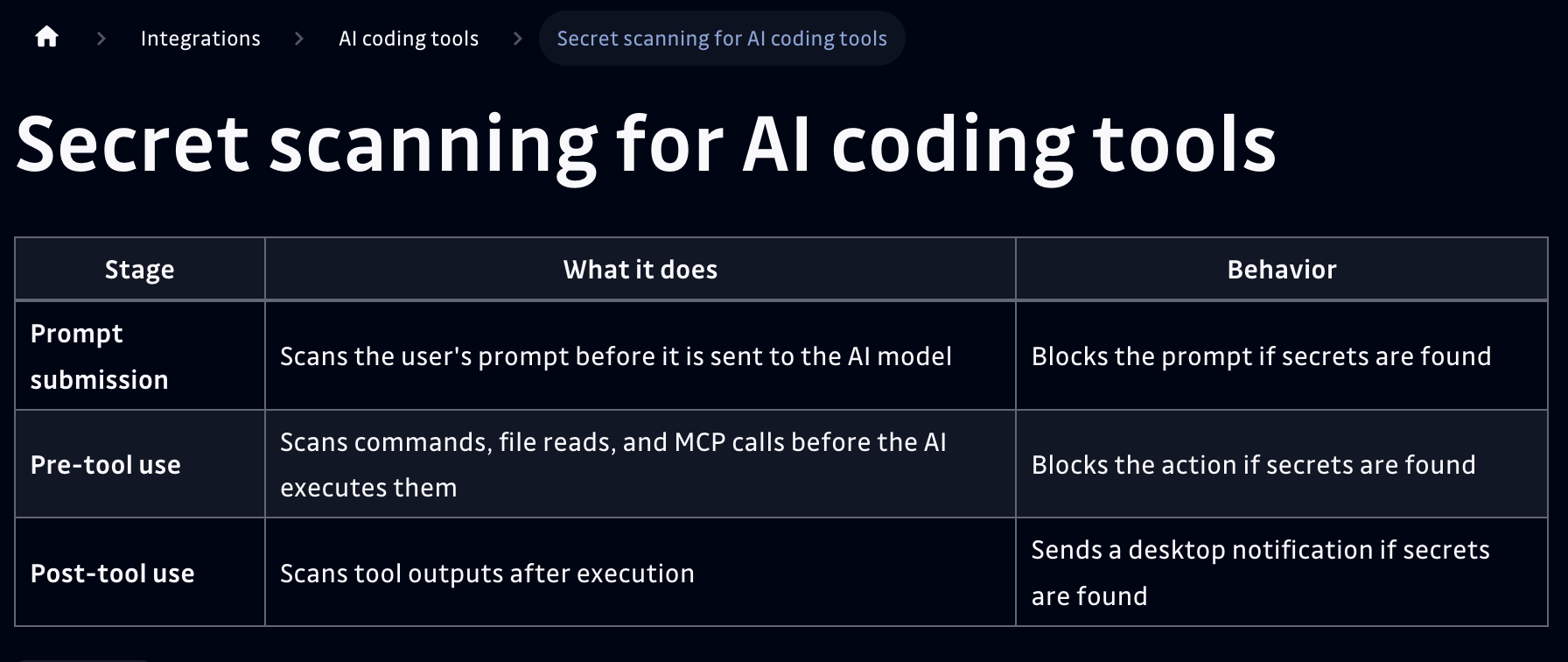
Together, these capabilities make GitGuardian part of any good pre-runtime credential security plan, alongside broader identity controls. Runtime platforms evaluate what an agent is doing during execution, while GitGuardian focuses on the credentials and authority available around that execution.
Summary: move the response window left
The rise of AI agents is forcing us to rethink where security decisions are made and where we should focus. We have spent years getting better at detecting bad behavior after it starts. That work still matters. However, agents add a new wrinkle because they can move faster, chain actions together, and exercise valid credentials without ever looking obviously malicious.
The most effective response is to reduce the amount of authority an agent can leverage in the first place. Runtime detection still needs to be in place to catch behaviors you could not predict in advance from a non-deterministic system.
GitGuardian can help you implement your pre-runtime control plans by detecting the credentials and identities surrounding agents and helping you prioritize your remediation efforts, fixing any access paths or keys that are stale, exposed, or broader than necessary. Of course, the real value comes from leveraging the automated workflow tools to prevent those credentials from leaking into agent workflows in the first place. If you are trying to get started, begin with a simple question: Which agents are running in your environment today, and what valid credentials can they already reach? Answer that, and you have the first map of your AI agent attack surface.
Start checking your agent's access today; we would be glad to help you on your journey.
FAQ
What is AI agent threat response?
Detecting, containing, and preventing threats involving AI agents: both attacks on agents (prompt injection, goal hijacking) and misuse of what agents can reach, especially valid credentials. It spans two layers: pre-runtime controls that limit what an agent could misuse, and runtime detection that monitors what an agent is doing.
Is runtime monitoring enough to secure AI agents?
It answers one of two questions. Runtime monitoring detects malicious or anomalous agent behavior during execution. It does not inventory the valid credentials sitting readable in agent configs, caches, and environment files before any session starts. A mature program runs runtime detection alongside pre-runtime credential controls.
What are pre-runtime controls for AI agents?
Controls that act before an agent executes: inventorying agents and MCP servers, discovering exposed credentials within their reach, revoking and right-sizing those credentials, enforcing guardrails that keep agents from reading or transmitting secrets, and planting honeytokens as tripwires.
What is agent-aware threat detection?
Runtime detection built to understand agent behavior: sequences of tool calls, session context, and intent, rather than single events. It complements pre-runtime controls; the fewer exposed credentials an agent can reach, the smaller the space agent-aware detection has to police.
How do AI agents misuse credentials?
Agents read what their environments expose: plaintext keys in .env files, MCP configuration files, CLI caches, and AI tool directories. A manipulated or misaligned agent can use those valid credentials in well-formed API calls that look legitimate, which is why exposure has to be removed before execution.
What does OWASP say about agentic AI threats?
The OWASP Agentic AI Threats and Mitigations guidance catalogs threats specific to autonomous agents, including tool misuse and privilege compromise. Several of the listed threats are credential-mediated: they depend on an agent holding or reaching credentials it should not, which is what pre-runtime controls remove.
Do I need both pre-runtime controls and runtime detection?
Yes, if you want both questions answered. Pre-runtime controls determine what an agent could misuse; runtime detection catches manipulation while it happens. They cover different points on the same timeline, so they work together rather than one substituting for the other.
How is this different from agentic AI for threat detection?
Agentic AI for threat detection uses AI agents to automate SOC work. AI agent threat response, the subject here, secures the agents themselves and what they can reach. The phrases look similar; the buying decisions are entirely different.