TL;DR
- "Endpoint protection" is often heard as EDR: When buyers hear "endpoint," they think antivirus or EDR. Antivirus started as signature-based malware detection; EDR added continuous behavioral monitoring and response. Both are designed to detect and stop malicious activity on the machine.
- Credential security asks a different question: Neither antivirus nor EDR can tell you which valid credentials are exposed on a machine right now. That's credential security.
- A mature program needs both: EDR asks whether something malicious is happening. Credential security asks which secrets are exposed - and, just as importantly, helps you fix them by rotating, redacting, and preventing that exposure, not just inventorying it.
This article draws the line between the two and explains why a mature endpoint program runs both.
Why "endpoint" is a loaded word
For two decades, endpoint protection meant detecting malicious activity. Antivirus came first, then EDR, and finally, XDR. The whole lineage is about malware and behavior. When a new tool says "endpoint," buyers reasonably hear "EDR agent."
But the endpoint holds something this lineage was never built to protect: the credentials themselves. Cloud keys, API tokens, and SSH keys sit in plaintext across developer machines, in .env files, shell history, CLI caches, and increasingly, AI tool directories.
Protecting your machines from malicious activity and knowing which secrets are exposed on them are two different jobs. And the second one needs its own control.
That's why GitGuardian launched Developer Endpoint Protection. The Developer word is deliberate: this is the credential layer of the developer machine, not another behavioral agent for the fleet.
What EDR does, and does well
EDR is continuous behavioral monitoring and response on the endpoint. It watches processes, memory, file operations, and network activity, then detects and contains malicious behavior.
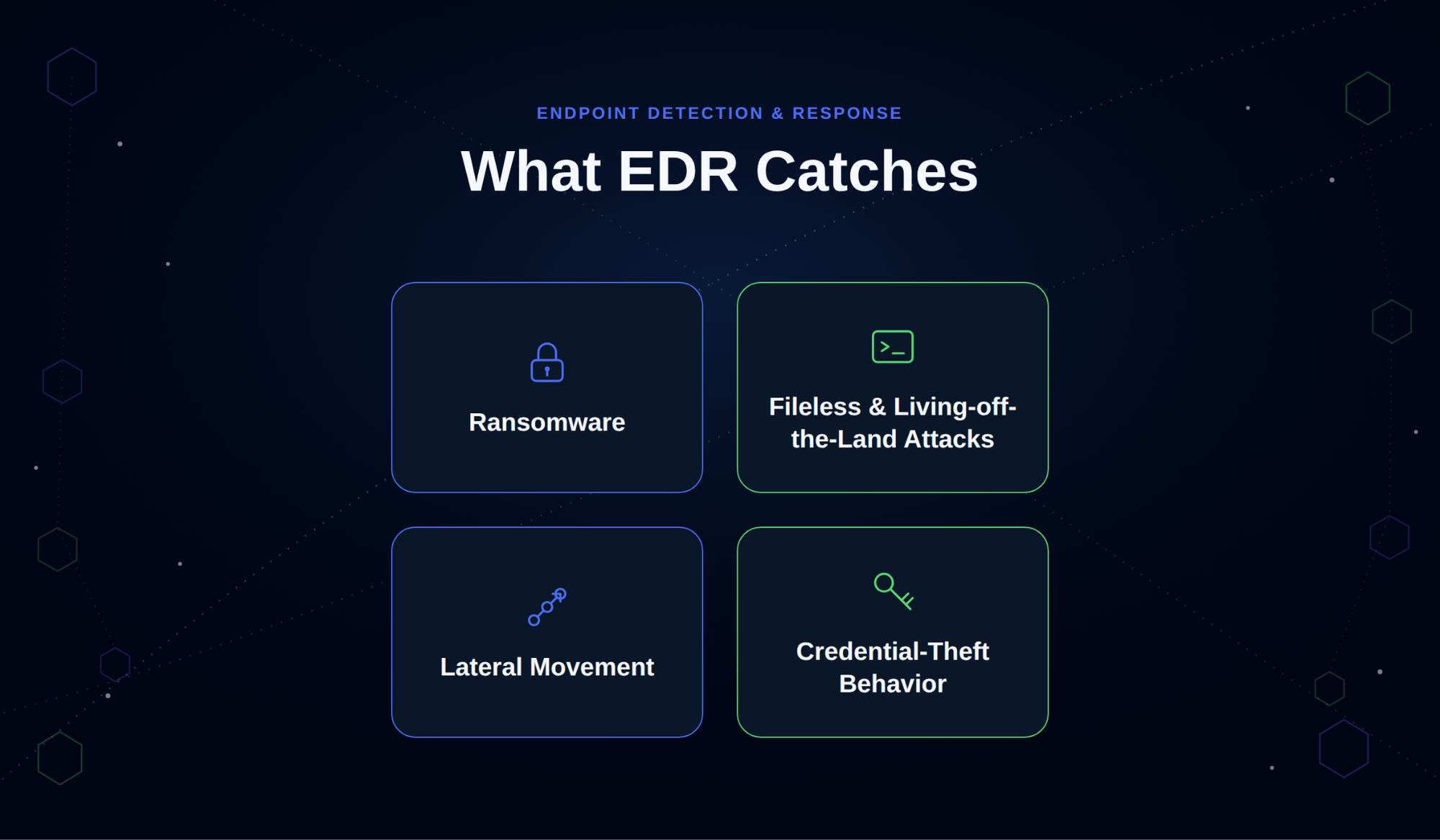
- What EDR catches: EDR catches ransomware, fileless and living-off-the-land attacks, lateral movement, and credential-theft behavior, like a process reading LSASS memory.
- Where EDR sits: EDR is positioned as the behavioral detection and response layer of the endpoint. Every mature security program should run it.
Some EDR and identity platforms have expanded into credential-adjacent features. CrowdStrike's Falcon Identity Threat Detection and Falcon Identity Threat Protection surface weak or exposed identity credentials, detect authentication anomalies, and flag dark-web credential exposure. Microsoft Defender for Identity covers similar ground. CrowdStrike's Falcon Cloud Security also scans container images and IaC files for secrets, though without a published detector methodology, liveness validation, or remediation workflow, it functions as a checklist item rather than a mature credential security capability.
These features share a structural limitation: they key off domain email addresses and managed identity systems like Active Directory, Entra ID, and cloud IAM. A hardcoded AWS key, GitHub token, or SSH key carries no domain email address. When domain email attribution is missing, these tools have no way to track the credential. Hardcoded developer secrets fall structurally outside what they're built to see.
CrowdStrike sees the malware and, increasingly, who owns the identity. GitGuardian sees the credential that shouldn't exist in the first place.
What credential security does
Credential security is the control that covers the credential plane on the endpoint. It has three functions: discovery, remediation, and deception.
Discovery runs on a schedule. Periodic scans build a timestamped record of which valid secrets are present on a machine over time.
These secrets include cloud keys, tokens, and SSH keys in .env and config files, shell history, and CLI or AI tool caches. At GitGuardian, we also include credentials in environment variables and memory at scan time to ensure we capture every potential secret on a device.
Findings are scored by machine, severity, and validity, then routed for remediation: local redaction from the developer's machine for lower-risk findings, escalation to the incident workflow for confirmed-leaked or high-privilege credentials.
Deception is the third function, and the only one that fires in real time. Honeytokens are decoy credentials planted where harvesting tools look. Any attempt to use one alerts immediately, so you learn the instant someone acts on an exposed secret rather than only that it exists.
Together the three functions cover the credential plane the way detection and response cover behavior: discovery establishes what is exposed, remediation reduces it, and deception catches anyone reaching for what remains.
"Credential security" on the endpoint isn't a named analyst category the way EDR and XDR are, at least, not yet. In our opinion, it's a distinct endpoint function that the market still needs to carve out and label.
The core difference: Behavior vs. the credential plane
A valid exposed credential is neither malicious nor anomalous on its own. An attacker who uses it looks like a legitimate user. EDR can sometimes catch the harvesting act, a process exhibiting infostealer behavior on the endpoint. What it can't catch is the use of the stolen credential afterward, which looks like a normal login from a different machine. Credential security closes the front end: finds the credential before it's taken.
Why the credential plane needs its own control now
The scale of the problem is what makes it urgent. GitGuardian's Developer Endpoint Protection launch data found roughly 15 times more valid secrets on developer endpoints than in the repositories those same teams already scan, an average of about 150 per machine. The surface most security teams have never inventoried holds far more live credentials than the one they have.
It is also growing fastest where coverage is thinnest. In the last three months, 59% of endpoints scanned held at least one secret written by an AI coding agent, and around 40% of high and critical secrets surfaced in AI tool directories and log files, away from repo scanners. Some AI coding tools don't support .env credential isolation, so secrets have to live in plaintext config files. The developer can't prevent that. They can only inventory and monitor it.
These credentials are also long-lived. Of the credentials that were valid in 2022, over 64% were still valid when retested in January 2026, so an exposed secret is rarely a stale one.
That matters because stolen valid credentials grant legitimately authorized access. The attacker using one looks like a normal user, not an intruder. Behavior-based tools can't always catch this: infostealers harvest credentials from the endpoint and take session tokens that are already authenticated, sidestepping MFA, and none of that has to look malicious. Sophisticated infostealers go further and operate through legitimate system tools, so a stolen session token in use is indistinguishable from an authorized login. The controls built to catch this kind of anomaly, like role-based access control and conditional access policies, are often missing or only partially configured, which widens the gap further.
During an incident: The credential-plane view
When a machine is compromised, the security team needs to answer three questions quickly: which credentials were exposed, what does the attacker now have access to or control over, and what needs to rotate first. That scoping has to be complete before any rotation starts: if three credentials get rotated while three more stay live, the attacker can dig in for persistent access before the team finishes evicting them. Complete visibility first means remediation happens in one pass instead of tipping them off.
If the solution is deployed before the incident, the credential record is waiting the moment the team needs it, and that's the right posture. Deployed in the first 48 hours of a confirmed compromise, before shell history rolls and temp files clear, it still captures most of what matters. The further from the incident, the more ephemeral the evidence becomes.
When used together, EDR will tell you what happened on the host while the credential-plane inventory will tell you what was there to take. This combination shortens the path from detection to containment.
What good looks like: Covering both questions
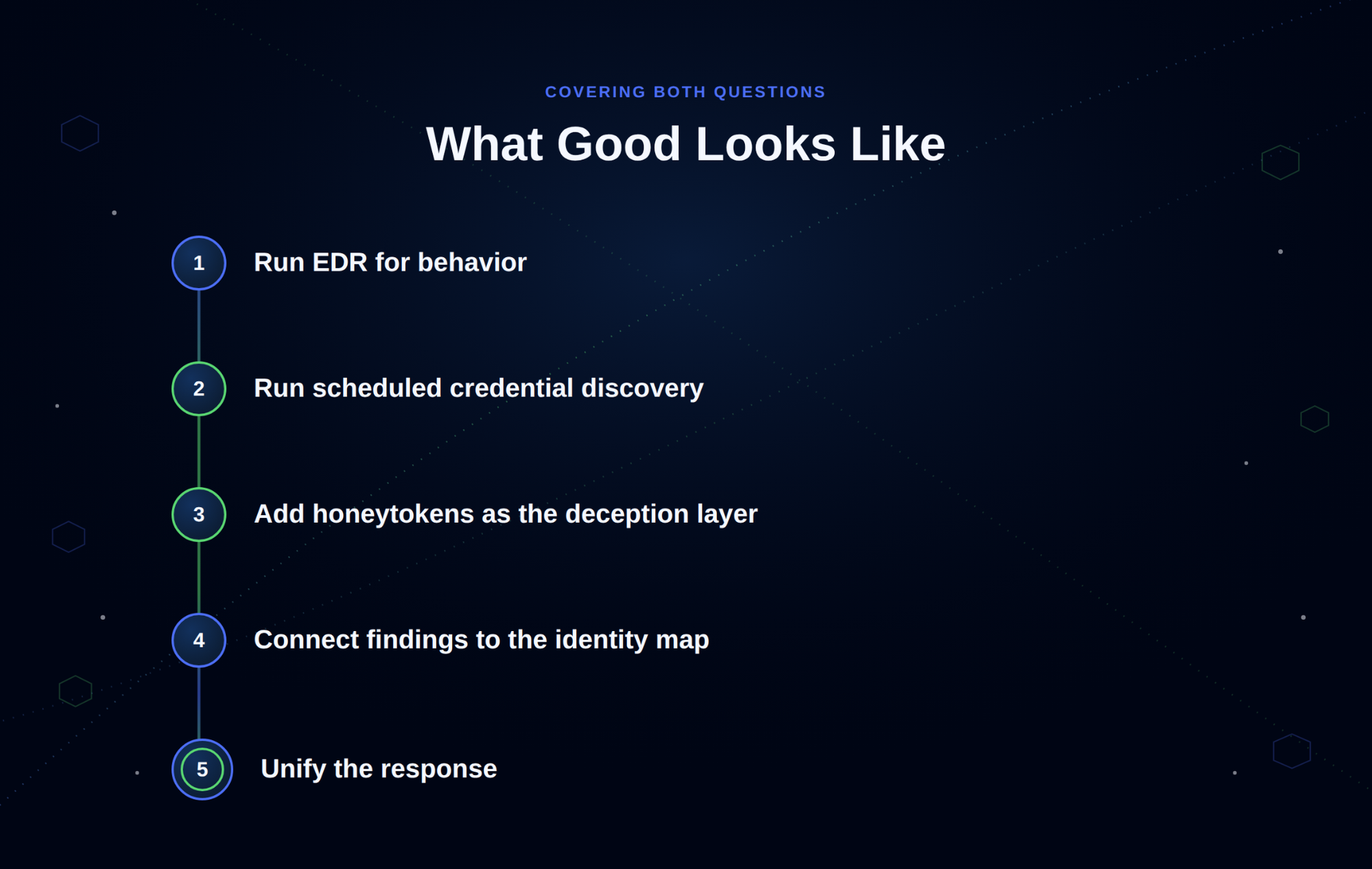
A mature endpoint program answers both the behavioral and credential-plane questions to maximize security potential. Here's what that looks like in practice.
- Run EDR for behavior: Keep EDR as the behavioral detection-and-response layer. To succeed at this step, ensure full EDR coverage across your entire fleet.
- Run scheduled credential discovery: Scan every endpoint on a regular cadence. The output is a ranked list: what to rotate immediately, what to remediate over time, and what to accept and monitor with a honeytoken alongside it.
- Add honeytokens as the deception layer: Plant decoy credentials in the locations where infostealers look. Any attempt to use one fires a high-fidelity alert with near-zero false positives.
- Connect findings to the identity map. A credential found on 12 machines that also appears in a secrets manager is a different risk signal than one on a single laptop. Routing endpoint findings through the GitGuardian dashboard surfaces that pattern automatically and routes it to the right team.
- Unify the response: Route behavioral alerts and credential findings into one incident workflow. To succeed at this step, confirm that both signals land in the same queue with shared context. That way, every team member works from the same information.
How GitGuardian fits
GitGuardian Developer Endpoint Protection is the credential security layer on endpoints. It's one capability in the broader GitGuardian platform, alongside Internal Secrets Monitoring, Public Secrets Monitoring, and NHI Governance. Each helps protect secrets.
Developer Endpoint Protection scans the locations where credentials accumulate on the machine, on a schedule deployed through your existing MDM (Intune, Jamf, or Kandji). It then scores each finding by machine, severity, and validity and surfaces results as a prioritized, deduplicated list. You can also disseminate honeytokens that fire the moment an attacker attempts to use a harvested credential. Developers can redact secrets from their machines directly from the dashboard.
In addition, GitGuardian's CLI, ggshield, runs the endpoint secret scanning process locally, and only hashed metadata leaves the machine, never the secret value or the source files.
Developer Endpoint Protection isn't an EDR or an antivirus. It answers the credential-plane question and complements EDR and XDR. It doesn't replace them.
Two questions, one endpoint
The credential surface keeps growing. Every new AI workflow is a new credential surface, and none of it shows up in behavioral telemetry. The teams that answer the blast radius question fast: which credentials were on the compromised machine, what an attacker can reach, and what rotates first, built the inventory before they needed it. They didn’t start from zero.
Find the credentials sitting on your endpoints
FAQ
Is credential discovery the same as EDR?
No. They're different controls that share the same endpoint. EDR is behavioral detection and response. As such, it watches activity and detects malicious behavior. Credential discovery is a point-in-time inventory of the valid secrets exposed on the machine, scored and ready to revoke. The first acts on behavior, while the second acts on the exposed state.
Does endpoint security mean antivirus?
Not only. Antivirus and its successor, EDR, protect the machine from malicious code and behavior. Endpoint security for secrets also means knowing which credentials are exposed on the device. It's a different job that antivirus and EDR were never designed to do.
Can EDR find secrets on a developer machine?
Not as its core purpose. EDR watches process and system behavior. It can detect a process stealing credentials, but it doesn't inventory the plaintext secrets that sit at rest in config files, caches, and history. This kind of inventory is what credential discovery provides.
Does EDR detect exposed credentials?
EDR detects credential-theft behavior, like a process reading memory to dump credentials. Some EDR and identity platforms also flag weak or exposed identity accounts and dark-web exposure. None of them enumerate the plaintext API keys, tokens, and SSH keys sitting in files on a developer's disk. Finding those at rest is credential discovery's job. This is also why questions like "Does EDR scan for hardcoded secrets" and "Does EDR detect exposed credentials" have the same answer. EDR detects the theft, not the exposure.
What's the difference between EDR and secrets detection?
EDR is behavioral detection and response on the endpoint. Secrets detection, also known as credential discovery, finds the exposed secrets on the endpoint. Put simply, one watches what's happening while the other inventories what's present. Mature programs use both.
Do I need EDR and credential discovery?
Yes, if you want both endpoint questions answered. EDR catches malicious behavior. Credential discovery finds the exposed credentials that an attacker would use. They each cover different risks in the same place, so they work together instead of one substituting for the other.
What does "endpoint" mean for secrets security?
It means the developer machine as a place where credentials accumulate, not only a place to defend against malware. Endpoint security for secrets is about discovering and revoking the exposed credentials on the device, alongside the behavioral protection that EDR provides.