This is a follow-up to an article we published in The Hacker News introducing time to revoke as a critical CISO metric. This version provides a practical guide for measuring it across exposed secrets and non-human identities.
Detection is not the same as credential revocation
Detection tells you when a credential was found. A remediation ticket tells you when work was assigned or closed. Neither tells you whether the exposed access was fully neutralized.
For leaked credentials, “Did we find it?” is the first question. “How long did it remain valid?” is just as important, if not more so.
If a leaked API key, cloud credential, service account token, OAuth secret, private key, or database connection string is still valid, it is a point of ingress. Until it is revoked, rotated, or otherwise invalidated, it remains a path an attacker can use. Credential rotation only counts when the exposed credential is disabled, expired, or otherwise rendered unusable. That makes time to revoke a critical CISO metric. It connects detection to business risk by measuring the exposure window security teams need to close.
What is time to revoke in secrets remediation?
Time to revoke measures how long an exposed credential remains usable after it has been confirmed valid.
Time to revoke = confirmed invalidation timestamp − validation timestamp
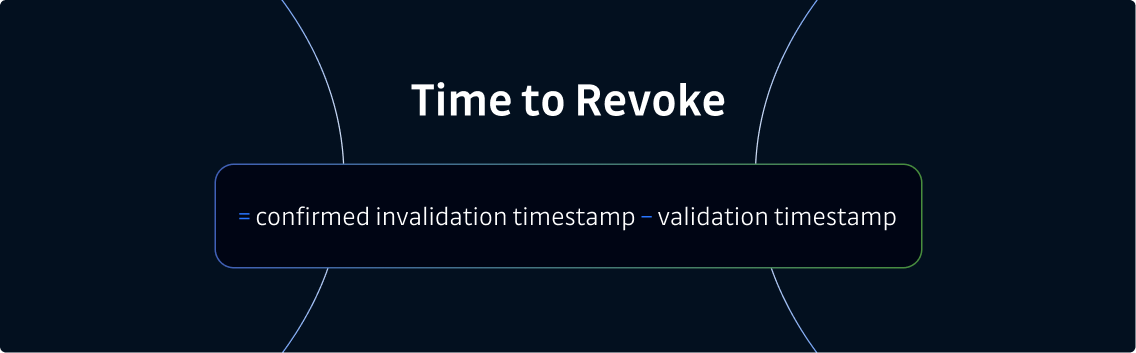
The clock starts when the organization verifies that the credential works and stops when it confirms that the credential can no longer be used. Closing a ticket, deleting a file, or removing the secret from a repository does not stop the clock. Only revocation, rotation, expiration, or another form of confirmed invalidation does.
Why secrets remediation needs more than MTTD and MTTR
Security programs have become much better at finding exposed secrets. Source code scanning, pre-commit hooks, CI/CD controls, secret detection in collaboration tools, and monitoring for public leaks have all improved visibility. But visibility is only the first step.
A secret can be found quickly and still remain valid for days, weeks, or months. It can be removed from a repository, cleaned from a pull request, or deleted from a local file without invalidating the credential itself. For attackers, cleanup doesn’t matter if the credential still authenticates.
Many security teams already track mean time to detect and mean time to remediate. Those metrics still matter, but they can blur the specific risk that exposed secrets create. Mean Time to Detect (MTTD) tells you how quickly a secret was found. Mean Time to Remediate (MTTR) often depends on how the organization defines “resolution”: a closed ticket, a cleaned file, a merged pull request, or a completed rotation.
For secrets, that ambiguity is dangerous. Time to revoke is stricter, and measures one outcome: whether the exposed credential was invalidated. That makes it a better metric for credential exposure risk and a necessary companion to MTTD and MTTR.
How to measure time to revoke: secrets remediation metrics
The best version of time to revoke is simple enough to report and specific enough to drive action.
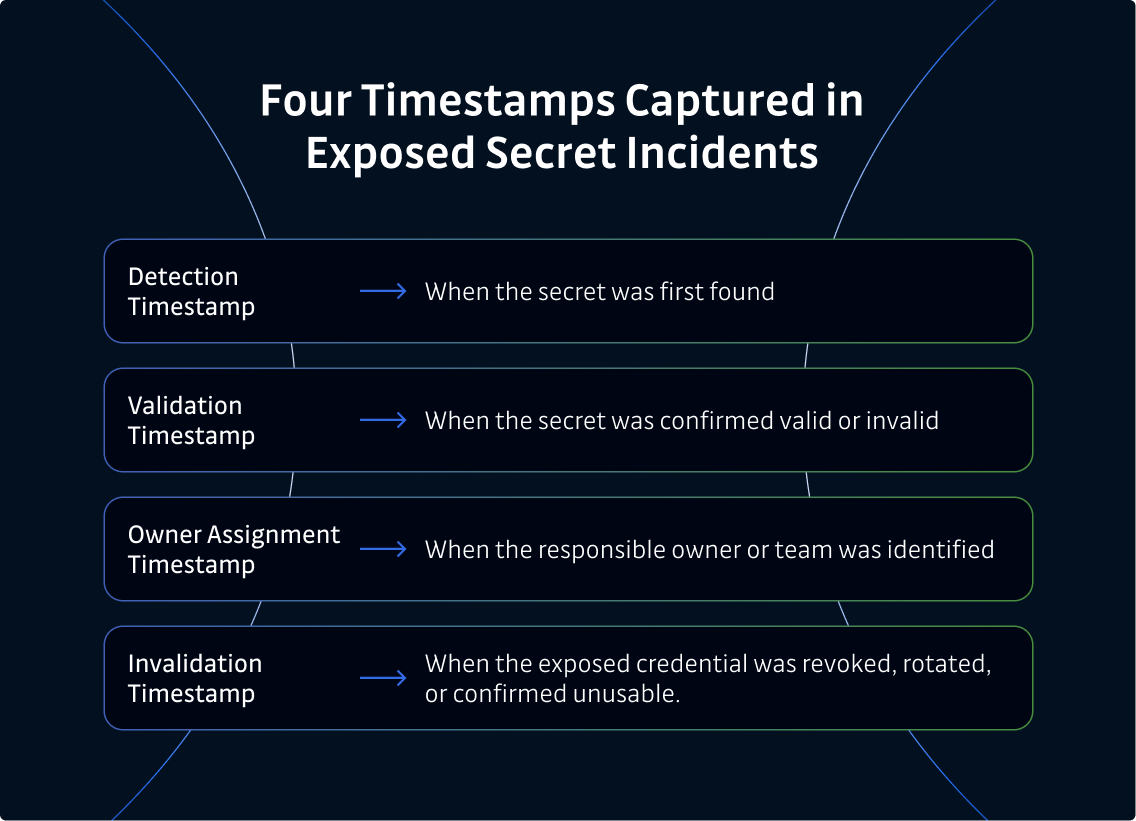
At a minimum, each exposed secret incident should capture four timestamps:
- Detection timestamp: when the secret was first found.
- Validation timestamp: when the secret was confirmed valid or invalid.
- Owner assignment timestamp: when the responsible owner or team was identified.
- Invalidation timestamp: when the exposed credential was revoked, rotated, or confirmed unusable.
From those timestamps, security teams can report several useful measures.
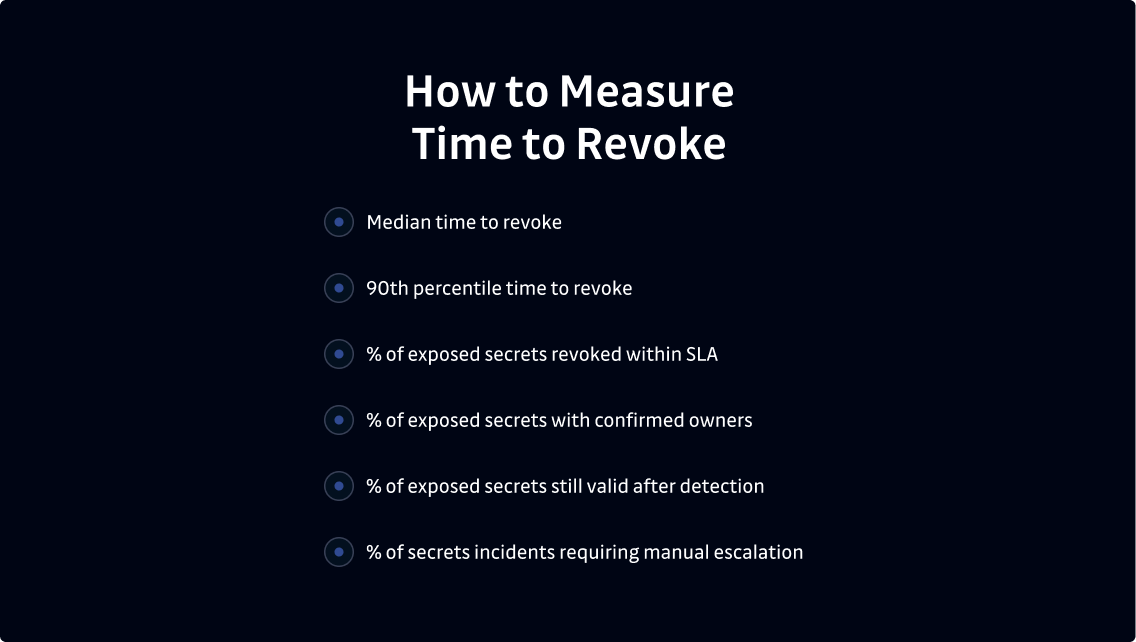
Median time to revoke
Median time to revoke shows the typical speed of credential neutralization. It is useful for trend reporting because it is less distorted by a small number of extreme outliers.
90th percentile time to revoke
P90 time to revoke shows the long tail. This is often where the real risk lives: secrets with unclear owners, sensitive access, or operational dependencies that keep them valid too long.
Percentage of exposed secrets revoked within SLA
This turns time to revoke into an accountability metric. For example, security teams might set different targets for different risk levels:
- Critical valid production secrets: revoke within hours
- High-risk valid secrets: revoke within one business day
- Lower-risk valid secrets: revoke within a defined remediation window
- Invalid or expired secrets: document and clean up according to policy
The specific SLA should reflect the organization’s risk model. The important point is that the SLA is tied to credential invalidation, not ticket movement.
Percentage of exposed secrets with confirmed owners
Owner mapping is one of the strongest predictors of remediation speed. If a credential has no known owner, time to revoke will almost always suffer. Tracking owner coverage helps CISOs see whether they have a detection problem, an identity governance problem, or an operational handoff problem.
Percentage of exposed secrets still valid after detection
This is one of the clearest risk indicators. It shows how many exposed credentials remain usable after being found. For executive reporting, this is often more meaningful than raw alert volume. A thousand detected secrets may sound alarming, but the board-level concern is how many of them still grant access.
Percentage of secrets incidents requiring manual escalation
Manual escalation is a sign of process friction. If many incidents require security to chase owners, interpret provider-specific documentation, or negotiate revocation manually, the organization has a scalability problem. This metric helps justify investment in automation, ownership mapping, provider integrations, and better remediation workflows.
CISO security metrics for leaked credentials
Time to revoke belongs in executive reporting because it translates a technical exposure into a business risk window. For board and executive audiences, the point is not to report every leaked key or every remediation ticket. The point is to show whether the organization is reducing the amount of time exposed access remains usable.
A useful CISO dashboard might include:
- Number of valid exposed secrets detected
- Percentage tied to production, sensitive data, or privileged systems
- Median and P90 time to revoke
- Percentage still valid beyond SLA
- Top systems or teams contributing to delayed revocation
- Recurrence rate by credential type or business unit
This gives leadership a clearer view of exposure than alert counts alone. It also reframes remediation as a measurable security outcome: are we shrinking the window of usable exposed access?
Want to reduce time to revoke for exposed credentials?
Measuring time to revoke shows how long exposed access remains usable and where the remediation process is slowing down. The next step is reducing that window by addressing the ownership, dependency, and workflow problems that delay revocation.
See how it works.