
TL;DR
- Code is being written three times faster than anyone can review it: GitHub logged 34.3 billion commits this year, up from 12.9 billion, and more than 40% of pull requests now start with an AI agent, not a human.
- The newest developers are not developers: Citizen coders now ship apps wired to business systems with API keys they have never been taught to protect. Claude Code-assisted commits already leak secrets more often than human-made commits.
- A leaked key outlives your whole security program: 64% of credentials found valid were still valid more than four years later. See which controls actually keep pace with agents, automation, and everyone who can now ship code.
Every year, we look forward to GitHub's State of the Octoverse report. It is one of the best leading indicators of where software development is heading, and what the rest of the technology industry can expect in the coming years. This year's report is especially exciting, and the numbers are staggering.
Over the past year, developers generated 34.3 billion commits across GitHub, up from 12.9 billion the previous year. That is nearly three times the activity in just one year. Even more remarkable, over 40% of pull requests now start with an AI agent, up from just 17% six months earlier. GitHub Actions also executed more than 45 billion jobs, over three times the previous year's total.
These numbers signal a fundamental change in who creates software and how quickly it gets built. Professional developers are working faster, citizen developers are creating applications with AI, and autonomous agents are taking on more development tasks.
These numbers are also startling when you consider trends already reported in other reports like GitGuardian's State of Secrets Sprawl 2026, which documented a record 28.65 million exposed secrets in public GitHub commits during 2025.
The trends emerging on GitHub today show where we are headed as an industry and what organizations everywhere will soon be managing. Here are the five findings that stood out to our team and what they tell us about the future of software security.
Five key takeaways from GitHub Octoverse 2026
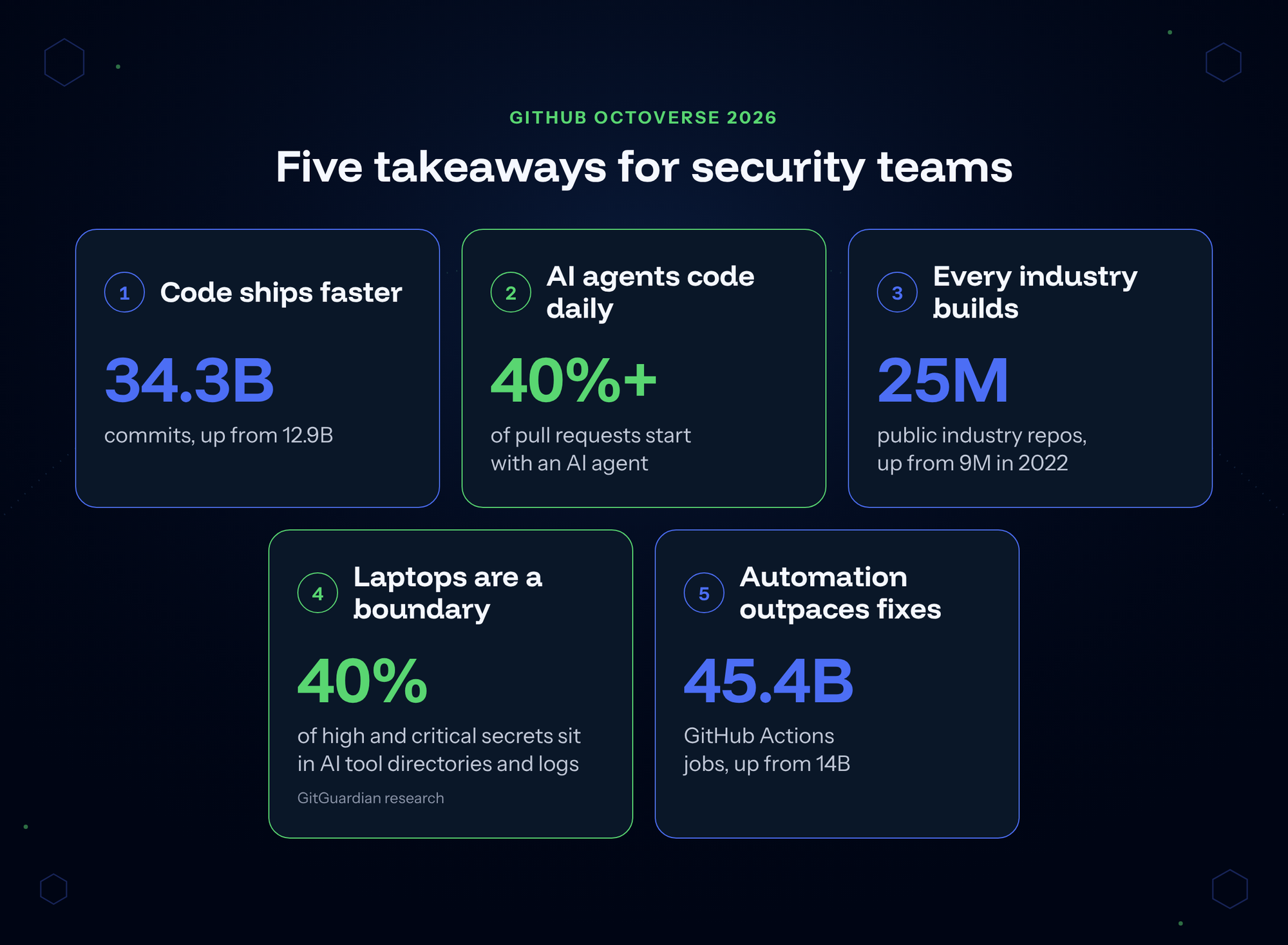
GitHub's latest Octoverse report reveals how quickly AI is transforming software development. Here are the top stats that popped out to our team:
1. Software development is accelerating faster than ever
GitHub recorded 34.3 billion commits in 2026, up from 12.9 billion the previous year. That is not a small increase. That is an explosion. Code pushes increased by approximately 167%, reaching 17.9 billion.
GitGuardian's State of Secrets Sprawl 2026 had already documented a 43% increase in public commits during 2025, alongside a 34% increase in exposed secrets. The research showed the highest number ever recorded last year, at 28.65 million new secrets in public GitHub commits. While GitHub Push Protection does affect the rate, by their own numbers, they ran 5.8 billion scans this year vs the total 17.9 billion pushes. This implies the majority of code pushes go unchecked, which aligns with our conclusion that Push Protection is no silver bullet.
Across almost all recent security reports, we have seen a consistent trend of rapid growth. As software production accelerates, organizations need secrets detection and credential security controls that keep pace with development.
2. AI agents are becoming everyday software developers
In March 2026, approximately 17% of pull requests started with an AI agent. By September, that figure exceeded 40%, representing approximately 110 million agent-started pull requests in a single month.
We have previously identified security implications of AI-assisted development. Claude Code-assisted commits exposed secrets at approximately twice the baseline rate, with 3.2% containing a secret compared with 1.5% across public commits. We believe that this implies that people are not reviewing code deeply enough to catch security issues that the AI introduces.
AI coding agents create many chances for unintended credential exposure and access to sensitive systems during otherwise legitimate development tasks. Preventative security controls need to operate during agent execution, alongside traditional source code scanning.
3. Citizen developers are expanding software creation into every industry
GitHub reports more than 225 million developers on its platform. Public repositories associated with identifiable industries grew from about 9 million in 2022 to 25 million in 2026.
AI-powered development tools are making it easier for employees without traditional programming experience to build applications. Citizen developers can now create internal dashboards, automate business workflows, and integrate external services using natural language instructions.
These applications frequently require access to business systems through API keys and service credentials. Citizen developers may have limited experience with secrets management, application security, or cloud permissions.
Organizations need secure development processes that are accessible to employees across departments. Safe defaults for credential handling let citizen coders build useful applications while reducing exposure. The right guardrails in the right workflows can prevent a lot of issues.
Watch to learn what AI-assisted coding means for secrets security, using data from GitGuardian's State of Secrets Sprawl 2026 report.
4. Developer machines are a critical security boundary
AI coding assistants most commonly operate directly within a developer's environments. They can read project files, inspect application configurations, and execute commands as part of routine development work.
Research into the second major wave of the Shai-Hulud supply chain attack identified 33,185 unique secrets across 6,943 compromised machines. Separate endpoint research found that 40% of high and critical secrets identified on developer laptops were located in AI tool directories and logs.
Discovering and eliminating unnecessary local credentials reduces exposure. Preventative controls such as git hooks provide additional protection when agents interact with files and tools.
5. Automation is growing faster than traditional credential remediation
GitHub Actions executed approximately 45.4 billion jobs during the latest reporting period, compared with 14 billion the previous year. This represents growth of more than 220% in automated development activity.
As automation increases, organizations must manage a growing number of credentials and their associated permissions. This includes moving towards shorter-lived authentication mechanisms.
More than 64% of credentials, originally found to be valid, stayed valid for more than four years, according to our research. The report also showed that 46% of critical secrets could be missed when prioritization relies exclusively on provider validation.
As software development and automation continue accelerating, detecting exposed credentials, remediating existing risks, and preventing new exposures must become part of everyday development workflows.
For more detail, read the full GitHub Octoverse 2026 report here.
Practical steps for securing AI-driven development
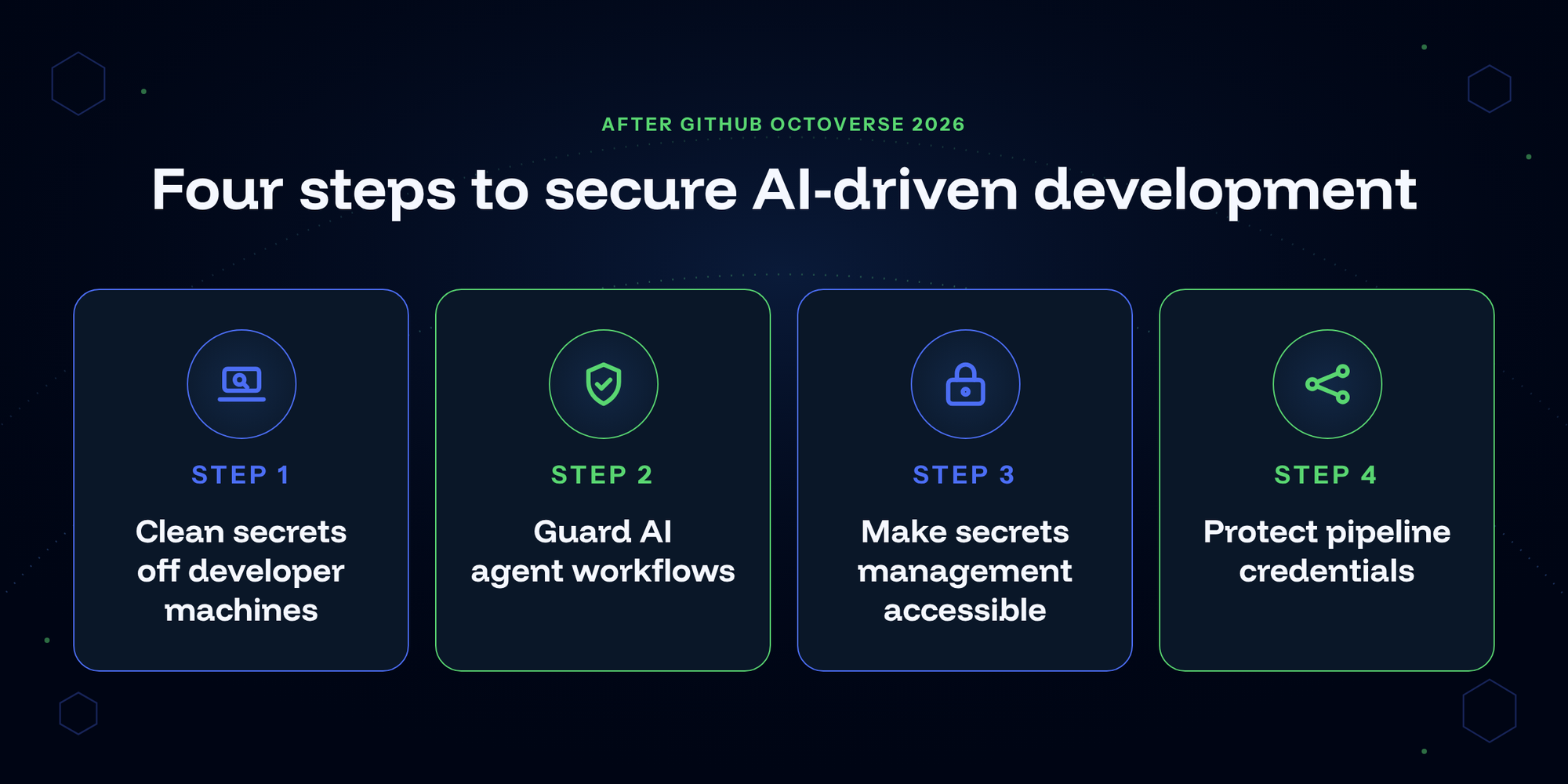
As AI agents and citizen developers take on more development tasks, organizations need to account for how credentials are accessed, shared, and used throughout these workflows. A few practical controls can help teams embrace faster development while reducing the risks of unintended credential exposure.
1. Find and eliminate exposed credentials on developer machines
Developer workstations frequently contain credentials in local configuration files, environment variables, and application settings. Attackers increasingly target these through infostealer-based supply chain attacks. AI coding agents can encounter and unexpectedly use these credentials while performing routine tasks. GitGuardian's Developer Endpoint Protection helps identify exposed secrets on developer machines and provides context for remediation. Moving plaintext credentials into approved secrets managers also reduces the risk of unintended access.
2. Build credential protection into AI workflows
AI coding assistants increasingly interact with local files and external services on developers' behalf. GitGuardian AI Hooks can prevent credential exposure during these interactions. Embedding preventive controls directly into agent workflows lets developers benefit from AI automation with greater confidence. This supplements pre-commit git hooks to catch secrets out of code, which many developers have already adopted.
3. Make secure secrets management accessible to everyone
Citizen developers need straightforward ways to connect applications to business systems securely. Centralized secrets management and appropriate access permissions provide a foundation for safer development. GitGuardian helps teams identify exposed credentials, understand their ownership and potential impact, and prioritize remediation. We work with leading secret management solutions to make it easy to Push-to-Vault any exposed plaintext credential. These capabilities help organizations establish consistent credential security practices across developers of all experience levels.
4. Strengthen supply chain security through credential protection
AI-assisted development is accelerating the creation of applications and infrastructure. Credentials used by repositories, build systems, and deployment pipelines can provide access to critical parts of the software supply chain. GitGuardian helps teams detect and remediate exposed credentials while preventing new exposures through local scanning and development workflow integrations. This reduces opportunities for credential compromise as software delivery continues to accelerate.
AI-driven development demands a new approach to security
GitHub's State of the Octoverse 2026 confirms that AI is fundamentally changing how software is created and who gets to create it. Professional developers are producing code at unprecedented rates, AI agents are taking on increasingly complex tasks, and citizen developers are building applications that would have required specialized engineering skills just a few years ago.
The number of applications, integrations, and credentials organizations must secure has never grown this fast. The attack surface is much larger now. GitGuardian's State of Secrets Sprawl 2026 already showed an increase in exposed secrets alongside the growth of AI-assisted development. As more employees and autonomous agents can build and deploy software, these risks will continue to challenge traditional security processes.
Organizations need a comprehensive approach to credential layer security that scales with this new development reality. The GitGuardian platform addresses the whole credential layer, helping organizations detect exposed secrets across their environments, remediate credential risks with the context needed to prioritize action, and prevent future exposures throughout the development lifecycle. As citizen developers and AI agents accelerate software creation, this approach enables organizations to maintain control over their credentials while supporting innovation at an unprecedented pace.
Ready to learn more? Take a quick tour of our platform. We would be glad to work with you if you'd like to start securing your credential layer today.
FAQ
What is GitHub's State of the Octoverse report?
The State of the Octoverse is GitHub's annual report on how software development is changing. The 2026 edition shows 34.3 billion commits, up from 12.9 billion the year before, along with rapid growth in AI agent activity and automation. It is a useful leading indicator of what organizations everywhere will soon be managing.
How is AI changing who builds software?
Professional developers are working faster, citizen developers are building applications with natural language instructions, and autonomous agents are taking on more development tasks. Over 40% of pull requests now start with an AI agent, up from about 17% six months earlier. GitHub also reports more than 225 million developers on its platform.
Why do AI coding agents increase secrets exposure risk?
Agents can read project files, inspect configurations, and run commands, which creates many chances to encounter credentials during legitimate work. GitGuardian's State of Secrets Sprawl 2026 found that Claude Code-assisted public commits leaked secrets at 3.2%, compared with a 1.5% baseline across public commits. Preventive controls need to operate while the agent runs, alongside traditional source code scanning.
What security risks come with citizen developers?
Citizen developers can build internal dashboards, automate workflows, and connect external services, and those applications usually need API keys and service credentials. They may have limited experience with secrets management, application security, or cloud permissions. Safe defaults for credential handling let them build useful applications while reducing exposure.
Why are developer machines a critical security boundary?
AI coding assistants usually run directly in the developer's environment, where they can read project files and execute commands. Research on the second wave of the Shai-Hulud supply chain attack found 33,185 unique secrets across 6,943 compromised machines. Separate endpoint research found that 40% of high and critical secrets on developer laptops were in AI tool directories and logs.
Does GitHub Push Protection solve the secrets sprawl problem?
It affects the rate of exposure, but it does not remove the problem. GitHub ran 5.8 billion push protection scans this year against 17.9 billion total pushes. GitGuardian's State of Secrets Sprawl 2026 documented a record 28.65 million new secrets in public GitHub commits during 2025, so teams still need detection, remediation, and prevention across their own environments.
How can organizations secure AI-driven development?
Find and eliminate exposed credentials on developer machines, build credential protection into AI workflows with GitGuardian AI Hooks, and make secrets management accessible to citizen developers, including Push-to-Vault for exposed plaintext credentials. Teams should also protect the credentials used by repositories, build systems, and deployment pipelines. Together, these steps support credential layer security that scales with faster development.
 Guardians

 Soujanya Ain