TL;DR
- 4,064 high-impact leaks affected 1,588 companies: GitGuardian identified these exposures over five months, with 45.6% of the leaks rated critical.
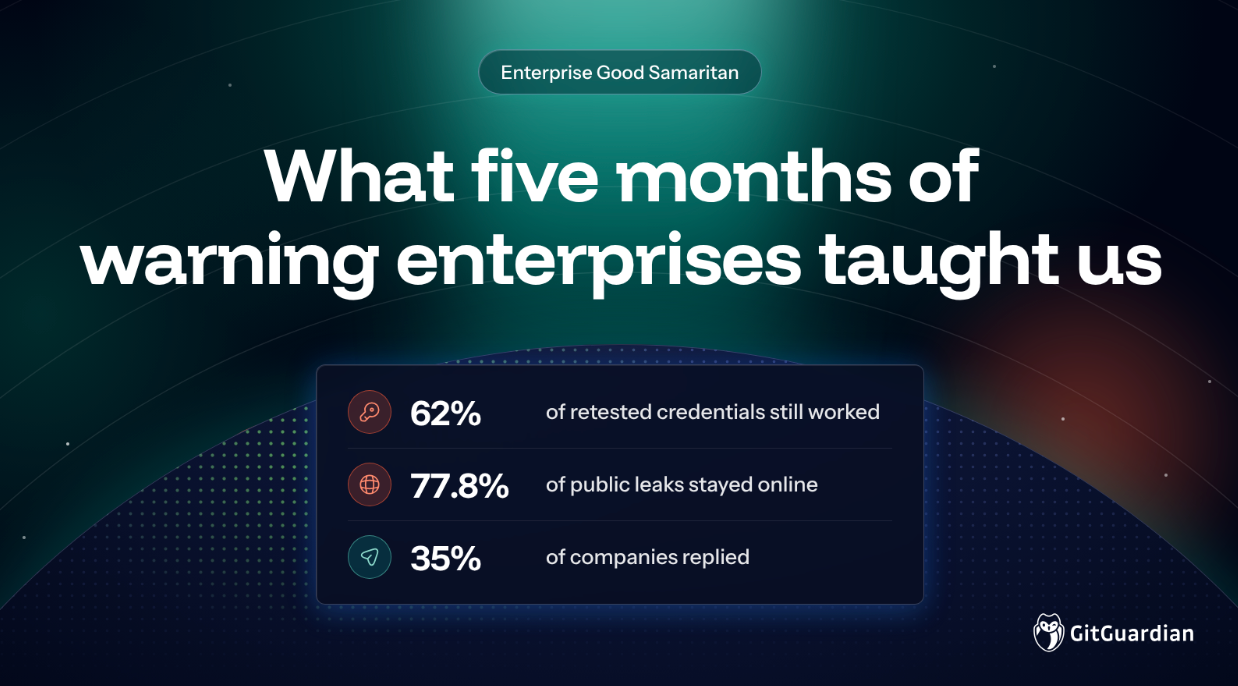
- 62% of previously valid credentials still worked after notification: Of the credentials confirmed working when first discovered, nearly two-thirds still worked when retested after notification.
- 77.8% of public leaks remained online: Among leaks that were public when we emailed affected companies, nearly four in five were still publicly accessible as of late November.
- Only 35% of companies replied: Most organizations we contacted did not respond to our warnings.
- High-impact leaks had been public for a median of 320 days: Nearly half (46.2%) had already been exposed for more than a year before we flagged them.
- 5% of leaks originated with suppliers or contractors: A third party exposed credentials belonging to another organization, meaning the person who committed the secret wasn't necessarily part of the company whose systems were at risk.
Since June 2026, we've identified 4,064 high-impact leaks tied to 1,588 companies and these are the findings from the first five months of GitGuardian's Enterprise Good Samaritan Program.
We warned companies that their credentials were exposed in public code. When we checked back, 62% of the valid credentials still worked.
The exposed code often remained online, too. Of the leaks that were public when we emailed the affected companies, 77.8% were still accessible as of late November. And only about 35% of companies we emailed had replied.
These are exposed secrets that could do serious damage in the wrong hands, based on the access they provide and the systems they can reach. We believe organizations should know when their credentials are exposed, whether they're GitGuardian customers or not. Through the program, we identify the companies behind these leaks and alert them directly, giving their security teams the information they need to investigate and act.
Why these findings matter now
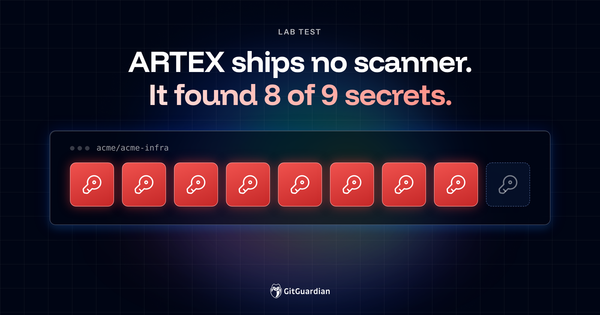
AI-powered attacks are shrinking the time between finding an exposed credential and exploiting it. Recent campaigns involving ARTEX, an autonomous penetration-testing framework, show how attackers are putting these capabilities to use in real-world intrusions. Microsoft documented just how quickly this kind of attack can unfold: in one case, an AI agent went from searching GitHub for secrets to exfiltrating Azure Key Vault data in five minutes. More recently, the FBI warned that some ARTEX intrusions reached privileged access in under three hours.
Our findings reveal a stark contrast between how quickly attackers can exploit exposed credentials and how long those credentials can sit in public code. The median high-impact leak had already been public for 320 days before our program flagged it. Nearly half (46.2%) had been exposed for more than a year.
The potential impact was significant. Of the leaks we discovered, 45.6% were rated “critical.” And the affected organizations included major enterprises: 38.5% were publicly listed, and 43.2% employed at least 10,000 people.
But identifying these exposures and alerting the companies involved was only the first step. We wanted to understand what happened afterward.
Most public leaks remained online, and 62% of retested credentials still worked
The first thing we checked was whether the exposed material was still online. As of late November, 77.8% of the leaks that were public when we emailed the affected companies remained publicly accessible.
But public exposure only tells us part of the story. A company can invalidate a credential while the code containing it remains online. And removing that code doesn't eliminate the risk: if the credential still works, anyone who copied it before removal can still use it. That's why we also checked whether the exposed credentials themselves remained usable.
Of the working credentials we retested after sending notifications, 62% still worked. This finding echoes our longer-term research. The 2026 State of Secrets Sprawl report found that 64% of credentials confirmed valid in 2022 were still active four years later. We believe these findings point to a broader structural challenge in enterprise security; organizations have built security around protecting systems and identities, but the credentials connecting them move across repositories, teams, and organizational boundaries, often beyond the visibility and control of those responsible for securing them.
Why notifying the developer isn't always enough
Our original Good Samaritan Program, launched in 2018, alerts developers when they commit secrets to public repositories. But the person who exposes a credential isn't necessarily the person who can secure it.
Corporate credentials can end up in developers' personal GitHub repositories, outside company-owned codebases. And in 5% of the leaks we identified, a supplier or contractor exposed a client's credential, meaning the person receiving the alert didn't even work directly for the affected organization.
We saw this play out earlier this year with CISA. In May 2026, we investigated sensitive CISA credentials, including privileged AWS GovCloud keys, exposed in a contractor employee's public GitHub repository. Our original program had already sent the commit author nine alerts without a response. Once our researchers escalated the disclosure to reach CISA directly, the repository was taken offline within 26 hours.
That's the reason we expanded Good Samaritan to reach enterprises directly; identifying an exposed credential isn't enough if the warning never reaches the person who can act on it.
“Every company needs a door for these reports, and someone behind it.” — Eric Fourrier, CEO at GitGuardian
What the findings mean for enterprise credential security
Even when we contact affected organizations directly, closing the loop remains a challenge. Only about 35% of the companies we emailed replied. That doesn't necessarily mean the others failed to act. They may have investigated or remediated the exposures without responding, but without a reply, we have limited visibility into what happened.
For security leaders, that points to two priorities.
First, make it easy for external researchers to reach the right people. A monitored security contact, a clear reporting channel, and someone accountable for handling disclosures are essential, particularly when credentials are exposed outside the organization's own systems.
Second, don't mistake detection for remediation. Acknowledging a warning or removing exposed code doesn't necessarily eliminate the risk. Compromised credentials need to be revoked or rotated, and teams need to verify that they can no longer provide access.
Ultimately, security isn't measured by how many exposed credentials are discovered or reported. It's measured by how much risk is actually eliminated.
Do you know which of your organization's credentials are exposed on GitHub? Start with a GitHub Security Audit to uncover potential exposures before attackers do.
About this data
These findings cover 4,064 high-impact leaks tied to 1,588 companies, identified between June and November 20, 2026. The 77.8% figure is based on 1,571 leaks that were public when we emailed the affected company. The 62% figure is based on the credentials that worked when we found them and that we retested after the email. It covers only credential types we can check automatically. Reply rates exclude automatic responses such as out-of-office messages. A company that did not reply may still have acted, and a credential that no longer works may have expired on its own.
 Gaetan Ferry